
Episode 2
The EMI Lifestyle Scam Nobody Warned Us About
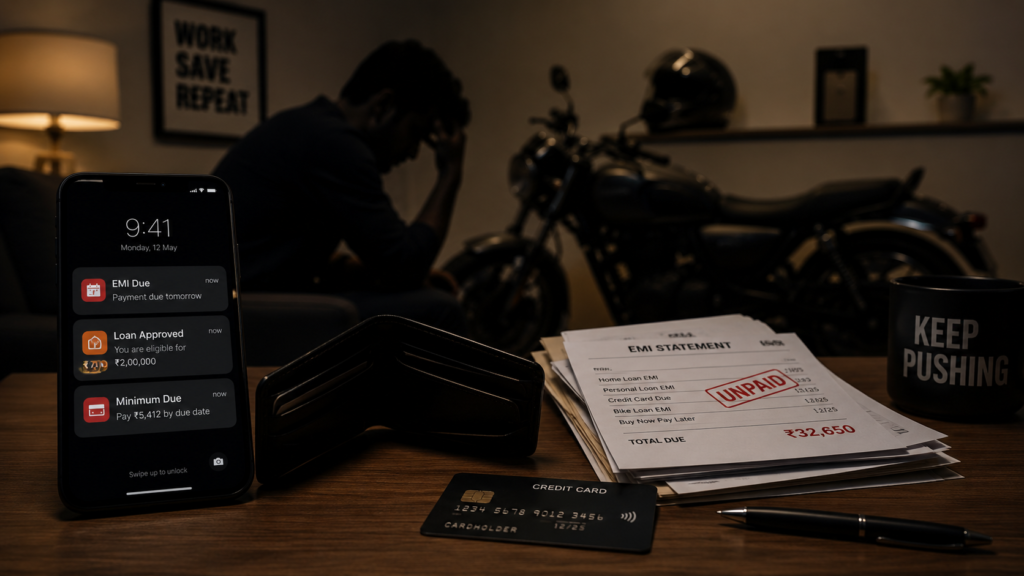
Hemanth never thought a single swipe could change his life.
It started with a phone.
“Zero Down Payment.”
“Instant Approval.”
“Only ₹1,999 per month.”
The numbers looked small enough to ignore.
That was the beginning.
Three years ago, Hemanth used to save money before buying things.
Today, he buys things first…
…and worries about money later.
Not because he is irresponsible.
Because modern India has made borrowing feel normal.
At 29, Hemanth works hard.
Night shifts, Weekend overtime, Constant pressure. He earns ₹32,000 a month and once believed that increasing his salary would solve his problems.
Instead, his expenses upgraded faster than his income.
First came the smartphone EMI.
Then the bike loan.
Then the credit card.
Then “Buy Now Pay Later.”
Then an instant personal loan during an emergency.
Each monthly payment looked harmless individually.
Together, they slowly started eating his future.
Today, Hemanth’s monthly breakdown looks like this:
| Expense | Amount |
| Bike EMI | ₹4,200 |
| Smartphone EMI (Iphone) | ₹8,299 |
| Credit Card Minimum Due | ₹5,500 |
| Electronic Gadget EMI | ₹3,000 |
| Fuel | ₹3,800 |
| Groceries | ₹4,000 |
| Electricity + WiFi | ₹1,200 |
| Chit Fund | ₹5,000 |
Balance left before month-end: ₹-2,999
Negative.
And yet… he still looks financially “normal” from the outside. That is the modern debt trap.
The dangerous thing about today’s financial culture is this: Nobody sells loans as debt anymore. They sell them as lifestyle upgrades. You are never told:
“This will mentally pressure you for the next 24 months.”
You Normally hear:
- “Only ₹118 per day.”
- “Instant approval.”
- “No-cost EMI.”
- “Pre-approved offer.”
- “Eligible customer.”
- “No CIBIL score required”
The language itself is designed to reduce fear.
And it works.
Because people are exhausted. When life becomes stressful, convenience becomes attraction.
The system knows something powerful about the middle class:
Most people cannot afford luxury.
But they can afford monthly payments.
And so, India quietly transformed from a saving economy…
into an EMI economy.
Today, people finance:
- phones,
- electronic gadgets
- vacations,
- furniture,
- weddings,
- education,
- bikes,
- groceries,
- even food delivery purchases.
The line between need and lifestyle has become dangerously blurred.
And banks are no longer waiting for people to ask for loans.
Now loans chase people.
Every day, Hemanth receives notifications:
- “Congratulations! You are eligible for ₹5 lakh instantly.”
- “Your credit limit increased.”
- “Get cash within 5 minutes.”
- “Zero paperwork.”
The scary part?
The easier money becomes to access, the harder peace becomes to maintain.
The middle class is slowly entering a cycle where:
Loans pay old loans.
Credit cards manage emergencies.
EMIs replace savings.
And salaries become temporary pass-through accounts.
Money enters.
Money exits.
Nothing stays.
Yet the pressure to appear successful continues. Because modern society rewards visible lifestyle not invisible financial discipline. Nobody praises the person who avoided unnecessary debt, but everyone notices
The new iPhone.
The new bike.
The vacation photos.
The upgraded life.
Even if that life is borrowed.
Perhaps that is why financial exhaustion today feels different.
People are not just tired from working.
They are tired from maintaining a life they cannot comfortably afford anymore.
One Sunday afternoon, Hemanth opened his old gallery photos. Three years ago, he had less money but somehow more mental peace. Today, he earns more but every notification feels like pressure. Somewhere between ambition and affordability, his freedom quietly disappeared.
Monthly.
Automatically.
The Mantra Take
The most dangerous trap in modern India is not poverty. It is artificial affordability.
The ability to buy things instantly without feeling the pain immediately because EMIs are designed to feel small today… while becoming heavy tomorrow.
And still, there are people quietly escaping this cycle not by earning crores but by understanding a simple truth earlier than others: Just because something is affordable monthly
does not mean it is affordable financially.
- They delay purchases.
- Avoid emotional spending.
- Ignore social comparison.
- Build emergency funds before upgrading lifestyles.
- And most importantly…
- they understand that peace has a financial value too.
Because freedom is not about owning more things, sometimes, freedom is simply waking up without fearing deductions but the next trap waiting for the middle class may be even deeper.
A trap where people are no longer buying things because they need them but because social media convinced them they are falling behind.
And that trap is becoming addictive.
The best thing about this episode is that whoever reads it it feels that’s it his story…