
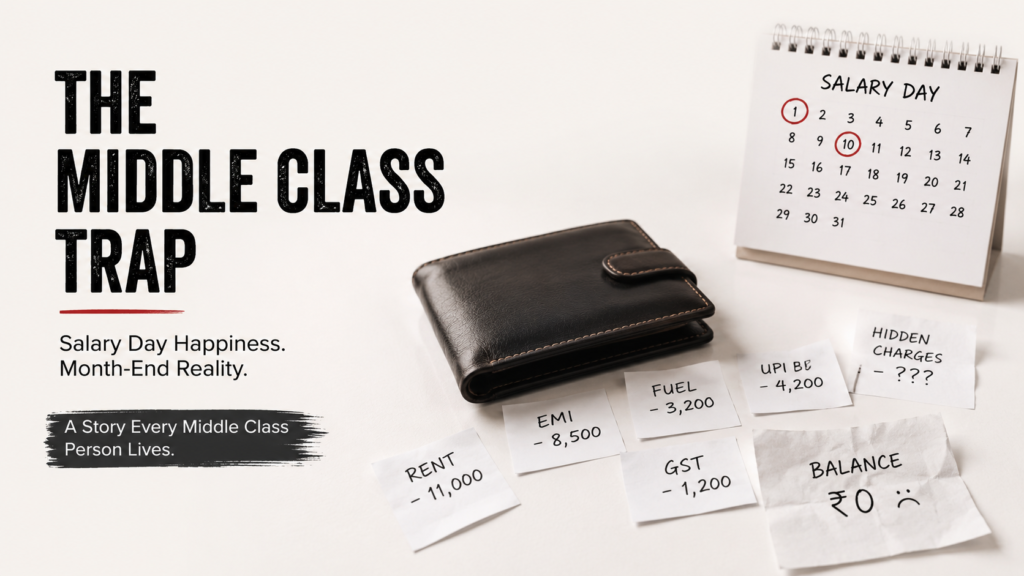
Pawan earns ₹38,000 a month.
Every salary day begins with relief. For a few minutes, he feels like life is finally moving forward.
Then the deductions begin their monthly ritual.
Rent takes its share first.
EMIs follow silently.
Fuel prices bite next.
UPI notifications keep coming.
Internet bill. GST. Hidden charges he never noticed before.
By the time the first week ends, his salary already feels like a memory.
And by the 10th of every month, Pawan stops living…
…and starts surviving.
Pawan 30 years old, works in a private company – US shift. His life runs on caffeine, monthly targets, and the hope that “next year things will improve.”
Every month starts with optimism. Every month ends with calculation.
He earns what most people would call a “decent salary.” Yet somehow, he feels poorer than he did three years ago, not because he spends recklessly – but because modern middle-class life has quietly become a subscription model. You don’t buy things anymore. You buy monthly payments.
By the evening of salary day, Pawan’s account looks like this:
| Expense | Amount |
| House Rent | ₹10,000 |
| Bike EMI | ₹4,500 |
| Education Loan | ₹3,800 |
| Credit Card Payment | ₹6,200 |
| Fuel | ₹3,000 |
| Groceries | ₹4,000 |
| Internet + Mobile Bills | ₹1,200 |
| Other EMI’s | ₹5,000 |
Balance left: ₹300
The month has just started. No emergencies yet, No hospital bills, No weddings, No unexpected Repairs, No festivals and No life.
Ten years ago, middle-class dreams looked different. A stable job meant security.
Today, a stable job means stable anxiety because salaries are increasing slowly but the cost of living is increasing faster.
Rent climbs every year.
Food prices quietly rise.
Fuel prices become normal after every shock.
Streaming subscriptions multiply.
Apps encourage instant spending.
Banks offer “pre-approved” loans before asking whether you actually need one.
And somewhere in between all this, the Indian middle class slowly entered a silent agreement: “I will borrow from my future to survive my present.”
Nobody says it loudly but millions are living it daily.
Walk into any office space today, you’ll hear the same conversations repeated in different languages.
- “Bro, EMI cleared ah?”
- “Bro, can I get X,000 K credit, will return once salary is credited”
- “Salary vanished.”
- “This month credit card became too much.”
- “Need to survive till month-end.”
People laugh while saying it, but behind the jokes is exhaustion.
An entire generation is learning financial stress before financial stability.
The most dangerous trap is not poverty. It is appearing financially okay while silently drowning.
The middle class has mastered this art.
- Instagram photos continue.
- Office attendance continues.
- Weekend outings continue.
- Birthday celebrations continue.
But underneath the surface, many are one emergency away from collapse.
- One surgery.
- One job loss.
- One family issue.
- One missed EMI.
- That’s all it takes.
Pawan realized this one night at 2:30 AM post his shift break. He opened his expense tracker and noticed something disturbing. For the past 18 months, he had not purchased anything that truly made his life better. Everything went toward maintenance. Maintaining rent, loans, maintaining social expectations and the image of being “settled.”
Even happiness had become EMI-based.
The irony is brutal. Middle class is taxed like the rich, but lives with the fear of the poor.
No safety nets, no inherited wealth, no room for mistakes.
Just continuous monthly pressure disguised as “responsibility.” The system is also keep pushing to upgrade phone, lifestyle, outings, wardrobe, status etc etc..
Influencers selling luxury lifestyles, LinkedIn success stories, Advertisements reels are constantly reminding about what you don’t have and starts pressuring.
One Sunday morning, Pawan’s father called him. “Are you saving anything for the future?”
Pawan paused. He didn’t know how to explain that survival had replaced savings long ago.
So, he simply replied: “Trying, Daddy.”
That single word carries the emotional weight of millions of Indian households.
Trying.
- Trying to earn more.
- Trying to stay employed.
- Trying to avoid debt.
- Trying to appear stable.
Trying to breathe inside a system that becomes costlier every year. And maybe that is the real middle-class trap.
The Mantra Take
The modern Indian middle class is not living paycheck to paycheck anymore. It is living notification to notification.
“Salary Credited.”
“EMI Deducted.”
“Payment Due.”
“Insufficient Fund.”
Somewhere between ambition and survival, an entire generation became financially exhausted without ever looking financially broken but hidden inside this chaos, there is also another reality.
A small number of people know/lean how to control their salary instead of emotionally reacting to it. They are not necessarily earning lakhs. They simply becoming financially aware earlier than others, track expenses, avoid lifestyle upgrades, question unnecessary EMIs, build emergency funds slowly. Say “no” to social pressure.
“A higher salary does not automatically create a better life. Better financial decisions do.”
That difference is separating survival from stability in modern India.
Not everyone is escaping the trap.
But a few are slowly learning the map.
And the scariest part?
This is only the beginning because the next trap is even more dangerous:
The culture of easy loans, instant credit, and the illusion of affordability.
The kind of trap that makes people feel rich for a few months…
A good genius story. Well said 👌
Reality which hunts if you think deeper…Great episodes vaishak keep going on
Good read