
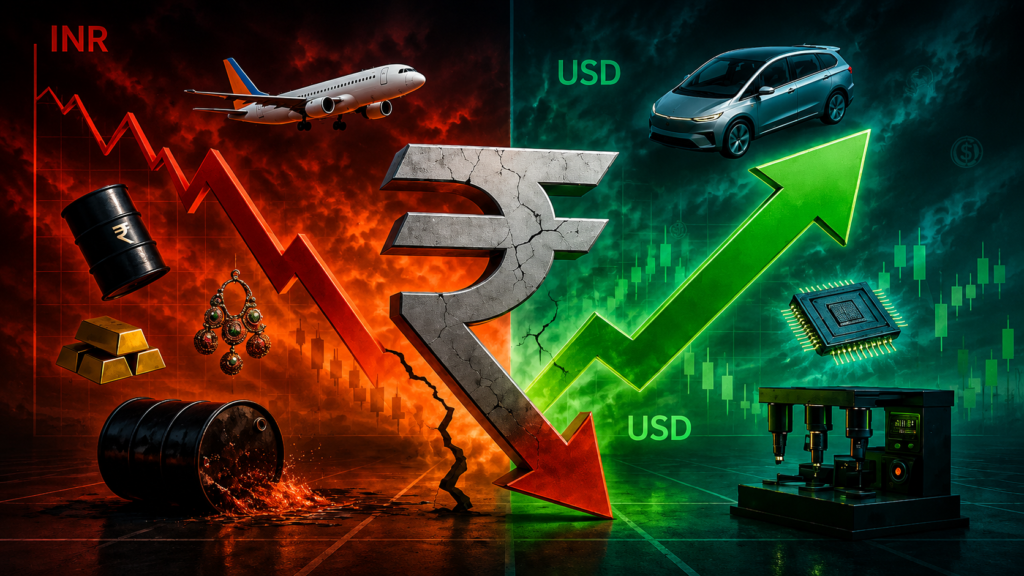
The Indian rupee continues its painful slide, trading near ₹96.5–97 per US dollar in mid-May 2026 a depreciation of over 10–12% in the current financial year alone. This is not a one-off shock but an acceleration of a structural vulnerability that has seen the currency lose nearly 35% of its value against the dollar in the past decade. While the Reserve Bank of India (RBI) and the government have deployed firefighting measures, the persistent weakness exposes deeper flaws in economic planning: over-reliance on imported energy, gold, electronics, and discretionary spending such as foreign travel. The result? Everyday Indians — from Mysuru’s middle-class families to rural Karnataka’s small farmers — are bearing the brunt. Without bold, forward-looking reforms, the cycle risks repeating with even greater intensity.
Understanding the Devaluation: Not Just Bad Luck, But Systemic Gaps
The rupee’s fall stems from a classic dollar shortage. India’s current account deficit has widened sharply due to multiple pressures. Soaring crude oil prices Brent crude hovering above $110–120 per barrel amid Middle East tensions remain the biggest culprit, as India imports 85–88% of its oil.
Gold imports add another heavy layer. In FY26, gold imports surged 24% in value to nearly $72 billion, making it the second-largest item in the import bill. Cultural demand for weddings, festivals, and jewellery, plus its role as an inflation hedge, keeps dollar outflows high and creates a self-reinforcing cycle.
Outbound foreign travel further drains reserves. Rising middle-class aspirations have driven foreign holidays, business trips, overseas education, and medical treatment to record levels. These discretionary outflows crossed $15 billion in FY26, widening the travel account deficit every time Indians book international flights, hotels, or foreign university fees.
Global headwinds compound the problem: a resilient US dollar, higher American interest rates pulling capital away from emerging markets, and foreign portfolio investor (FPI) outflows exceeding $17 billion this year. Persistent trade imbalances in electronics, fertilisers, and machinery tilt the scales further.
Critics say the RBI and government have “failed.” That is only partly fair. The RBI has sold dollars from its reserves, imposed curbs on bank speculation, and used currency swaps. The government has hiked gold and silver import duties, appealed for moderation in gold purchases and foreign travel, and pushed rupee trade settlement plus export incentives. Yet decades of policy inertia on energy security, gold demand management, and curbing discretionary forex leakage have left the system more vulnerable than it should be.
The Human Cost: How a Weaker Rupee Hits the Common Man
A depreciating rupee is not an abstract statistic it directly squeezes household budgets:
- Fuel and transport prices surge, pushing up petrol, diesel, and LPG. Freight costs rise, inflating vegetables, milk, and groceries.
- Gold becomes significantly costlier in rupee terms, inflating wedding expenses, jewellery purchases, and traditional family savings especially during festival and marriage seasons.
- Foreign tours, education, and medical travel turn into luxuries: International holidays, overseas studies, or treatment abroad now demand far more rupees, forcing many middle-class families to cancel or postpone plans.
- Daily essentials, smartphones, appliances, plastics, tyres, and fertilisers carry imported components, with manufacturers announcing 3–7% price hikes.
- Inflation erodes purchasing power, threatening the RBI’s 4% target and hitting hardest those without dollar-linked incomes.
For the average salaried employee or small farmer in Mysuru or rural Karnataka, the net effect is reduced real income and greater financial stress. Remittance-receiving families see modest gains, and export-oriented sectors (IT, textiles, gems) may eventually add jobs a silver lining, as a modestly weaker rupee makes Indian goods more competitive globally. But these benefits are slow and uneven.
The Way Forward: Immediate Actions and Long-Term Structural Reforms
The government and RBI must act on two tracks: stabilise the present while building resilience for the future.
Immediate Measures (Next 3–6 Months)
- Continue targeted forex interventions and tighten bank speculation limits without exhausting reserves.
- Manage oil and gold imports via strategic reserves, supplier diversification, and calibrated subsidies/appeals for vulnerable households.
- Encourage moderation in discretionary outflows (gold purchases and foreign travel) while coordinating policy to attract stable inflows and keep inflation in check.
- Accelerate rupee-denominated trade settlements and bilateral currency swaps.
Long-Term Structural Reforms (Keeping the Future in Mind)
This devaluation must become a wake-up call to supercharge “Atmanirbhar Bharat” in high-potential sectors. The focus: slash import dependence and turn India into an export powerhouse.
Electronics Goods and Components Despite the PLI scheme’s early success, the electronics import bill remains massive. Scaling PLI 2.0, offering deeper incentives for component manufacturing, and fast-tracking land and approvals can transform India into a global assembly and design hub — cutting dollar outflows and boosting exports to Europe, Africa, and the US.
EV Batteries, Parts, and Electric Mobility The electric vehicle ecosystem is a strategic goldmine. Fast-tracking PLI for Advanced Chemistry Cells (ACC), battery manufacturing, domestic mineral processing (lithium, cobalt), and nationwide charging infrastructure can reduce oil import dependence by 20–30% over the next decade, create millions of green jobs, and position India as a major EV exporter.
Semiconductors and Chips The India Semiconductor Mission must shift from policy to production at breakneck speed. Attracting global giants through enhanced incentives, skilled talent visas, and reliable water/power guarantees for fabs and OSAT units will slash reliance on imported chips — vital for electronics, defence, telecom, and autos — while generating high-value exports and saving billions in forex annually.
Additional High-Impact Levers
- Accelerate renewable energy, green hydrogen, and domestic oil/gas exploration to cap the energy import bill permanently.
- Expand trade agreements, improve logistics, and simplify export processes.
- Sign more government-to-government labour pacts to boost remittances — India’s reliable “invisible export.”
- Maintain fiscal discipline and ease FDI norms to attract stable long-term capital.
Balancing the Scales: The Double-Edged Sword of Depreciation
While the domestic pain of a sliding rupee is undeniable, a complete macroeconomic view reveals critical structural cushions. A weaker currency inherently acts as a powerful catalyst for India’s export-driven sectors. It makes Indian IT services, software development, textiles, and pharmaceutical exports significantly cheaper and more competitive on the global stage, potentially stimulating job creation.
Furthermore, India remains the world’s largest recipient of private remittances. As the dollar strengthens, the value of funds sent home by non-resident Indians (NRIs) surges in rupee terms. This massive, reliable capital inflow provides an invisible but vital financial cushion for millions of households, directly offsetting some of the microeconomic stress caused by imported inflation. Finally, it is crucial to recognize that the RBI enters this defensive battle with immense firepower; India’s foreign exchange reserves stand at a historic high of over $700 billion, ensuring the central bank has the necessary buffers to prevent an erratic or speculative run on the currency.
Conclusion: Turning Crisis into Opportunity
The rupee’s devaluation is painful today, but it need not define tomorrow. With decisive action, especially in electronics, EV value chains, and semiconductors, India can build a self-reliant, export-competitive economy less vulnerable to global shocks. As global supply chains shift and technology reshapes mobility, India’s peak demographic dividend presents a historic ten-year window.
The RBI and government possess the necessary tools; what is required now is relentless execution. Ordinary Indians across the country deserve an economy where currency stability actively supports, rather than undermines, their aspirations. The time to act is now.