
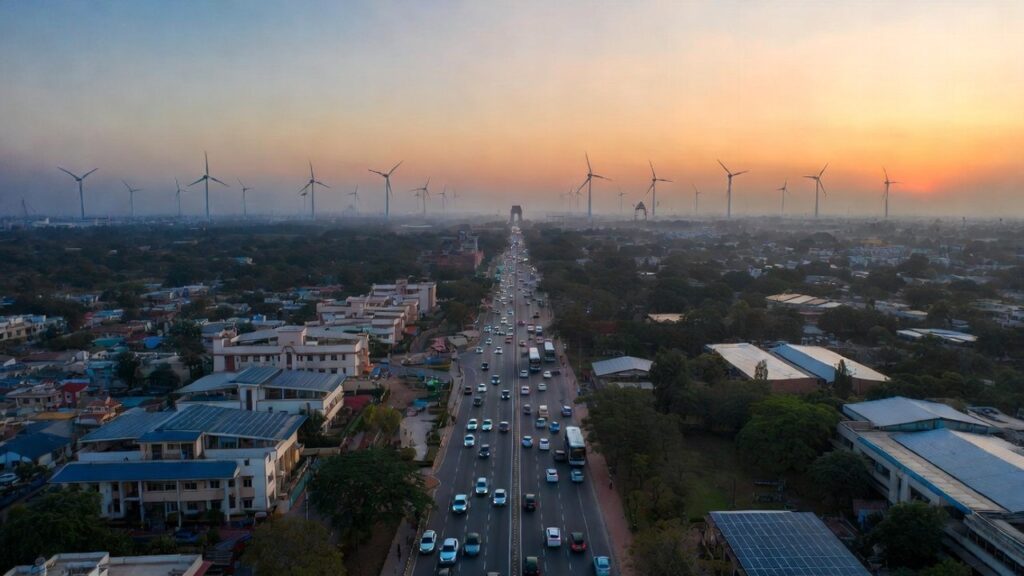
India woke up in February 2026 to a sobering new record: 91% of its crude oil was imported the highest level in recent memory while domestic production continued its 11-year decline. With West Asia tensions pushing an extra $70 billion onto the annual import bill, every litre of petrol crossing ₹97 in cities across the country is no longer just a price shock. It is a stark reminder that India’s economic security still hangs on foreign oil.
Yet in this very crisis lies the clearest path to true energy independence the country has ever had.
India’s oil import dependency touched a staggering 91% in February 2026 the highest in recent memory. Domestic crude production has now declined for the 11th straight year. The ongoing West Asia tensions have added an estimated $70 billion to the annual import bill, with petrol prices once again crossing ₹97 per litre in several cities. Transport still consumes ~60% of India’s oil. Every price spike directly fuels inflation and drains household budgets.
Yet this crisis is also a historic opportunity. India has already achieved E20 ethanol blending nationwide (mandatory from 1 April 2026), electric vehicle sales hit a record 24.52 lakh units in FY25-26 (24.6% growth), and non-fossil capacity stands at 283.46 GW now accounting for more than 50% of total installed power capacity after a record ~55 GW addition last fiscal year.
The question is no longer if India can break free it is how quickly we act on the tools already in hand.
1. Immediate Quick Wins (0–18 Months): Use What We Already Have
Accelerate ethanol to E25 and flex-fuel vehicles
E20 is now the law of the land. The government is evaluating phased E25 rollout and has circulated draft rules for E85/E100 flex-fuel vehicles. Every additional 5% blending can displace millions of tonnes of crude. So far the programme has already saved ₹1.7 lakh crore in foreign exchange, paid ₹1.5+ lakh crore to farmers, avoided 736–869 lakh MT of CO₂ emissions, and substituted over 289 lakh MT of crude. Brazil proved this model works it runs 85%+ ethanol blends and flex-fuel cars as standard. India can do the same faster.
Supercharge EVs in two- and three-wheelers plus public fleets
These segments already drive 80%+ of sales. Extend PM E-DRIVE incentives, fast-track the 72,000+ public chargers and battery-swapping networks, and mandate more e-buses in state fleets. One e-bus can displace thousands of litres of diesel every year.
These two levers alone could cut import growth by 15–25% within 2–3 years.
2. The Prize at Stake
Reducing oil dependence is not just energy policy it is economic and environmental transformation. Lower imports mean a stronger rupee, lower inflation, and billions freed for health and education. The green transition is already creating millions of new jobs in solar manufacturing, EV assembly, ethanol distilleries, and battery recycling. Every gigawatt of renewable power and every lakh of EVs sold brings India closer to Atmanirbhar Bharat and Viksit Bharat @2047.
3. Medium- & Long-Term Structural Shifts
- Electrify cooking, agriculture, and industry using the renewable backbone.
- Scale green hydrogen and compressed biogas for hard-to-abate sectors.
- Ramp domestic exploration as a bridge while substitution takes over.
- Enforce stricter efficiency standards across vehicles, buildings, and appliances.
Current Status vs 2030 Targets (at a glance)
| Sector | Current (2026) | 2030 Target | Gap to Close |
|---|---|---|---|
| Ethanol Blending | E20 mandatory | E25–E30 + flex-fuel | Fast-track rules |
| EV Penetration | ~8.6% | 30% | Accelerate 2W/3W & fleets |
| Non-Fossil Capacity | 283.46 GW | 500 GW | Maintain record pace |
What You Can Do- Right Now
As a citizen/family:
- Choose E20-compliant petrol and consider flex-fuel or electric two-wheelers for your next purchase.
- Switch to induction cooking + rooftop solar.
- Use public transport or carpool whenever possible.
As a business/fleet operator:
- Convert commercial fleets to CNG/CBG or electric.
- Install solar on factory rooftops and warehouses.
The Way Forward
The foundations are rock-solid. Strategically diversifying our energy mix with Russian crude now securing ~50% of imports and shifting 70%+ of supply lines away from the volatile Strait of Hormuz has bought us invaluable breathing room. But a buffer is not a solution. What we need now is ruthless, uncompromising execution: notify E25 and flex-fuel standards within months, double down on the PM E-DRIVE scheme with aggressive fleet incentives, and treat renewable grid integration and Strategic Petroleum Reserve expansion as vital matters of national security.
India does not need to perfectly predict the next geopolitical crisis. It needs to make itself completely immune to them.
The tools are in our hands. The urgency is undeniable. The only question left is how boldly we choose to act today.