
Episode 3
The Comparison Economy — Why Nobody Feels Rich Anymore
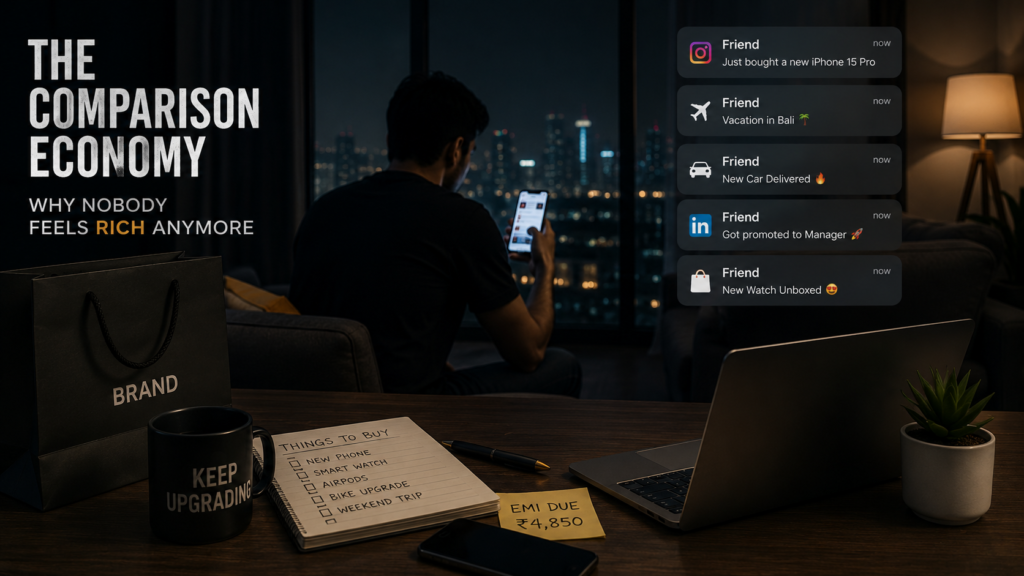
Pawan’s phone was working perfectly.
The battery was fine.
The camera was decent.
The screen had no cracks.
But after watching three friends upload photos with new iPhones in the same month suddenly, his own phone started feeling old.
That is how modern dissatisfaction begins, quietly not because life became worse but because somebody else’s life started looking better.
Three years ago, Pawan used social media to relax. Today, it silently pressures him.
Every scroll feels like a reminder:
- someone bought a car,
- someone went to Bali,
- someone got promoted,
- someone bought a house,
- someone is “winning” at life.
And slowly, without realizing it comparison becomes a monthly expense.
Pawan earns ₹38,000 a month now, technically, he earns more than he did two years ago but strangely, he feels financially smaller because the more society upgrades visually
the more middle-class people feel emotionally left behind.
One weekend Pawan sat with his friends at a café in Bengaluru. The table looked so expensive not because the people were rich but because everybody was trying to look financially comfortable. One friend upgraded his bike recently. Another bought the latest iPhone on EMI. Someone booked an international trip through a credit card offer. Someone casually mentioned stock market profits. The conversation sounded successful. But underneath it all, almost everyone at that table was financially stressed. Nobody admitted it because modern middle-class culture has an unwritten rule: “Struggle privately. Appear stable publicly”
A few days later, Pawan opened an online shopping app “just to browse.”
Two hours later, he had ordered:
- branded shoes,
- wireless earbuds,
- a smartwatch strap,
- and a dinner coupon he didn’t even need.
Total amount: ₹11,480.
Paid using: “Buy Now Pay Later”, At first, it felt exciting. Then came the monthly deductions.
This is the new economy nobody openly talks about. An economy where people are no longer buying things only for utility.
They are buying emotions:
- status,
- validation,
- confidence,
- belonging,
- relevance.
Because in today’s world, appearing successful often matters more than feeling peaceful.
And social media understands this perfectly. Every platform survives on one powerful business model: Make ordinary people feel incomplete. That’s why your feed constantly shows:
- luxury lifestyles,
- productivity influencers,
- perfect relationships,
- expensive gadgets,
- aesthetic workspaces,
- “Success before 30” stories.
Not because everyone is truly living like that but because aspiration keeps people consuming.
Modern consumer culture had quietly transformed spending into emotional therapy and businesses were profiting from loneliness, insecurity, and comparison. Savings left: Almost nothing. The painful part? Most of these expenses were not survival expenses, they were comparison expenses.
The middle class today is trapped in a dangerous psychological race not to become rich but to avoid feeling unsuccessful and there’s a difference, A huge difference.
Because once financial decisions become emotional logic slowly disappears.
Why peace feels rare now? Because comparison never ends.
There will always be:
- a better phone,
- a bigger house,
- a higher salary,
- a better vacation,
- a richer friend,
- a more successful colleague.
The finish line keeps moving and the middle class keeps running.
The Mantra Take
The modern middle class is no longer competing with neighbours. It is competing with entire timelines. Thousands of lifestyles, Millions of edited realities and slowly, social media has transformed comparison into a full-time economy.
An economy where insecurity creates consumption, where validation creates spending where appearances quietly become financial pressure but hidden inside this noise, there are still a few people choosing a different path.
People who:
- delay unnecessary upgrades,
- spend without performing,
- live below their salary,
- protect peace more than appearances,
- and understand that financial freedom is often invisible.
Because real wealth does not always look luxurious online, sometimes, it simply looks calm and maybe that is what the middle class truly messed up today.
Debt can sometimes be repaid but comparison? Comparison is endless.