
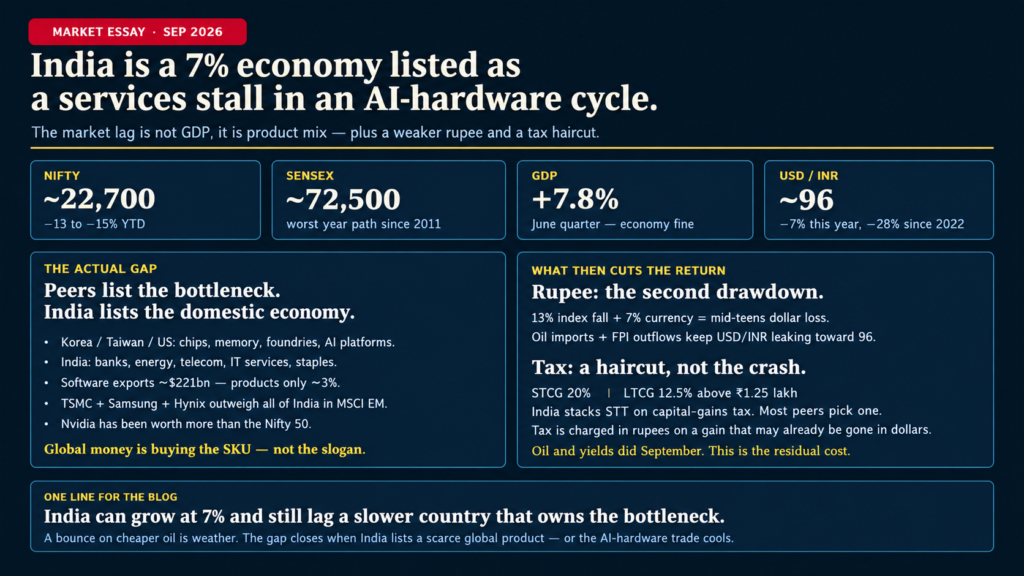
Nvidia has been worth more than the entire Nifty 50. That is the Indian market problem.
The world is bidding for a scarce product. India’s listed companies do not sell one
TSMC, Samsung and SK Hynix now weigh more in the MSCI Emerging Markets index than the whole of India. Nvidia has been worth more than the Nifty 50. Reliance, India’s largest company, has sat outside the world’s top 100. No Indian name is in the EM top ten. That is not a branding problem, and it is not first an oil problem. It is what a stock market looks like when the world is bidding for a scarce product and your listed companies do not sell one.
By late September 2026 the Nifty was near 22,700 and the Sensex near 72,500 — down about 13–15% on the year, at six-month lows, after a September drop of roughly 7%, and after seven losing weeks. If the year ends here it is the weakest calendar print since 2011. Domestic institutions bought almost rupee-for-rupee against foreign sales. June-quarter GDP printed 7.8%. Corporate India was not collapsing. The tape still fell.
Korea’s Kospi has been up on the order of 60–100% this year. Taiwan 50–70%. Japan’s Nikkei around 30%. The S&P 500 low-to-mid teens, Nasdaq more. China and Hong Kong were merely soft. India was the large market that went the other way. Oil above $105 after the US–Iran standoff, a US 10-year yield above 5.2%, a rupee testing 96, and $24–26 billion of foreign equity outflows explain why September was violent. They do not explain why India had so little defence. Global funds can be underweight India and still own the defining trade of the cycle. That is the story, compressed.
The SKU, not the slogan
A market rerates when its listed firms sell something the world must buy, cannot easily replace for five to ten years, and can scale without hiring in lockstep with revenue. That is what “future demand” looks like on an exchange.
The United States lists the platforms and the chip architecture: Nvidia, Microsoft, Google, Amazon, Apple. Taiwan lists the factory. TSMC has about 70% of advanced foundry work and has been around two-fifths of Taiwan’s market. Korea lists the memory those servers cannot run without. Samsung and SK Hynix have been close to half of Korea’s market value. China, even with a messy onshore tape, still lists scaled physical products — EVs, batteries, solar — that the world actually imports. Japan lists the tools, materials and components that sit inside other countries’ products.
An allocator does not need a view on Taipei traffic. They need the object.
India’s object is different. The Nifty’s large weights are energy, private and public banks, telecom, IT services, lenders, infrastructure and staples: Reliance, HDFC Bank, Airtel, ICICI, SBI, TCS, Bajaj Finance, L&T, Hindustan Unilever, Sun Pharma. Excellent businesses for an Indian decade. Almost none is a must-buy global product in the way HBM memory or a 3-nanometre wafer is a must-buy product.
This is the point most 2026 copy blurs. India *does* sell to the world. Software exports are about $221 billion, which is recited as proof of a tech power. Read the composition. Software *products* are about 3% of that pile and they shrank in the latest year. The rest is IT services, engineering services and BPO — people and projects sold to foreign CIOs. TCS and Infosys do not sell a chip, a model or a platform the world cannot substitute. Generative AI makes that effort look more replaceable, not more scarce. Hence the same cycle that levitated chip stocks compressed Indian IT, a heavy index weight, and took the benchmark with it.
The merchandise basket is the same fact in steel and solvent. India’s goods exports are led by engineering, refined petroleum, assembled electronics (especially smartphones), generic medicines, chemicals, gems and textiles. Real exports. Replaceable exports. A buyer can switch a generic, a refined cargo, a contract phone, an auto part. Volume is not a bottleneck. Pricing power is limited. Multiples stay ordinary.
So the “low global presence” complaint and the “no future-demand product” complaint are one fact, stated twice. Eighteen months ago India’s market capitalisation was several times Korea’s and more than twice Taiwan’s. The lead vanished because those markets listed the shortage and India listed the economy that will consume inside its own borders. Other exchanges are growing because they contain a clearly defined object the next decade has to buy. India contains banks that need Indian loan growth, refiners that need Indian fuel demand, and service firms that need foreign IT budgets not to shrink.
The factory India is building is not yet the stock India is listing
The honest reply is that the country is not sitting still. Chip packaging and test plants are already shipping — Micron at Sanand, Kaynes, CG Semi and others. Some of that output is already going to global customers. Tata’s first large silicon fab at Dholera is under construction, with commercial production talked about around 2028, on mature nodes rather than TSMC’s leading edge. India already has a deep chip-design bench. Design was never the constraint. Owning the product is.
Until that product is large, listed and in the free float, “India underowned” is an incomplete sentence. A packaging plant that assembles dies fabbed elsewhere is a real industrial start. It is not SK Hynix. Bernstein’s colder version of the same point: foreign flows stay flat to only modestly positive until India builds globally competitive businesses in chips, defence and deep tech — not until the GDP print looks respectable again.
What India does have that is clearly demand-oriented is mostly inside India. Credit, insurance and capital markets as savings formalise. Power, roads, railways, defence, data centres. Telecom and digital public infrastructure. Organised retail and quick commerce. Autos for a young population. Those are ten-year compounding themes. They are not a global shortage. A Seoul allocator can buy SK Hynix and know every AI server needs it. A Mumbai allocator buys HDFC Bank and needs Indian loan growth, Indian rates and Indian politics to stay friendly. Pharma is the closest India has to a true global product franchise. It is meaningful. It does not move a $4–5 trillion market the way memory and foundries move Korea and Taiwan.
The second drawdown is the rupee
Even a flat Nifty would have been a dollar loss. USD/INR ended 2024 near 85.6, 2025 near 90, and by late September 2026 was testing 96, with a 52-week high above 97. That is roughly 7% weaker this year and about 8% weaker than a year earlier. From early 2022, when the dollar averaged about 74.4, the rupee is down close to 28%.
Attribute the foreigner’s year that way and the picture sharpens. A 13% fall in the index plus a 7% fall in the currency is a mid-teens dollar drawdown before fees and tax. High oil is a mechanical bid for dollars in an economy that imports most of its crude: the import bill, the current account, inflation expectations and the fiscal arithmetic worsen together. Foreign sales of rupee assets to remit dollars are themselves rupee-negative. The weaker print then reduces the dollar value of what remains, which invites the next sale. That is a loop, not a mood.
Two other facts make the loop harder to break. Net FDI has been softer than the “India growth” slogan, with rising repatriation. And large dollar inflows through FCNR deposits and external commercial borrowings have often been absorbed into reserves rather than sold in the spot market, so they pad the RBI’s war-chest without producing a lasting bid for the rupee. The currency can look managed and still trend weaker. That is what has happened.
The rupee’s contribution to the lag is therefore threefold. It cuts the dollar return. It raises the local return a foreigner needs to stay invested. And it becomes an independent reason to stay underweight after the first sale. A Korean or Taiwanese market up 50–70% in local currency still looks spectacular after a milder currency move. An Indian market down 13% in rupees looks worse than it already is once translated.
Tax is a haircut, not the crash
Do not promote tax into a co-equal cause of a 13% year. Oil, yields and the product gap did that. Tax is why the residual return has to work harder than the chart, especially for capital that does not live in rupees.
Since 23 July 2024 — left unchanged in Budget 2026 — listed-equity short-term gains are taxed at 20% and long-term gains at 12.5% above ₹1.25 lakh. That replaced 15% and 10% above ₹1 lakh. India then charges securities transaction tax on the ticket and does not allow it as cost of acquisition. Most large markets pick a transaction tax or a gains tax. India stacks both. Dividends, after a 25.17% concessional corporate rate, are taxed again in the shareholder’s hands; residents face TDS, non-residents a 20% domestic withholding unless a treaty cuts it to the 5–15% band. Surcharge and cess sit on top. Debt funds bought after April 2023 have no long-term rate at all.
Singapore and Hong Kong still treat most capital gains as untaxed. China has been cited near 10% on comparable equity gains. The United States taxes long-term gains — on companies that dominate global indices, so the tax sits on a product the allocator already wants. India is taxing a market the allocator can underweight without losing the AI cycle. Recent relief for FPIs on specified government securities is a bond-market and rupee policy. It does not rewrite the equity stack.
The only tax point that belongs in the argument is the translation trap. Gains are computed in rupees. The foreigner accounts in dollars. A book that is up 10% in Mumbai and down in dollars can still generate a 12.5% bill on the rupee “profit.” Domestic SIP money never sees that bill. That is why household flows can support the market while foreign weights shrink. Two experiences of the same index.
The objection that has to be met
India is not a broken market sitting under a broken economy. Say that plainly or the piece is a rant.
SIP and DII buying is a structural change from 2008: the index is less hostage to a single foreign week. In several stretches this year mid- and small-caps held up better than the Nifty; the pain was concentrated in large-cap IT and financials, which carry the benchmark. Earnings were muted for two years and can recover toward the low-to-mid teens in FY27 if oil mean-reverts Motilal, Emkay, Morgan Stanley and others have kept some version of that recovery. A 7% compounder *should* trade richer than a 2% economy. Valuations have already de-rated from the 2024 premium toward, and on some measures around, long-term averages. DBS still has India at a premium to Asia about 21 times forward earnings against roughly 12 times for Asia ex-Japan while India’s 2026 earnings growth is high-single-digit against a much faster regional rebound off lower bases. That premium was the 2023–24 prospectus. The world has already paid it once.
Those points are true. They are also why the 2026 question is not whether India grows. It is whether India is the scarce object in the cycle the world is funding. It is not. External headwinds overpowered domestic tailwinds. That is not a mystery. It is what happens when the listed mix is domestic and the global bid is for hardware.
Four complaints, one mechanism
Product mix: India does not list a globally scarce object, so when the world runs an AI-hardware cycle, capital leaves.
Low global presence: no Indian name in the world’s top cohort, a shrinking EM weight; allocators can be underweight India and still own the trade.
Rupee: outflows, oil and a current account hostage to crude weaken the currency; dollar returns fall; the next sale gets easier.
Tax: 20% short-term, 12.5% long-term, STT on the ticket, dividend withholding on the way out — a third slice on a market that was already optional.
Oil and US yields decide the month. This mechanism decides whether India is a core holding or a tactical residual. In 2023–24 India was priced as both a structural compounder and a scarce EM asset. In 2026 the world bought the scarce asset in Taipei and Seoul and let Indian SIPs look after the compounder.
What would close it — and what would not
A 1,000-point bounce because Brent drops $15 is weather. So is a week of FPI buying after an index rebalance. The gap closes if one of three things becomes true.
One: India lists a globally scarce product at meaningful free-float scale — advanced chips, memory, platforms, defence systems, or specialty materials the world cannot easily replace. Packaging lines and a 2028 mature-node fab are the start of that road, not the destination.
Two: the global cycle itself rotates. If AI hardware cools and allocators need earnings that are not already inside a 40-times multiple, India’s banks, industrials and domestic consumption become the less-crowded trade. That is a cyclical gift, not a structural fix.
Three: the rupee and the tax code stop taking slices that Seoul and Taipei do not take. Not a strong rupee — a less surprising one, and a current account less hostage to a single oil spike. Not a populist tax holiday — an end to stacking STT on capital-gains tax, a long-term rate that does not move every other Budget, and an exit and dividend regime that does not make Singapore the default holding company for capital that was always destined for India.
Until then, treat every rally as a price event. Demographics, digital rails, capex and household financialisation remain the best long-run case in emerging markets. They are a case for owning India in rupees over a decade. They are not a case for why the Nifty should have kept pace with Korea in a year when the world paid any price for memory.
India can grow at 7% and still lose to a slower country that owns the bottleneck. That is not a paradox. It is product mix, expressed through an index, a currency and a tax code. An “India underowned” note that does not name the SKU is nostalgia for the last multiple.