
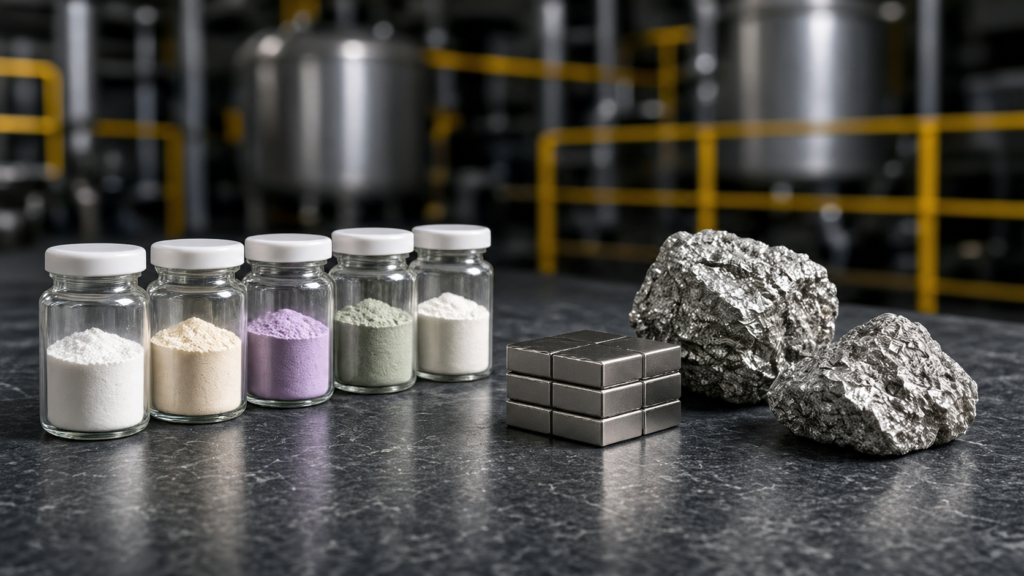
From powder to magnet. These oxides and metals are what factories actually buy. China dominates this step, not just the mine
The fight is not about who has more rocks in the ground. It is about who can turn those rocks into the magnets used in cars, turbines, phones, and weapons.
In 2024, rare earths were mined on four continents. Almost all of that rock still had to go to China before a factory could use it.
That is the real story. China does not only have the mines. China has the factory.
Car makers, wind-turbine makers, and defense ministries do not buy raw ore. They buy cleaned oxides, metals, and strong magnets. A new mine in California or Australia does not break China’s hold if the material still has to travel to China for the next steps. Beijing controls those steps.
What this article covers:
- Why the world needs rare earths
- Why processing matters more than mining
- How China built this lead
- How the United States, Europe, Japan, and Australia fell behind
- Three simple tests to see if other countries are really catching up
How much China controls (2024–25)
| Step | China’s share |
| Mining of the rare earths used in magnets | About 60% |
| All rare-earth mining | About 69% |
| Cleaning and separating the metals | About 91% |
| Processing of heavy rare earths (dysprosium and terbium) | About 99% |
| Making the strongest magnets (sintered NdFeB) | About 94% |
The rare earths used in magnets make up about 95 percent of the industry’s value. Demand for those four metals has doubled since 2015. Under today’s policies, it is likely to rise by about one-third by 2030, to more than 120,000 tonnes.
Why rare earths matter
There are 17 rare earth elements. The political fight is about four of them.
Neodymium and praseodymium are the main metals in NdFeB magnets. These are the strongest magnets used in everyday industry. Dysprosium and terbium are added so the magnets still work when a motor gets hot. The other rare earths are used in glass, polishing powders, catalysts, screens, and medical scanners. Magnets matter most because they sit inside machines that turn electricity into motion, and motion into electricity.
Cars. A battery-electric car usually holds about 1.5 to 2 kilograms of these magnets in its motor. Most new electric-car designs use them. Global electric-car sales rose from about 300,000 in 2014 to more than 17 million in 2024. In 2015, electric cars were less than 1 percent of magnet demand. Today they are about 9 percent. By 2030 they may be about 18 percent. That is the fastest-growing part of demand. Because of this risk, automakers are trying to engineer their way out: companies like BMW and Renault use magnet-free motors, while others use advanced boundary-diffusion techniques to cut heavy rare earths in half. Yet for pure efficiency, power density, and driving range, permanent magnets still lead the market.
Wind power. A large offshore wind turbine that uses a direct-drive magnet generator can need about 200 to 600 kilograms of high-grade magnet for each megawatt of power. The exact amount depends on the design. As turbines get bigger and move out to sea, companies like these magnets because they save space, require less maintenance, and waste less energy.
Factories, phones, and data centers. Most magnet rare earths still go into ordinary machines: factory motors, robots, air-conditioners, hard drives, speakers, sensors, and home appliances. Data centers add more demand through cooling systems and power equipment. This everyday use is why demand does not collapse if electric-car sales slow for a year.
Weapons. The amounts used in defense are small next to cars. The risk is not small. A 2013 U.S. report, based on a Pentagon study that was never published in full, said an F-35 fighter contained about 417 kilograms of rare-earth material. Later studies say the actual metal content is much lower, perhaps tens of kilograms. Even then, those kilograms sit in parts that are hard to replace: flight controls, radar, electronic warfare, and power systems. Missiles, satellites, and aircraft all need special magnets and alloys. These parts take years to qualify and approve. If China stops licenses, factories and militaries feel it fast.
So rare-earth processing sits in the middle of two big systems: clean energy and advanced weapons. The country that separates the metals, makes the alloys, and presses the magnets can slow a car plant or a weapons program without firing a shot.
The real choke point is not the mine
China mines a lot of rare earths. That is not the tightest grip.
In 2024–25, China mined about 60 percent of the rare earths used in magnets and about 69 percent of all rare earths. The United States, Myanmar, and Australia mine most of the rest. The United States is again the world’s second-largest miner, almost all from one site: Mountain Pass, in California. That sounds like balance. It is not, if the next factory is still in China.
The hard step is separation. Rare earths are found mixed together. Chemically, they are very similar, so they are hard to pull apart. Plants still use long chemical lines called solvent extraction. Material moves through dozens or hundreds of tanks. Workers must keep acid levels and temperatures steady. The waste is acidic and can be slightly radioactive. After that, customers still need metals and finished magnets that pass strict automotive and defense tests. A mine with no local plant is only a shipping business.
China now has the capacity to make about 380,000 to 400,000 tonnes a year of the strongest sintered magnets. Plants outside China are still measured in a few thousand tonnes each. Twenty years ago, China made about half of these magnets. Today it makes about 94 percent. That is why a Chinese license on a few metals can stop assembly lines far from any Chinese mine.
How China built the factory
This did not happen by chance. China worked on it for about 60 years.
Leaders treated it as national strategy. The huge Bayan Obo deposit in Inner Mongolia was identified in the 1920s. Rare earths began to come out with iron ore in the 1950s. Deng Xiaoping visited in 1964 and said China needed steel and rare earths. After he took power, the industry became a long-term state project. In 1992 he said: the Middle East has oil; China has rare earths. The government called these metals strategic. It limited foreign control of mines. It gave the industry cheap power, cheap loans, and export tax breaks.
Scientists made the chemistry work at scale. In the early 1970s, Peking University chemist Xu Guangxian was asked to separate two very similar metals, praseodymium and neodymium, to military purity. He had already worked on nuclear-fuel chemistry. He built a method that let factories move from small lab tests to large production lines. The method was taught across state plants. By the mid-1990s, China made most of the world’s high-purity separated rare earths. Prices fell. Many Western plants cut output or closed. China did not invent this chemistry. It made it cheaper, and it kept the skilled workers.
Low prices pushed rivals out. In the 1980s and 1990s, China used tax breaks and many small plants in the south to flood world markets with cheap oxides and metals. Soft clay deposits in southern China also made it easier and cheaper to get heavy rare earths. Those metals are harder to produce from hard rock elsewhere. Pollution rules were weak while the industry grew. That lower cost was a real advantage. Western plants had to pay more to handle wastewater and radioactive waste. Chinese plants often did not—until later, when the state consolidated private firms into massive state champions like China Rare Earth Group and cleaned some sites without giving up operational scale.
China then took the next step: magnets. Separating metals is not the end of the value chain. Magnets are. In 1995, General Motors sold Magnequench, the U.S. company that made special rare-earth magnets used in precision weapons. Buyers included Chinese state-linked firms. The know-how moved. China then built magnet plants next to its own car, wind, and electronics industries. Home demand kept those plants busy even when China used low export prices to hurt foreign rivals.
China is now locking the door. In 2024 and 2025, Beijing added export licenses on heavy rare earths and magnets, then tightened bans on exporting rare-earth extraction, separation, and magnet-manufacturing equipment. China treats the middle of the industry as a proprietary strategic asset, not a normal commodity.
How other countries fell behind
Other countries did not lack rocks. They lacked the will to keep a dirty, low-profit, hard-to-run middle industry once China offered to do the work cheaper. Each region failed in a different way.
United States: had the lead, sold the factory, then paid for the mine
From the 1960s into the 1980s, Mountain Pass supplied most of the world’s rare earths and ran its own separation plant. Then three things hit at once. Regulators cracked down after wastewater spills into the Mojave Desert. Chinese material arrived cheaper than U.S. plants could match. And Washington treated magnets as just another business, not a strategic industry. Separation stopped in 1998. The mine closed in 2002. The Magnequench sale removed key magnet know-how.
The 2010 export shock should have been the warning. A company called Molycorp spent more than a billion dollars to restart Mountain Pass. China then eased limits, increased supply, and drove prices down. Molycorp went bankrupt in 2015. MP Materials later restarted the mine. For years it still sent most of its concentrate to China, because the United States no longer had the plant. Washington found it easier to praise a domestic mine than to rebuild the separators, metal plants, and magnet lines that can survive a price war. That is how a country can be the world’s No. 2 miner and still import the product that matters.
Europe: kept the demand, pushed out the chemistry
In La Rochelle, on the west coast of France, a plant has separated rare earths since 1948. It passed through French chemical groups that later became Rhône-Poulenc, Rhodia, and Solvay. For years this was the West’s answer to China’s plants: a site that could separate the full set of rare earths. When cheap Chinese oxides arrived, and European pollution rules got stricter, La Rochelle did not close. It moved upmarket into catalysts, screen materials, and medical-grade oxides. It left bulk magnet feedstock to China. That was smart business. It was also a strategic loss. Europe still wanted offshore wind, electric cars, and factory motors. It stopped making the middle products those machines need.
The European Union now writes critical raw materials acts and lists “strategic” projects. Solvay is trying to return to magnet-grade oxides and hopes to cover part of Europe’s need by 2030. The volumes are still small next to China’s. The cost gap is still real. Europe learned how to limit pollution. It forgot that the magnets still have to come from somewhere.
Japan: learned the lesson in 2010, then built one backup, not a full chain
On 7 September 2010, the Chinese fishing boat Minjinyu 5179 hit Japanese Coast Guard ships near the Senkaku Islands. Tokyo held the captain, Zhan Qixiong. Beijing said there was no official ban. In practice, Chinese customs stopped rare-earth shipments to Japan. At the time, China made about 97 percent of the world’s rare earths. Japan was the top buyer and the workshop that turned those metals into motors and electronics. Tokyo released the captain. The warning was clear. Japan then did the smartest thing any buyer did: it helped fund Lynas in Australia and Malaysia.
That created the only large separator outside China for the lighter rare earths. It did not create a magnet industry to match China’s. Japan stayed exposed on dysprosium and terbium until very recently. Fifteen years after the shock, Japan had a backup plant, not a full supply chain. One extra plant is insurance. It is not independence.
Australia: mined some of the best ore, processed it somewhere else
Mount Weld is one of the world’s best rare-earth deposits. Australia did not want the radioactive waste at home. Lynas built its initial cracking operations to export semi-processed material to Malaysia for main separation. That choice kept the company alive, but political pushback in Malaysia later forced Australia to take the first dirty step back—building a cracking and leaching plant inland at Kalgoorlie. Lynas now makes some separated dysprosium, terbium, and samarium outside China. That matters. The volumes are still small next to China’s. Other Australian refinery plans are late and costly. They still sell into a market where China can push prices down.
The deeper problems
After the 1990s, Western countries trained far fewer people to run these plants. China kept the university courses and the factory skills. On a slide, separation looks simple. In a plant with 100 chemical stages, it is not. New methods get funding. Old solvent extraction still runs the world.
Time made it worse. A U.S. mine can take about 20 years from discovery to production. A refinery can take seven to ten years to get permits. A new Western plant can cost several times more than an old Chinese plant that is already paid for. Capital markets also operate on quarterly returns, whereas building an alternative processing plant takes a decade. Without government price floors or guaranteed off-take contracts, private money retreats whenever China cuts prices. A customer contract is not the same as a magnet that has passed two years of car-industry tests.
The pattern since 2010 is familiar: a scare, a rush of money, a price crash or a permit delay, then another plan. Molycorp is the warning. Many of today’s projects look like the same story with better branding.
Catch-up has started. These three tests will show if it is real.
MP Materials is adding U.S. separation and magnet plants, with government support and orders from car and tech companies. Neo has a magnet plant in Estonia. Lynas is expanding heavy-rare-earth output in Malaysia. Solvay is pushing La Rochelle back toward magnet oxides. Korea, Vietnam, Germany, and France have plants planned or just starting. Recycling will help, especially in Europe, as old electric cars and turbines are scrapped.
The numbers are still harsh. Even with announced projects, plants outside China in the 2030s may cover only about half of non-Chinese mine demand, about a quarter of refining demand, and well under a fifth of magnet demand. Mines are the easy announcement. Magnets decide whether a factory runs.
Ignore the ribbon-cuttings. Watch these three tests:
- Can countries outside China make heavy rare earths at real commercial scale—not a trial line, but thousands of tonnes of separated dysprosium and terbium that a magnet maker can buy every year?
- Can car or defense plants use magnets made in series production without Chinese oxides, metals, or Chinese process equipment?
- Can the new plants survive a Chinese price war? If Beijing makes too much and cuts prices for three years, do Western governments back these operations with price supports, or do the new refineries go bankrupt like Molycorp?
Until all three are true at the same time, “alternative supply chain” is mostly a press release.
The lesson countries keep missing
China’s lead is not a story about who dug the bigger hole. It is a story about who was willing to live with the chemistry.
China accepted pollution for a long time, trained a generation of plant workers, protected the industry when it lost money, and then moved into magnets while electric cars and wind turbines were still a future market. By contrast, the West celebrated mine reopenings while relying on Chinese chemicals to process the ore.
A mine announcement is not a supply chain. A magnet plant that cannot buy separated dysprosium is only a building. Until other countries fund the unglamorous middle—separation, metals, product testing, price guarantees, and the people who run the plants—China will keep owning the factory the world still needs.