
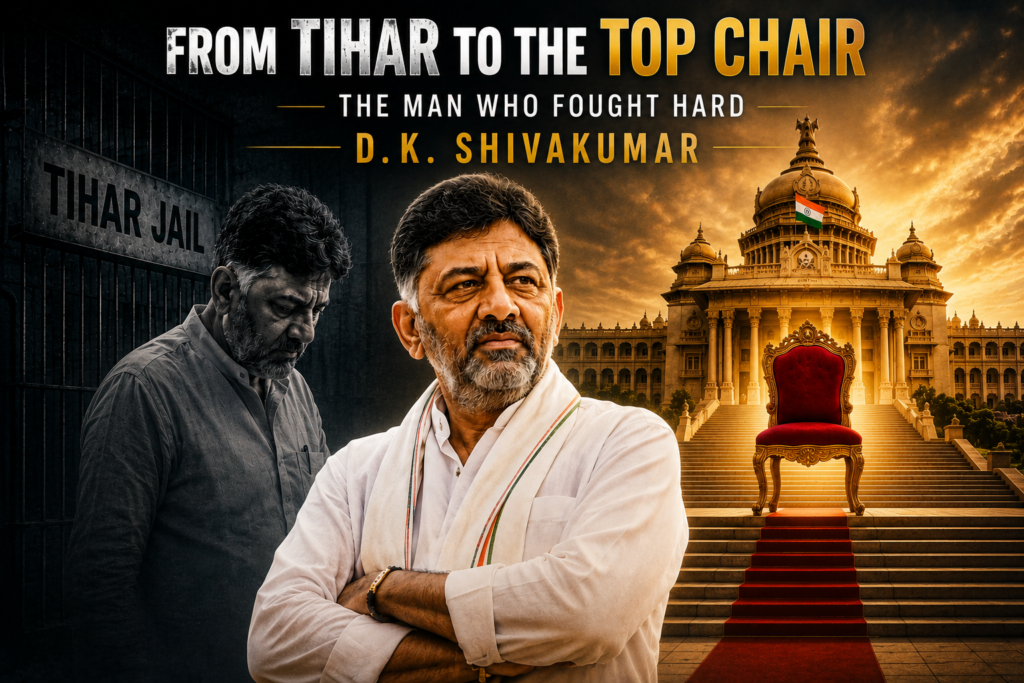
From Prison Walls to Power Corridors: The Unstoppable Rise of DKS
Karnataka politics has always been dramatic. Power struggles, internal rivalries, caste equations, loyalty battles, Delhi pressure, emotional speeches, sudden twists – the state has seen everything over the decades but among all modern Karnataka politicians, very few leaders have built an image as powerful, mysterious, resourceful, and politically resilient as D.K. Shivakumar.
For some, he is the ultimate political strategist. For others, he is a master negotiator who understands power better than anyone else. For many Congress workers, he is the man who never gave up on the Chief Minister’s chair, even after jail, raids, controversies, betrayals, and internal sidelining and For some he is a corrupted politician.
On 28th May’2026, as Karnataka stands at another major political turning point with Siddaramaiah stepping down and D.K. Shivakumar emerging as the next Chief Minister, one thing is clear: This was not an overnight rise. This was a decades-long political war.
The Difference Between Siddaramaiah and D.K. Shivakumar
Before understanding DKS, one thing must be said honestly. Siddaramaiah and D.K. Shivakumar represent two completely different political generations.
Former CM Siddaramaiah was a leader whose politics was deeply rooted in welfare governance, social justice, backward class empowerment, and old-school mass politics. In many ways, he was a leader perfectly suited for the Karnataka of the 1980s and 1990s – a period where government support systems, welfare schemes, caste mobilization, and rural politics shaped electoral success.
But modern Karnataka is different.
Today’s generation talks about:
- Bengaluru infrastructure
- Global investments
- Startup ecosystems
- Metro expansion
- Technology
- Urban mobility
- International branding
- Employment generation
This generation expects speed, visibility, execution, and aggressive development politics and this is where D.K. Shivakumar enters, his visionary towards development was always inspiring.
A Political Entry Against a Giant
Most politicians begin their careers safely but DK Shivakumar did not at just 23 years old, D. K. Shivakumar entered electoral politics in 1985 from the Sathanur constituency against a giant H. D. Deve Gowda — a towering Janata leader who would later become Prime Minister of India.
DKS lost that election but politics noticed him because very few young leaders had the courage to challenge such a giant directly, four years later, in 1989, D.K. Shivakumar defeated Deve Gowda by over 13,000 votes. Overnight, he became Karnataka’s Future Leader.
By the age of 29, DKS became a minister but his real rise happened during the political era of S. M. Krishna’s leadership, Bengaluru started transforming into India’s IT capital. As Urban Development Minister between 1999 and 2004, he built deep influence not just inside Congress, but also among contractors, local leaders, business circles, and power networks across Karnataka and many people say that this is the period where D.K had made his wealth.
The Enormous Wealth Debate Around DKS
No discussion about D.K. Shivakumar is complete without discussing wealth. Over the years, his election affidavits showed a dramatic increase in declared assets:
- Around ₹251 crore in 2013
- Around ₹840 crore in 2018
- More than ₹1,400 crore by 2023
This triggered a huge public debate.
Supporters call him a highly connected businessman-politician with vast investments and financial acumen. Nonparty peoples see him as the symbol of money power in Indian politics.
Sidelined: In 2013, when Siddaramaiah became Chief Minister, many expected DKS to receive a major role immediately. Instead, he was initially kept away from the cabinet due to controversies linked to illegal mining reports and political concerns. For many politicians, this would have been the beginning of decline. But not for DKS. He lobbied aggressively.
Strengthened internal support and proved his political strength. Eventually, he returned to the cabinet as Energy Minister in 2014.
This period became important because Karnataka witnessed one of Asia’s largest solar park developments in Pavagada. Projects like these helped shape DKS’s image as a leader more focused on infrastructure and execution compared to many traditional welfare politicians.
Congress Party’s “Troubleshooter”
This is probably the chapter that truly transformed DKS into a national-level Congress power player. Whenever Congress governments across India faced danger, DKS often became the man handling crisis operations. In 2002, he reportedly helped protect Maharashtra Congress MLAs during a government survival battle. In 2017, during the intense Gujarat Rajya Sabha elections involving Ahmed Patel, DKS again played a major behind-the-scenes role by managing Congress MLAs in Bengaluru resorts. This was the period when national agencies conducted major raids against him. The media exploded with allegations, cash seizure reports, undisclosed asset claims, and huge debates.
Tihar Jail: The Moment That Could Have Ended Everything
In September 2019, the Enforcement Directorate arrested DKS in a money laundering case. He spent nearly 50 days in Tihar Jail at that moment; many political analysts believed his career was over but Indian politics is unpredictable. When he returned to Bengaluru, emotional visuals of supporters welcoming him created a completely different narrative. Instead of disappearing he appeared stronger.
The Road to the Chief Minister’s Chair
Soon after, DKS became Karnataka Congress President. That changed the game completely.
He rebuilt grassroots organization aggressively.
Strengthened booth-level structures.
Mobilized local leaders.
Used his organizational network
The result was very clear in the 2023 Karnataka Assembly elections with 135 seats but even after delivering victory, DKS had to compromise, the Chief Minister chair initially went to Siddaramaiah. And today, after years of waiting, setbacks, investigations, humiliation, power struggles, and relentless political survival, D.K. Shivakumar finally stands at the top of Karnataka politics.
Can DKS Transform Bengaluru?
Bengaluru is no longer just Karnataka’s capital. It is India’s global technology identity.
City Faces:
- Traffic collapse
- Flooding
- Water crisis
- Urban corruption
- Infrastructure delays
- Garbage management failures
- Poor planning
DKS now enters office with enormous expectations.
Unlike older-generation politicians focused mainly on welfare politics, he is widely seen as someone obsessed with execution, visibility, infrastructure, and political control.
Supporters and many youths believe he may push:
- Faster infrastructure clearances
- Metro expansion
- Investment attraction
- Urban modernization
- Real estate-driven development
- Administrative speed
Final Thoughts
Love him or hate him, Karnataka politics cannot ignore him.
And now, for the first time, the man known as Congress’s troubleshooter may finally have the opportunity to prove whether he can become Karnataka’s ultimate administrator.
The next few years may not just decide DKS’s legacy. They may decide the future direction of Karnataka itself.
Disclaimer: This article is written purely from the perspective of a political observer and independent blogger. I am neither a supporter, member, nor worker of any political party, including the Indian National Congress, BJP, JD(S), or any other political organization.
The purpose of this article is not to promote or oppose any individual, party, ideology, or government. Instead, it aims to document and analyze the remarkable political journey of D.K. Shivakumar, a leader whose rise from electoral battles, political setbacks, investigations, imprisonment, and decades of power struggles to Karnataka’s highest office makes for a compelling political story.
Some opinions expressed in this article are personal observations based on publicly available information, political developments, media reports, and governance outcomes. Readers are encouraged to form their own conclusions and viewpoints.
This article should be viewed as political commentary and analysis, not political endorsement.