
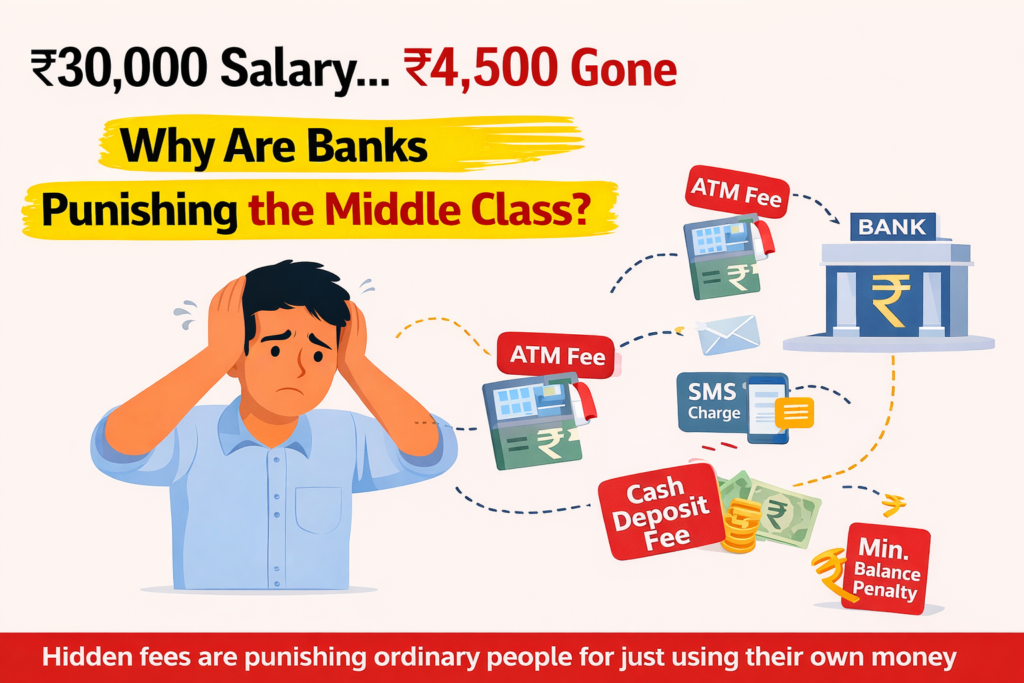
Last month, a friend received his salary — ₹30,000. Within a few days, ₹4,500 was gone.
Not for shopping. Not for bills.
But for bank charges – Cash deposit charges.
Minimum balance not maintained, Cash deposit charges, ATM card annual fee, SMS alert charges, Charges just for keeping money below a limit, even checking balance too many times can sometimes cost money.
And the worst part? No clear warning. No proper explanation.
This is not just one story.
This is happening to small shop owners, daily wage workers, and middle-class families across India.
A vegetable vendor deposits cash — gets charged.
A delivery boy forgets minimum balance — gets charged.
A worker withdraws money multiple times — gets charged.
Someone just wants an ATM card for easy access — still gets charged yearly.
In fact, this issue was recently raised in Parliament.
In his Rajya Sabha speech on March 16, 2026, MP Raghav Chadha called these bank penalties a “tax on poverty” and even “legalised pickpocketing.”
He revealed that banks collected over ₹19,000 crore in just three years from people who couldn’t maintain minimum balance.
He also pointed out how these charges mostly affect farmers, pensioners, and daily wage workers — people who use banks for safety, not profit — but still end up paying for SMS alerts, ATM usage, and hidden fees.
He urged the government and RBI to remove such penalties and protect small savings.
So what’s the real problem?
Banks say: “These are rules.” But for a person earning ₹20,000–₹30,000, losing even ₹500 hurts.
When people are already trying to save money, why are they paying just to use their own money?
That’s why many people still fear banks.
They feel:
- “My money is not safe.”
- “I don’t understand these deductions.”
- “Better to keep cash at home than lose it like this.”
And slowly, trust breaks.
The Mantras Take:
Banking should make life easier — not confusing or fearful.
If people are scared to keep money in banks, the system needs to change.
Money is hard-earned. Every rupee matters.
Charging people just to access or maintain their own money is not service — it feels like a burden.
If you’ve ever faced such charges please let us know in the comment box