
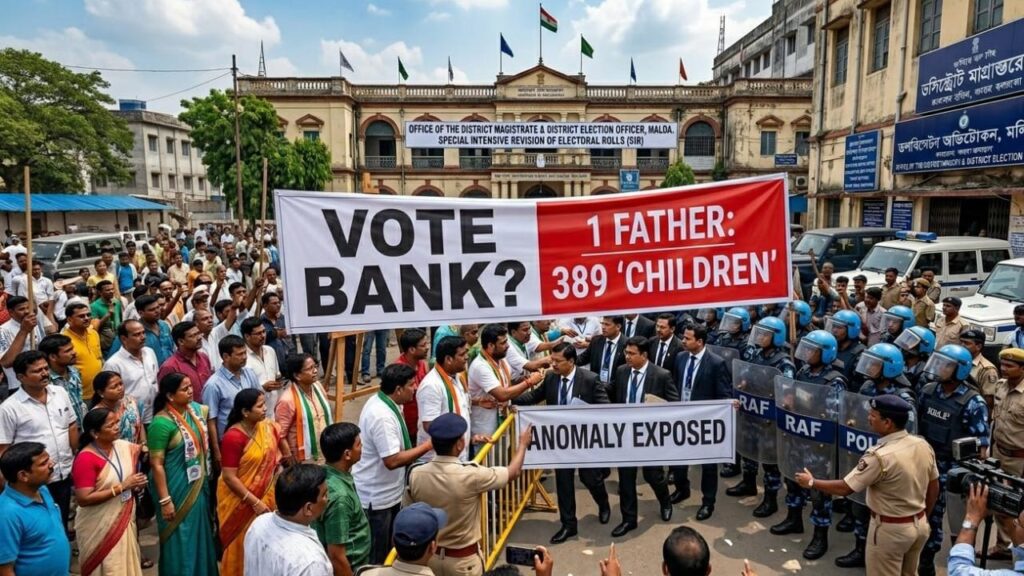
One Man, 389 “Children”: West Bengal’s Voter Roll Scandal Exposes Illegal Immigration and TMC’s Vote-Bank Politics
As West Bengal heads into the 2026 Assembly elections with polling in two phases on April 23 and April 29, and results on May 4 a sharp confrontation has broken out between Chief Minister Mamata Banerjee’s Trinamool Congress (TMC) government and the Election Commission of India (ECI). The central issue is the Special Intensive Revision (SIR) of electoral rolls, a rigorous cleanup that has exposed massive irregularities, including over 58 lakh deletions. Instead of fully supporting this effort to ensure only genuine Indian citizens exercise their franchise, the TMC has strongly opposed the process, accusing the ECI of bias, “snatching voting rights,” and working at the behest of the BJP. This standoff highlights a deeper concern: whether the ruling dispensation is prioritising the protection of a political vote bank allegedly bolstered by illegal immigrants and fake entries over the integrity of the democratic process.
Massive Irregularities Exposed by SIR
The SIR exercise has brought uncomfortable facts to light. From an electorate of around 7.66 crore, the draft rolls saw over 58 lakh names deleted roughly 7.6% of the total. (Note: Following the final roll publication on February 28, 2026, the total deletions rose to 63.66 lakh). According to ECI data, the deletions include:
- Approximately 24.17 lakh listed as deceased,
- Nearly 32.65 lakh as permanently relocated or migrated (including “shifted and absent”),
- Over 12.20 lakh as untraceable or missing,
- Around 1.38 lakh flagged as duplicates, fictitious, or fraudulent.
Thousands more failed to appear for verification hearings despite notices. Even after the final roll was published, a significant number of entries approximately 60 lakh cases remain under adjudication. To handle this, the Supreme Court has deployed over 500 judicial officers to act as Election Registration Officers.
The most striking anomalies involve impossible family linkages that point to systematic manipulation:
- In Barabani (Asansol), one individual was recorded as the father of 389 voters.
- In Bally (Howrah), another was listed as parent/guardian to 310 voters.
The ECI has flagged several such “scientifically impossible” cases where a single person was linked to over 100 “children.” While genuine errors deserve fair redressal, these extreme cases suggest bulk fake entries padded into the rolls, often in sensitive areas.
Illegal Immigration: A Persistent Challenge for West Bengal
West Bengal shares a 2,200-km porous border with Bangladesh, which has facilitated decades of undocumented migration. Intelligence reports and demographic trends indicate that inflows driven by economic factors, weak enforcement, and alleged political patronage have gone beyond natural population growth.
This has created real problems on the ground:
- Demographic shifts in border districts such as Murshidabad, Malda, North Dinajpur, and parts of the 24 Parganas.
- Strain on resources: Increased pressure on land, jobs, and public services has contributed to local tensions.
- Security concerns: Some pockets have been linked to radicalization risks and cross-border networks.
Critics argue that once undocumented migrants obtain identity documents, they become part of the electorate. This distorts political representation, dilutes the voice of long-term residents, and influences outcomes in key constituencies. The SIR process directly challenges such entries, which explains much of the resistance.
Why the Sitting Government Has Opposed the Cleanup
Mamata Banerjee and the TMC have framed the SIR as an attack on minorities, the poor, and Bengal’s identity. The government has urged mass appeals and resisted large-scale transfers of senior IAS and IPS officers including 13 District Collectors and 18+ IPS officers ordered by the ECI to counter “administrative inertia” and ensure neutrality. Protests have occasionally turned tense, with the Supreme Court criticising instances of state failure in protecting judicial officers handling appeals, particularly after a violent gherao in Malda in early April 2026.
This pattern has led many to infer a strategic motive: safeguarding a vulnerable support base. For years, the TMC has faced accusations of sheltering illegal Bangladeshi immigrants in exchange for electoral loyalty. By opposing rigorous verification, neutral administration, and removal of bogus entries, the government appears to be prioritising political retention over transparent electoral reforms.
The Road Ahead for Democracy in Bengal
Accurate and verifiable voter lists are the foundation of any democracy ensuring one citizen, one vote. When absurd anomalies like “super-families” surface and a government fights hard against their removal, it raises serious questions about willingness to let neutral processes run freely. Illegal immigration exacerbates the issue by straining resources, altering local demographics, and potentially distorting electoral outcomes.
West Bengal deserves elections that truly reflect the will of its genuine citizens. A balanced approach robust protection and easy redressal for genuine voters alongside firm action against duplicates, deceased entries, and ineligible ones would strengthen democracy. As polling dates approach, the ECI’s efforts, judicial oversight, and commitment to free and fair polls will be crucial.
The people of Bengal have the right to expect cleaner politics, not one shaped by infiltration or manipulated rolls. A purified voter list could be an important step toward restoring faith in the electoral system.