
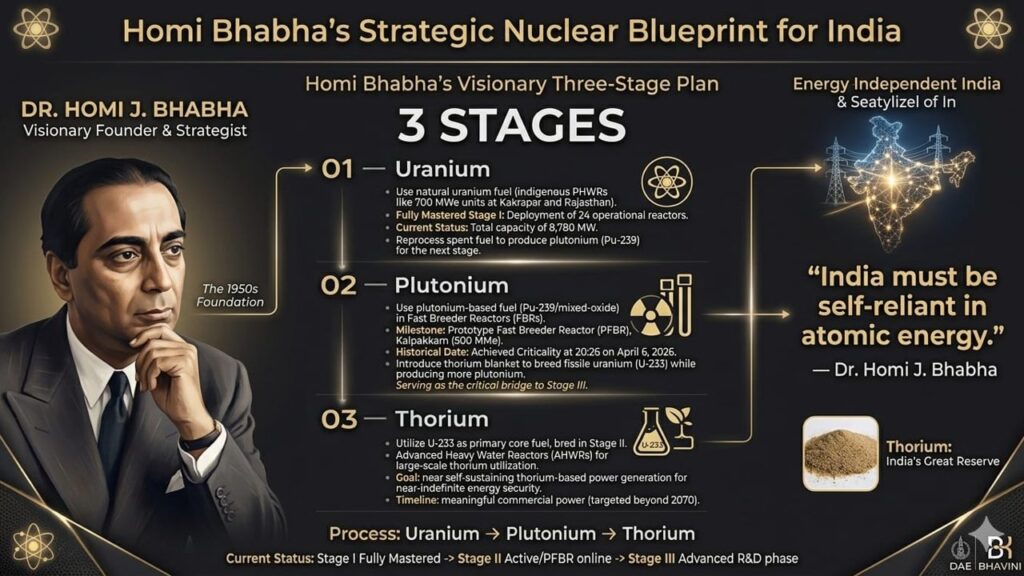
On a quiet evening in April 2026, India lit a historic atomic fire. The indigenously designed Prototype Fast Breeder Reactor (PFBR) at Kalpakkam achieved first criticality the moment a self-sustaining nuclear chain reaction began in a reactor that produces more fuel than it consumes. Prime Minister Narendra Modi called it a ‘defining step’ in India’s civil nuclear journey. In one stroke, the nation joined an ultra-elite global club and took a decisive leap toward complete energy self-sufficiency powered by its vast thorium reserves.
On April 6, 2026, India crossed a defining milestone in its pursuit of energy independence. The Prototype Fast Breeder Reactor (PFBR) at Kalpakkam, Tamil Nadu, achieved first criticality at 20:26 hours, marking the start of a self-sustaining nuclear chain reaction. Prime Minister Narendra Modi described it as a “defining step” in India’s civil nuclear journey a proud moment for the nation’s scientists and engineers.
The achievement was marked in the presence of key leaders including Dr. Ajit Kumar Mohanty (Secretary, DAE), Shri Sreekumar G Pillai (Director, IGCAR), and Shri Allu Ananth (CMD-In-Charge, BHAVINI).
This fully indigenous 500 MWe reactor, developed by Bharatiya Nabhikiya Vidyut Nigam Limited (BHAVINI) under the Department of Atomic Energy, signals India’s successful entry into Stage II of its visionary three-stage nuclear power programme. Once fully commissioned (targeted by September 2026 following a series of rigorous low-power physics tests), it will position India as only the second country after Russia to operate a commercial-scale fast breeder reactor.
The Three-Stage Nuclear Programme: A Strategic Vision
Conceived by Homi J. Bhabha in the 1950s, the programme was designed to overcome India’s limited uranium reserves while capitalising on one of the world’s largest thorium deposits (nearly 25% of global reserves, found mainly in coastal monazite sands). It follows a closed fuel cycle to maximise resource efficiency.
- Stage I – Pressurised Heavy Water Reactors (PHWRs): India has fully mastered this stage using natural uranium. Recent highlights include the successful deployment of indigenous 700 MWe units at Kakrapar and Rajasthan. India’s current nuclear capacity stands at 8,780 MW across 24 operational reactors.
- Stage II – Fast Breeder Reactors (FBRs): The PFBR uses plutonium-239 (produced in Stage I) to “breed” more fissile material than it consumes via fast neutrons. This multiplies India’s fuel inventory efficiently and serves as the critical bridge to the next stage.
- Stage III – Thorium-Based Reactors: The ultimate goal: converting abundant thorium-232 into fissile uranium-233 for near self-sustaining power generation.
A Rare Global Achievement
Fast breeder technology has proven extremely challenging worldwide. Only Russia has sustained long-term commercial-scale operations with its BN-600 (since 1980) and BN-800 reactors.
Many nations including France (Superphénix), Japan (Monju), the United States, United Kingdom, and Germany — built experimental or prototype fast reactors but ultimately scaled back or abandoned them. China continues to advance with demonstration units (CEFR and CFR-600) but has not yet achieved sustained commercial-scale breeding.
Why did most fail?
- Complex technical issues with high-temperature liquid sodium coolant (which reacts violently with water and air, causing leaks and fires).
- High capital costs and lengthy delays.
- Cheaper-than-expected uranium supplies that reduced the urgency for breeding.
- Safety concerns, public opposition, and non-proliferation issues related to plutonium handling.
India’s fully indigenous PFBR stands out as a remarkable success, achieved despite delays through persistent R&D and national commitment.
Why This Milestone Matters for Energy Self-Sufficiency
India’s electricity demand is rising rapidly due to economic growth, industrialisation, and urbanisation. Nuclear power currently contributes only about 3% of the electricity mix, while the country remains heavily dependent on coal and imported fossil fuels.
The three-stage programme offers a strategic solution:
- Domestic Resource Leverage: It shifts reliance from scarce uranium to abundant thorium, potentially providing centuries of clean energy. Economically extractable thorium reserves could support hundreds of gigawatts sustainably.
- Reduced Import Dependence: The closed fuel cycle minimises waste and cuts vulnerability to global uranium markets and geopolitical risks.
- Ambitious Capacity Growth: It supports the target of 100 GW nuclear capacity by 2047 more than a 10-fold increase from today’s 8,780 MW.
- Clean & Reliable Baseload Power: Nuclear complements renewables with low-carbon, round-the-clock electricity, aiding the net-zero emissions goal by 2070.
- Economic & Strategic Benefits: It strengthens “Atmanirbhar Bharat” through domestic manufacturing, high-tech jobs, and lower energy import bills.
Roadmap for Stage III (The Thorium Era)
Stage III is currently in the advanced R&D and design validation phase. The flagship technology is the Advanced Heavy Water Reactor (AHWR) a 300 MWe design featuring passive safety systems and high thorium utilisation (with options for Th-Pu or Th-U-233 fuels).
- Design work by BARC is largely complete, with physics experiments and peer reviews ongoing.
- Large-scale deployment requires a substantial buildup of fissile material (primarily U-233), which will come from sustained operations of multiple fast breeder reactors in Stage II.
- Experts project meaningful commercial thorium-based power generation beyond 2070, though a demonstration AHWR or pilot projects could materialise earlier once the FBR fleet expands (including planned follow-on 500–600 MWe units).
- Parallel efforts include exploring molten salt reactor concepts and integrating thorium into Small Modular Reactors (SMRs) under the broader Nuclear Energy Mission.
This deliberate, phased approach prioritises safety, economic viability, and optimal use of resources before full thorium rollout.
A Proud Chapter in Viksit Bharat
As Homi Bhabha envisioned decades ago, the programme transforms resource constraints into national strength. With the PFBR now critical, India has taken a decisive step toward a future powered by indigenous technology and vast thorium reserves.
This is more than a technological milestone. It is a strategic blueprint for long-term energy sovereignty, economic resilience, environmental sustainability, and global leadership in advanced nuclear science.
The atomic age of true self-sufficiency has begun.