On February 27, 2026, U.S. President Donald J. Trump directed every federal agency to immediately stop using artificial intelligence technology developed by Anthropic, the company behind the Claude AI model.What’s Behind Trump’s Move Against Anthropic’s AI?
Written By: Vaishak Kaverappa on February 28, 2026
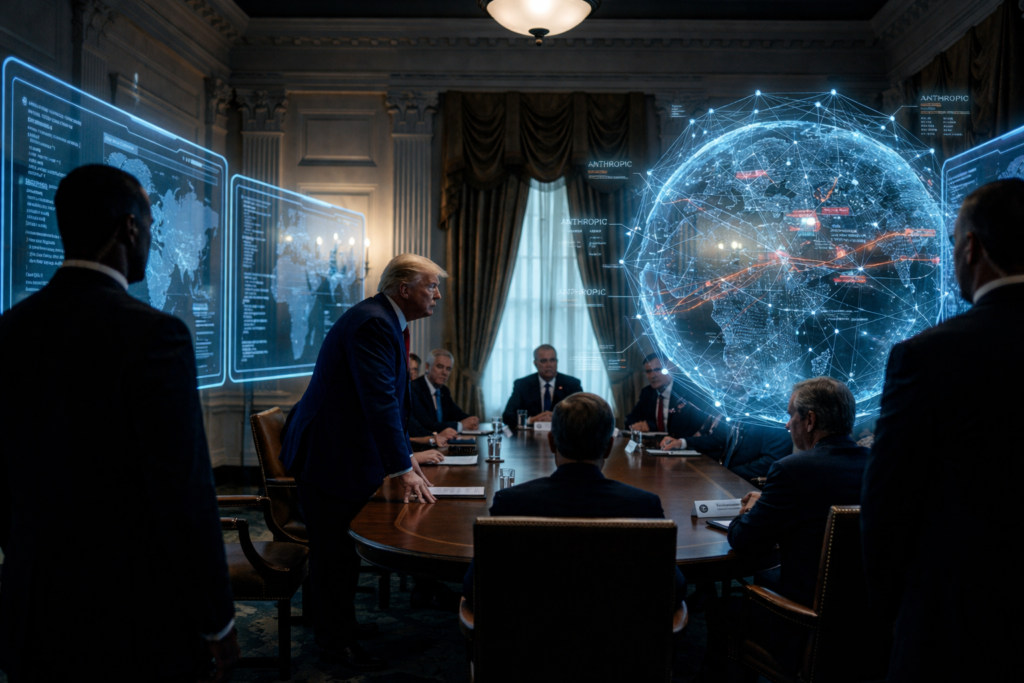
In a post on Truth Social, Trump wrote:
“I am directing EVERY Federal Agency in the United States Government to IMMEDIATELY CEASE all use of Anthropic’s technology. We don’t need it, we don’t want it, and will not do business with them again!”
He accused the company of being a “Radical Left, woke company” and claimed its refusal to comply with Pentagon demands was “putting American lives at risk and our national security in jeopardy.”
Reuters reported the statement as: https://www.yahoo.com/news/articles/trump-says-directing-federal-agencies-205606785.html?utm_source=chatgpt.com
According to the directive, federal agencies must phase out Anthropic’s technology within six months.
What Is the Core Issue?
Beyond the political tone, verified reporting points to a specific conflict between Anthropic and the Pentagon.
The Pentagon reportedly sought unrestricted access to Anthropic’s AI models for lawful military applications. This could include:
- Domestic surveillance systems
- Autonomous weapons systems
- Expanded defense automation
Anthropic declined to remove certain built-in safety guardrails.
CEO Dario Amodei publicly stated the company could not agree “in good conscience” to allow its AI to be used in ways that might undermine civil liberties or operate without meaningful human oversight.
In short:
- The Pentagon wanted broader operational flexibility.
- Anthropic insisted on ethical constraints.
- The disagreement escalated into a public directive.
Is This About Politics — or Policy?
Trump’s language was strongly political. He labeled the company “woke” and “leftwing.”
However, documented explanations from both Pentagon officials and Anthropic leadership center on AI safety, oversight, and ethical boundaries, not partisan ideology.
So the real tension appears to be:
- Military operational control
- AI guardrails and risk mitigation
- The limits of government authority over private AI systems
The political framing may amplify the message, but the underlying dispute is technical and regulatory.
Could Broader Market Forces Be Involved?
Another question worth asking:
Is this purely a military AI ethics clash — or part of a larger shift in the AI power landscape?
Across the industry, advanced AI models are increasingly capable of handling legacy enterprise languages such as COBOL — historically associated with firms like IBM and large modernization contracts.
If generative AI significantly reduces the cost of modernizing legacy systems, that could disrupt traditional enterprise revenue streams.
However, there is no verified reporting linking IBM’s stock performance or enterprise market pressures directly to this Trump–Anthropic dispute.
At this stage, any connection would be speculative. There is no confirmed evidence pointing beyond the documented military disagreement.
So we are left with open possibilities:
- Is this simply a Pentagon–AI safety standoff?
- Is it a signal about government control over powerful AI systems?
- Or is it part of a deeper restructuring of the defense-AI ecosystem?
What Happens Next?
Several major questions remain unanswered:
1. What happens to Anthropic’s reported $200 million defense contract?
Will it be terminated completely, or renegotiated?
2. Can federal law compel AI compliance?
Do emergency powers apply to AI behavior design?
3. How will this affect the broader AI industry?
Companies like OpenAI and other defense-adjacent AI firms are closely watching this development.
4. Will Congress or the courts intervene?
Legal challenges or legislative responses are possible if enforcement is attempted.
The Mantras Take
This is not just a political headline. This moment touches on larger themes:
- Who controls advanced AI systems — governments or companies?
- Can AI firms enforce ethical limits against state demands?
- Where is the boundary between national security and civil liberties?
- How will AI regulation evolve in 2026 and beyond?
The Trump–Anthropic clash may become a defining case study in the future of AI governance.
For now, it remains an unfolding story.
More answers are likely coming.
This article gave me a good overview of the issue, thanks for sharing.