
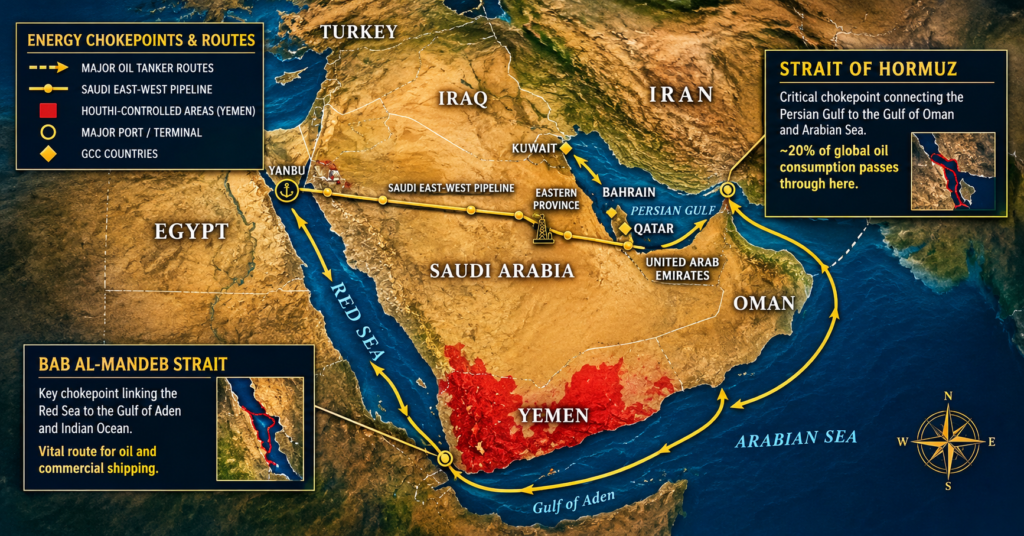
In September 2026 the Iran-backed Houthis seized Yemen’s Red Sea coast and Perim Island inside the Bab al-Mandeb Strait while drone strikes forced the temporary shutdown of Saudi Arabia’s East-West Pipeline. The moves placed simultaneous pressure on two of the world’s most important energy and shipping routes. For the GCC and for global markets, reducing the Houthi threat is strategically valuable. Achieving that reduction is far more difficult than the importance of the goal suggests.
The Strategic Stakes
Bab al-Mandeb normally carries roughly 6–7 million barrels of oil per day plus major container traffic. Houthi control or disruption of the strait forces ships around the Cape of Good Hope, adding one to two weeks and sharply higher fuel and insurance costs. The impact is especially severe for Saudi Arabia, which increased Red Sea exports to offset disruptions in the Strait of Hormuz.
The East-West Pipeline is the main Hormuz bypass. It can move 4–7 million barrels per day to the Red Sea port of Yanbu. After attacks in September it was shut as a precaution. Saudi officials later reported that flows had been restored to about 5.8 million barrels per day, yet the route remains exposed. Losing reliable access to both Hormuz and the Red Sea at the same time would cut Saudi export capacity, tighten global oil markets, and push prices higher.
Those price effects travel far beyond the Gulf. In 2026 the combined disruptions have repeatedly driven oil above $100 per barrel. Higher energy costs raise inflation, increase transport and manufacturing expenses, and slow growth in oil-importing economies. GCC revenues benefit from elevated prices in the short term, but physical interruptions still damage reliable export planning.
The Houthis also function as Iran’s most effective low-cost proxy. By striking Saudi energy infrastructure, airports, and Red Sea shipping they raise global energy costs and apply pressure without requiring direct Iranian confrontation. In early October a Houthi strike on Riyadh’s King Khalid International Airport killed at least 12 people and injured more than 300, forcing a suspension of operations. Continued attacks of this kind risk wider escalation that could affect other GCC states dependent on the same shipping lanes.
Why Elimination Is Extremely Difficult
The strategic value does not make the military and political task straightforward. Several structural factors make neutralizing the Houthi threat unusually hard.
The group operates from Yemen’s rugged mountains and relies on relatively cheap drones, missiles, and small units that are difficult to destroy completely with airstrikes. It has repeatedly absorbed heavy bombing and regenerated capacity. Iranian weapons, training, and advice have improved its range and accuracy, and it has developed some local production ability for drones and missiles.
Saudi Arabia and its partners have fought the Houthis for more than a decade. The campaign that began in 2015 was long, expensive, and inconclusive. Recent Houthi advances along the Red Sea coast exposed weaknesses in Saudi-backed Yemeni forces and gaps in intelligence. Airstrikes can degrade capabilities but have not eliminated them. A large-scale ground campaign would be costly in lives and resources and would risk another prolonged quagmire. Diplomatic efforts have not stopped the attacks, and direct U.S. military involvement has remained limited despite Saudi requests for greater support.
Political and international constraints add further difficulty. Full-scale escalation risks wider regional war, significant civilian casualties, and international criticism. Yemen’s fragmented politics and severe humanitarian crisis complicate any sustained effort. The Houthis’ ability to continue low-cost attacks even under pressure means that partial degradation may not restore reliable shipping or energy flows.
The Bottom Line
The Houthis currently sit next to routes that carry a large share of the world’s oil and goods. Neutralizing their ability to disrupt those routes would improve energy security for the GCC, reduce Iran’s regional leverage, and lower the risk premium in global oil markets. At the same time, their terrain, tactics, external backing, and the inconclusive results of more than a decade of prior campaigns mean that elimination would require a long, expensive, and uncertain effort with no guarantee of lasting success. The strategic importance is clear. The practical difficulty of achieving it is equally clear.