
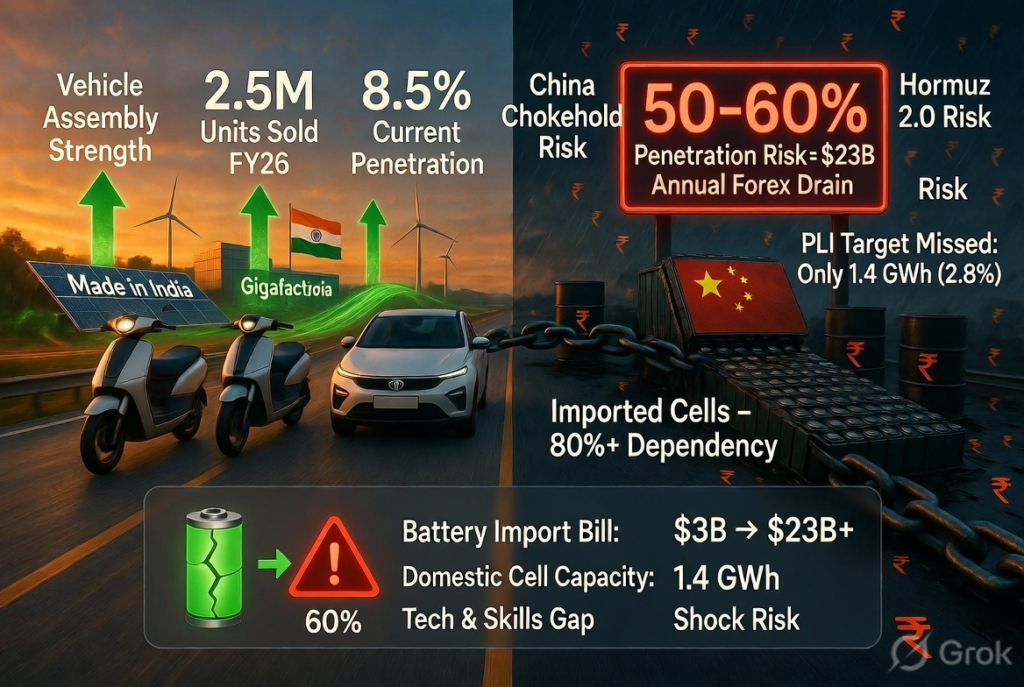
India’s electric vehicle (EV) momentum is undeniable. In FY2025-26, EV registrations crossed 2.5 million units a 24-25% year-on-year increase pushing overall penetration to 8.5%. Two- and three-wheelers still drive the bulk of volumes, while passenger EV penetration hovers around 4.5-5.1%. The government’s 30% target by 2030 remains ambitious but within reach on the vehicle side. Yet this success story masks a critical vulnerability: India remains almost entirely dependent on imported lithium-ion battery cells, overwhelmingly from China. As penetration scales toward 50-60% in the next decade, this dependency risks becoming a far costlier and more dangerous “petroleum 2.0”—one that could widen the Current Account Deficit, drain foreign exchange, destroy high-value manufacturing opportunities, and expose national security to supply shocks.
The Current Reality: Vehicle Assembly Strength, Battery Cell Weakness
India has scaled respectable capacity in battery pack assembly (~60 GWh) and vehicle manufacturing. But the high-value heart battery cells remains imported at 75-84%. Under the ₹18,100-crore PLI-ACC scheme (target: 50 GWh by 2025), only 1.4 GWh (just 2.8% of target) has been commissioned as of early 2026, entirely by Ola Electric’s partial line. No incentives have been disbursed because domestic value-addition (DVA) thresholds remain unmet. Ola has scaled back its own plans dramatically to just 5 GWh until FY2029. Other beneficiaries lag further, with most activity still limited to land acquisition and pack assembly.
Lithium imports alone surged to ₹37,624 crore in FY26 (a near-tenfold rise since FY2019). The overall battery import bill has already crossed $3 billion annually, with China supplying the vast majority.
The Scaling Trap: What 50-60% Penetration Really Means
At today’s ~8.5% penetration and ~20 GWh annual battery demand, the import burden is growing but manageable. Scale to 50-60% EV penetration (plausible by 2032-35 as total vehicle sales reach 35-40 million units) and the numbers become alarming:
- Annual EV sales could hit 15-20+ million units.
- Battery demand explodes to 200-272 GWh (10-14× current levels).
- Without aggressive localisation, the annual forex outflow on cells alone could exceed $23 billion (at ~$85/kWh landed costs) a recurring capital hit on top of residual oil imports.
This is not just substitution; it is front-loaded exposure. Batteries last 8-15 years and are recyclable, unlike oil, but the transition window is narrow. Current trends suggest domestic cell output may cover only 13-20% of demand even by 2030. At high penetration without change, the “petroleum 2.0” critique becomes reality: massive forex leakage, supply volatility, and lost economic multipliers.
Core Challenges: Technology Gap, Policy Failure, and Strategic Fragility
- Technology & Skills Deficit: India lacks proven, scalable cell manufacturing know-how. Electrochemistry, gigafactory processes, and quality control remain imported. A massive human capital gap exists India needs 50,000+ specialised battery engineers and technicians, yet skilling programmes lag far behind gigafactory plans. Visa delays for foreign experts compound the problem.
- PLI-ACC Execution Failure: Aggressive timelines, stringent DVA rules, and inexperience among early winners have delivered just 2.8% of the target after four years.
- Low Domestic Value Addition & Job Quality: Current “manufacturing” is mostly low-value pack assembly (20-30% value add). True cell production would deliver high-skill, high-wage jobs and stronger GDP multipliers opportunities currently lost to China.
- Upstream Mining Lag: Lithium reserves in Reasi (J&K) and Katghora (Chhattisgarh) are promising, but commercial output remains 5-10 years away.
- China’s Chokehold: Beijing controls ~68% of global cell capacity and dominates upstream processing. Recent export curbs on battery technologies, machinery, graphite, and critical materials have already raised costs and delayed projects. A border flare-up or strategic ban would mirror (or exceed) a Hormuz-style shock.
The Geopolitical Nightmare: A China Blockade = Hormuz 2.0 for EVs
In a conflict or escalated trade war scenario, new EV production would halt overnight. Replacement packs for the existing fleet would dry up. Two-wheelers the backbone of India’s EV story would be hit hardest. Recent global analyses show even a moderate 30% China supply shock could trigger 25%+ worldwide battery shortages. India, with negligible domestic cells, would suffer disproportionately. This is no longer hypothetical China has repeatedly weaponised critical mineral and battery-tech exports.
Urgent precautions: What India must do now before the tipping point
The window for corrective action is closing fast. Here is a prioritised, time-bound action plan:
- Fast-Track Genuine Cell Manufacturing: Enforce PLI-ACC with penalties for delays and relax initial DVA thresholds while mandating technology transfer. Target 20 GWh of operational cell capacity by 2028 and 100 GWh by 2030 through public-private JVs with proven global players.
- Build Strategic Reserves Immediately: Create 6-12 month buffers for lithium, cobalt, nickel, cells, and key machinery already under discussion; accelerate implementation by Q4 2026.
- Accelerate Recycling as a National Security Lever: Strengthen Battery Waste Management Rules with 90%+ recovery targets under Extended Producer Responsibility. Leverage the recent eligibility of 58 companies under the National Critical Mineral Mission to turn “urban mines” into a domestic supply source potentially offsetting 20-30% of demand within a decade.
- Diversify Upstream & Localise Components: Fast-track lithium mining clearances with safeguards. Double overseas acquisitions via KABIL. Launch a dedicated PLI for cathodes, anodes, electrolytes, and machinery.
- Massive Skilling Drive: Launch a national battery technology mission to train 50,000+ engineers and technicians by 2028, modelled on successful semiconductor skilling programmes.
- Learn from Global Peers: Adopt China-style aggressive subsidies + local-content mandates, combined with US/EU-style incentives tied strictly to domestic value addition and technology transfer.
- Policy & Monitoring Overhaul: Selectively raise cell import duties while protecting genuine localisation. Mandate annual “battery security audits” by NITI Aayog, stress-testing 50-60% penetration scenarios under supply disruptions.
The Opportunity: From Vulnerability to Global Leadership
EVs remain India’s smartest strategic bet for energy security, lower emissions, and a new high-tech manufacturing ecosystem. Done right with cells, materials, IP, and skills made in India this could create hundreds of thousands of quality jobs, slash oil imports by tens of billions, and position India as an EV and battery exporter to the Global South. The two-wheeler dominance gives India a unique low-cost advantage no other major economy enjoys.
But momentum without battery sovereignty is reckless. At 50-60% penetration, the import trap will snap shut unless decisive action begins today. India has the market scale, the capital, and the political will. The only question is whether policymakers and industry will treat battery localisation as the national security imperative it truly is—before the next geopolitical shock turns ambition into dependence.