
In 2026, India–Israel ties are accelerating faster than ever—but not for the reasons most people think. The biggest gains are happening in agriculture, healthcare, and trade. Read More.
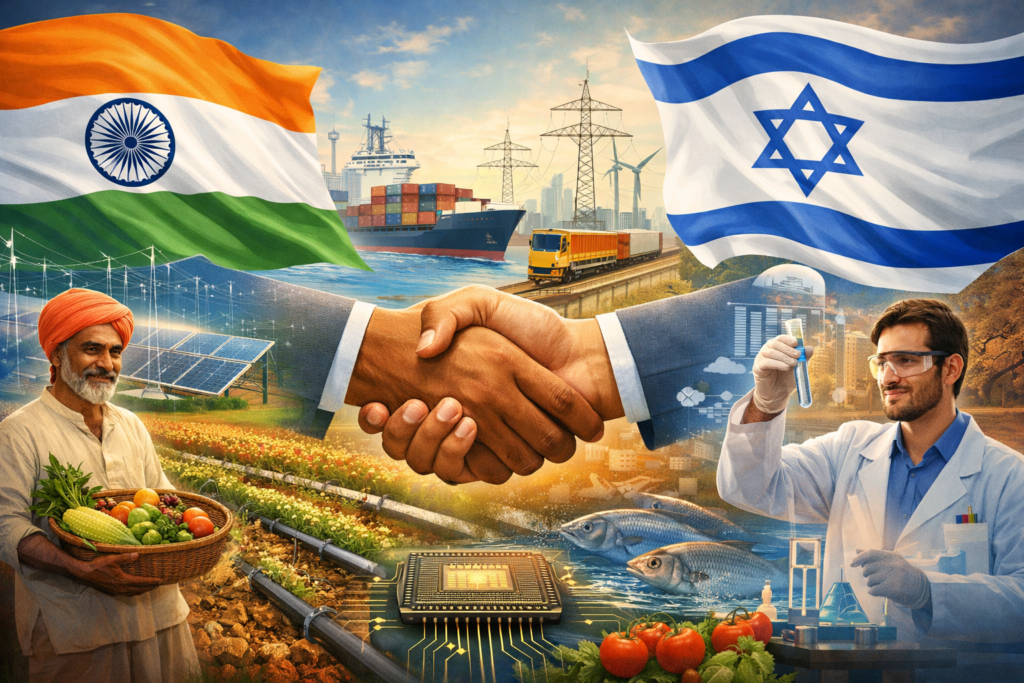
Defence grabs headlines in India–Israel ties, but the real story is the practical cooperation transforming Indian agriculture, healthcare, technology, and trade.
While many focus only on missiles and drones, the partnership delivers direct, everyday benefits to Indian farmers, patients, engineers, and the economy—driven purely by mutual needs, not ideology.
This is a classic business-style alliance:
- Israel provides cutting-edge innovation and expertise
- India brings massive market scale, talent, and growing demand
With high-level momentum in 2025–2026, the ties are accelerating fast.
Recent Momentum in Early 2026
On January 7, 2026, Prime Minister Narendra Modi and Israeli Prime Minister Benjamin Netanyahu held their first phone call of the year, exchanging New Year greetings and reaffirming commitment to deepen the strategic partnership. Netanyahu described it as a “deep partnership” with “boundless potential” and expressed eagerness for an in-person meeting in the near future.
The two leaders identified shared priorities to further strengthen the India–Israel Strategic Partnership in the year ahead, guided by shared democratic values, deep mutual trust, and a forward-looking vision.
They reiterated their zero-tolerance approach towards terrorism in all its forms and manifestations and reaffirmed their commitment to fight this menace. They also exchanged views on the regional situation, including the implementation of the Gaza peace plan.
The Indian Embassy in Israel called 2025 a “landmark” year, marked by:
- High-level visits
- Signing of the Bilateral Investment Treaty (BIT)
- Defence Cooperation MoU
- Finalized Terms of Reference for Free Trade Agreement (FTA) talks
- Successful CEOs’ Forums
A Joint Working Plan now guides deeper cooperation in technology, trade, agriculture, and more—setting the stage for even stronger progress in 2026.
Cultural and people-to-people links are also growing steadily, with:
- International Yoga Day events
- Bharat Corners at Israeli universities
- New direct flights to Tel Aviv
India–Middle East–Europe Economic Corridor (IMEC): A Strategic Link
The India–Middle East–Europe Economic Corridor (IMEC)—announced at the 2023 G20 Summit in New Delhi and backed by India, the US, UAE, Saudi Arabia, Israel, and European partners—adds a major economic dimension to the partnership.
This multi-modal route connects:
- India’s western ports to the UAE by sea
- Rail networks through Saudi Arabia, Jordan, and Israel (key hub: Haifa Port)
- Onward connectivity to Greece and Europe
It includes:
- Railways
- Undersea data cables
- Electricity grids
- Clean hydrogen pipelines
IMEC offers faster, more secure trade than some traditional routes, while reducing dependence on chokepoints like the Suez Canal.
Israel’s role as a transit point strengthens connectivity, energy security, and digital links for India. Though regional conflicts caused delays, discussions continue into 2026, with leaders highlighting IMEC’s potential for regional stability, integration, and long-term supply chain resilience.
Agriculture & Water: Real Help for Indian Farmers
Israel’s world-leading technology directly addresses India’s core challenges: water scarcity, low yields, and climate stress.
Key collaborations include:
- Indo-Israeli Centers of Excellence (CoEs)
Over 35 fully functional across Indian states, demonstrating drip irrigation, precision farming, post-harvest technologies, and more. The 2024–2026 Work Plan continues expanding these centers. - Fresh Agreements
In April 2025, ties deepened in soil and water management, horticulture, mechanization, and animal husbandry.
On January 15, 2026, Union Minister Rajiv Ranjan Singh and Israeli Minister Avi Dichter signed a Letter of Intent (LoI) covering agriculture, fisheries, and the blue economy—focusing on smart water management, innovation, startups, sustainable fishing, and capacity building. This builds on the “Blue Food Security: Sea the Future 2026” summit in Eilat. - Jain Irrigation’s Major Tie-Up
Jain Irrigation Systems Ltd. acquired 50% of Israel’s NaanDan Irrigation Systems in 2007 (forming the NaanDanJain JV), then bought the remaining 50% in 2012 for ~$35 million—bringing advanced Israeli drip and sprinkler technology to Indian farms.
Thanks to these collaborations, pilot projects in states like Rajasthan and Maharashtra have shown:
- 40–50% water savings
- 30–100% higher crop yields
These are direct, measurable wins for millions of Indian farmers facing drought, rising input costs, and climate variability.
Technology & Innovation: From Acquisitions to Big Ventures
Israel’s “Startup Nation” strength aligns naturally with India’s scale.
- Infosys–Panaya Acquisition (2015)
Infosys acquired Israeli SaaS firm Panaya for ~$200 million, gaining automation tools for SAP, Oracle, and Salesforce upgrades—helping reduce risk, cost, and complexity. - Tower Semiconductor & Adani Proposal
Tower Semiconductor partnered with Adani Group on a proposed $10 billion semiconductor fab in Maharashtra, approved in 2024. Though paused in 2025 due to demand concerns, the project reflects strong intent for joint manufacturing and long-term self-reliance. - Broader Technology Engagement
Joint R&D in AI, cybersecurity, biotech; the I4F fund; hackathons; and CEO Forums continue to push collaboration across sectors.
If revived or replicated, such fabs could create thousands of high-skill jobs and reduce India’s dependence on imported semiconductors.
Healthcare: Better Access and Green Solutions
Healthcare cooperation focuses on practical, scalable solutions.
- Health & Medicine Agreement
Covers training, expertise exchange, facility development, and Green Healthcare—climate-resilient hospitals and systems. - Israeli Strengths
AI diagnostics, stem cells, and tissue engineering feed into Indian collaborations—enabling affordable diagnostics and eldercare solutions. - Indian Pharma Giants’ Deep Ties
- Sun Pharmaceutical Industries holds a controlling stake in Taro Pharmaceutical Industries Ltd., giving access to specialty generics expertise.
- Dr. Reddy’s Laboratories acquired a stake in Israeli biotech Edity Therapeutics for advanced protein delivery technology.
These ties help deliver affordable specialty medicines and biotech solutions to millions of Indian patients.
Ports & Infrastructure: Global Economic Reach
- Adani Ports’ Haifa Acquisition
India operates a key Mediterranean port, strengthening trade routes and strategic presence. - Broader Infrastructure Links
Israeli technology in water and energy projects, and growing Indian participation in Israeli tenders.
Defence Cooperation: Key Pillar with Joint Successes and Future Plans
Defence cooperation has evolved from a buyer-seller model to joint development and co-production.
- Barak-8 Success Story
Co-developed by Israel and India, produced in India, and fully operational after multiple successful tests in 2025—proven performance, shared technology, real deterrence. - Major Future Joint Development Plans
The November 2025 Defence MoU expands cooperation into AI, cyber, R&D, and indigenous manufacturing—covering LMGs, carbines, UAVs, radars, and smart weapon systems.
Why This Matters: Logic Over Hype Defence is vital—but the broader partnership across agriculture, healthcare, technology, ports, and IMEC delivers everyday impact for Indian farmers, patients, engineers, and traders. This is cooperation grounded in logic, clarity, and measurable outcomes.
The Mantras Take
At its core, the India–Israel partnership succeeds because it is guided by logic rather than ideology, outcomes rather than optics, and long-term thinking rather than short-term noise. It focuses on solving real problems—water scarcity, food security, affordable healthcare, technological gaps, and secure trade routes—where innovation meets scale and intent meets execution. While defence cooperation may dominate headlines, the true strength of this relationship lies in its quiet, practical impact on everyday lives, from farmers and patients to engineers and entrepreneurs. In a world often driven by rhetoric, this partnership stands out for delivering results, built on mutual trust, shared needs, and a clear-eyed vision of sustainable growth for the decades ahead.
Informative
Strong focus on practical outcomes (farmers, healthcare, trade)
Impressive analysis and really informative post.