
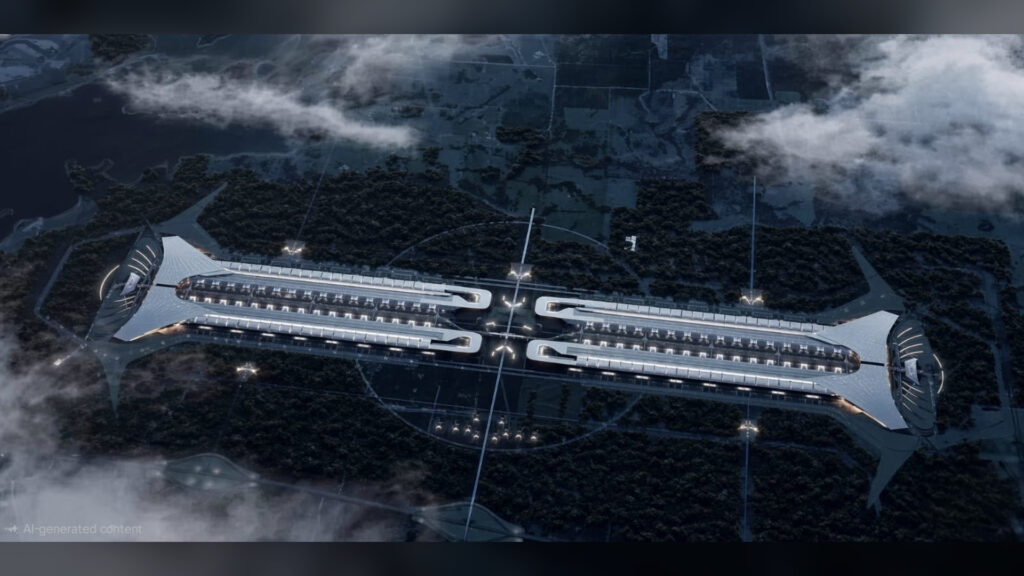
On a former coal-plant site in rural Texas, Tesla and SpaceX are quietly assembling what could become the world’s largest private AI chip factory a multi-phase complex that may cost up to $119 billion and is designed to produce one terawatt of custom computing power per year for Optimus robots, autonomous vehicles, and space systems.
On more than 6,000 acres in Grimes County, Texas, surrounding the former Gibbons Creek coal plant, Tesla and SpaceX are attempting a project no private company has pulled off at this scale in a generation: a fully vertically integrated advanced semiconductor complex that designs, fabricates, packages, and tests its own leading-edge AI chips. Announced in March 2026, with an initial confirmed investment of more than $16.8 billion and multi-phase filings that point to a potential total of $55–119 billion, Terafab is not a conventional foundry. It is captive capacity aimed at one terawatt of AI computing power per year, primarily for Tesla vehicles, Optimus humanoid robots, and SpaceX systems.
If it reaches even a meaningful fraction of that ambition, it would rank among the largest single industrial investments in U.S. history and move a strategically critical slice of advanced AI silicon production under American control.
The Scale Being Attempted
The main campus is planned as a roughly 100-million-square-foot complex, far larger than Tesla’s existing Giga Texas. Land assembly has already exceeded 6,000 acres inside a much larger reinvestment zone. Power and water demands at full build-out are extreme: continuous power in the multi-gigawatt range and tens of millions of gallons of water per day, supplied by on-site generation and the reservoir rather than the public grid.
The economic footprint matches the physical one. Thousands of high-skill jobs are projected across phases, along with the supplier ecosystem that follows a large fab. Local tax agreements exchange a decade of abatements for a minimum investment floor and job commitments. At the upper end of the capital range, the project would represent a significant share of a full year of global semiconductor capital spending.
A smaller research fab is already advancing near Giga Texas in Austin. The Grimes County site is reserved for high-volume manufacturing once the process is proven.
Technology and Partners
Intel is the indispensable process partner. Tesla and SpaceX plan to use Intel’s 14A node, a leading-edge process still maturing, for the advanced logic portion of their custom AI chips. Musk has described 14A as the right long-term choice because it should be mature by the time volume production begins. Intel’s involvement supplies the manufacturing process expertise that Tesla and SpaceX do not possess in-house.
The companies have stated they will build and operate the fab themselves. Discussions with TSMC have occurred, but Musk has limited any potential role to subleasing capacity rather than handing over operations or process technology. Equipment and materials suppliers, including Korean firms for various process tools, are being lined up, while Chinese suppliers have been excluded. The project remains dependent on specialized global equipment makers, most notably ASML for lithography.
What It Will Actually Produce
Terafab is focused on custom chips designed by Tesla and related entities rather than competing as an open foundry for every external customer. The product set centers on AI5 and AI6 inference chips optimized for edge computing in Tesla vehicles and Optimus robots, plus radiation-hardened or higher-power variants for space applications. The campus is planned to integrate logic fabrication, memory, advanced packaging, and testing under one roof, an uncommon level of vertical integration.
Near-term production of current chips continues with external partners (Samsung and TSMC). Terafab is the long-term effort to bring high-volume manufacturing of these designs in-house and, eventually, to support broader AI compute needs for Tesla, SpaceX, and xAI.
Timeline and Execution Reality
Internal targets call for a first functional test chip (an SRAM-style process vehicle) around May–June 2027 at the Austin research facility, followed by volume production at the main site in the third quarter of 2028 (with a possible slip into the fourth quarter). Musk has repeatedly labeled the schedule “very aggressive” and noted large uncertainty. Leading-edge fabs historically take longer to reach high yields, and equipment delivery plus process maturity remain major variables. Many industry observers treat 2029–2030 as a more realistic window for commercially meaningful output.
Future Benefits If It Succeeds
For Tesla and SpaceX. Control over custom silicon would reduce dependence on external foundries for the highest-volume chips powering Full Self-Driving, Optimus, and future vehicle platforms. It would also support SpaceX’s plans for space-based compute and allow faster iteration on chip designs tailored to specific robotics and autonomy workloads. At scale, the cost and supply advantages of captive production could become material for high-volume products.
For Optimus and robotics. Humanoid robots are expected to require large numbers of specialized inference chips for real-time vision, control, and onboard intelligence. A successful Terafab would give Tesla a dedicated supply path for these chips as Optimus production scales, rather than competing for capacity at external foundries.
For the United States. The project would add substantial advanced AI chip manufacturing capacity on U.S. soil, reducing exposure to concentrated production in Taiwan and South Korea and limiting reliance on China-related supply chains for this segment. It would also deepen domestic process and packaging expertise through the Intel partnership and the supplier ecosystem that follows a large fab.
Broader industrial effects. A campus of this size would pull in equipment, materials, and talent, creating a new node in the U.S. semiconductor ecosystem. Success could also demonstrate that large-scale captive AI chip production is viable outside the traditional foundry model, potentially encouraging similar vertical-integration moves by other large technology companies.
Competitive and Strategic Context
A fully successful Terafab would capture demand that currently flows to Samsung and TSMC for Tesla’s custom AI chips. It is a less direct threat to NVIDIA, which designs general-purpose accelerators sold across the industry and benefits from the CUDA software ecosystem. Tesla, SpaceX, and xAI have continued placing large orders for NVIDIA hardware for training clusters and other workloads. NVIDIA’s leadership has acknowledged the difficulty of leading-edge fabrication while noting Musk’s track record of execution on hard problems.
The project does not eliminate dependence on the global semiconductor supply chain. Specialized equipment, materials, and process knowledge remain concentrated. It does, however, move a strategically important volume of advanced AI inference silicon production under U.S. control and diversify the manufacturing base.
Bottom Line
Terafab is a high-stakes attempt to solve Tesla and SpaceX’s long-term AI silicon supply problem through vertical integration at unprecedented scale. The capital commitment, land footprint, and stated capacity target are all exceptional. The technical and execution risks are equally large: process maturity on 14A, yield ramp, equipment timelines, and the sheer complexity of standing up a leading-edge fab from a standing start.
If the aggressive schedule and yields are achieved, the project would give Tesla and SpaceX greater control over the custom chips needed to scale autonomy and robotics, while adding meaningful advanced manufacturing capacity in the United States. If timelines slip or yields prove difficult, it would still represent a major industrial effort whose intermediate results (research fab progress, supplier development, and process learning) could prove valuable. Either way, the outcome will be watched closely by the semiconductor industry, competitors, and policymakers focused on supply-chain resilience.