
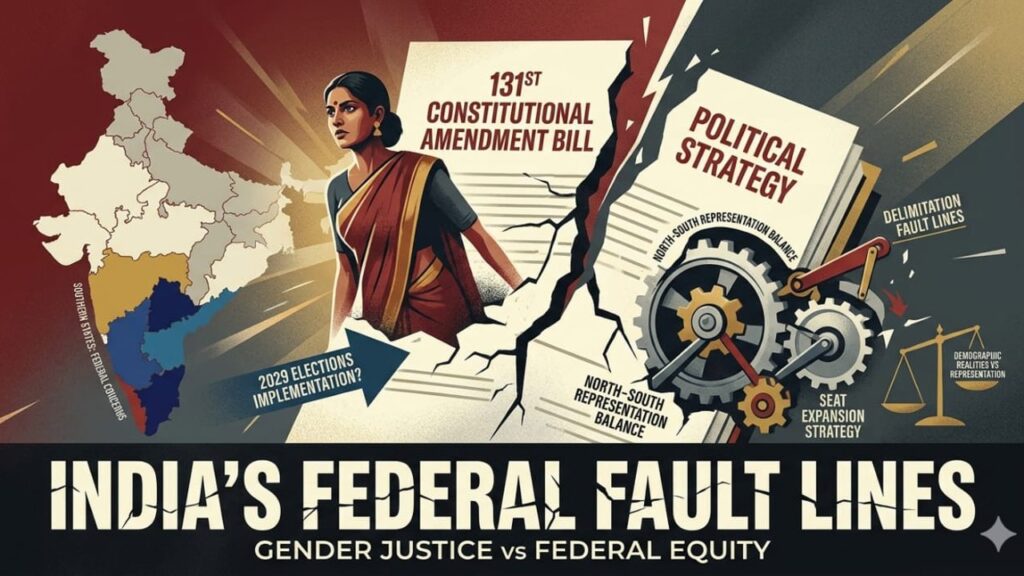
In a rare display of parliamentary muscle, the Opposition on 17 April 2026 defeated not just a bill to fast-track women’s reservation, but what many saw as a quiet constitutional coup disguised as empowerment. By bundling the popular 33% women’s quota with a near-50% expansion of the Lok Sabha and delimitation based on 2011 census data, the government wasn’t merely trying to deliver Nari Shakti sooner it was attempting to fundamentally tilt the balance of power in the world’s largest democracy. The move would have dramatically increased the relative weight of the Lok Sabha over the Rajya Sabha, weakened the Upper House’s influence in joint sittings and presidential elections, and handed future governments greater flexibility to decide the timing and basis of delimitation through simple majority. When the bill fell short by 54 votes, it wasn’t only southern federal concerns that prevailed it was a defence of India’s delicate bicameral balance against a potential long-term centralising shift.
In a significant setback for the Narendra Modi government, the Constitution (131st Amendment) Bill, 2026 was defeated in the Lok Sabha on 17 April 2026. Introduced on 16 April as the core of a three-bill package alongside the Delimitation Bill, 2026, and the Union Territories Laws (Amendment) Bill, 2026—it aimed to fast-track 33% women’s reservation in legislatures for implementation by the 2029 elections.
The bill received 298 votes in favour and 230 against, out of 528 members present and voting. It fell short of the required two-thirds majority (approximately 352 votes) under Article 368. The government immediately withdrew the two linked bills.
This episode exposed the delicate balance between advancing gender justice and preserving federal equity in India’s diverse democracy.
The 2023 Act and the Notification Gamble
The foundation was laid by the Constitution (106th Amendment) Act, 2023 (Nari Shakti Vandan Adhiniyam), which passed unanimously with cross-party support. It reserves one-third of seats in the Lok Sabha, state assemblies, and the Delhi assembly for women, with rotation for 15 years and sub-quotas for SC/ST women.
Implementation was always conditional on the first census after 2026 and subsequent delimitation. On 16 April 2026 even as Parliament debated the new package the government issued a gazette notification bringing the 2023 Act into force. Officials described it as a technical step, but it ensured the original law remained valid even if the amendment failed. Without delimitation, however, the quota cannot apply to the existing 543 seats. Consequently, the long-standing freeze on seat allocation (based on the 1971 census) continues.
The government argued that waiting until after the 2027 census would delay women’s representation unnecessarily. The 131st Amendment sought to accelerate this process by utilizing 2011 census data for delimitation and expanding the Lok Sabha’s total strength.
What the 2026 Package Proposed
The interlinked bills included:
- Constitution (131st Amendment) Bill: To use 2011 census figures for delimitation and increase Lok Sabha strength from 543 elected seats to approximately 850 (up to 815 from states and 35 from Union Territories). This was designed to accommodate the 33% women’s quota without reducing the number of existing seats for any state.
- Delimitation Bill, 2026: To establish a commission tasked with redrawing constituency boundaries.
- Union Territories Laws (Amendment) Bill: To extend similar changes to Delhi, Puducherry, and Jammu & Kashmir.
The pitch: correct severe imbalances in voter representation caused by decades of uneven population growth, uphold the principle of “one person, one vote, one value,” and deliver Nari Shakti by 2029.
Government’s Defence: Equity and Empowerment
Home Minister Amit Shah defended the package vigorously, arguing that seat expansion would provide every state, including those in the south, a proportional increase rather than any net loss. He warned that blocking the bill would deny women their due and accused the Opposition of fearing the growing support women have shown for the government. In a sharp post-defeat statement, Shah called the Opposition’s celebration “reprehensible” and an “insult to 70 crore women,” warning of their “wrath” in the coming elections.
Prime Minister Modi and the BJP presented the move as building on the 2023 consensus to empower women without further delay.
Opposition’s Critique: Trojan Horse for Delimitation
A united Opposition including the Congress, DMK, TMC, SP, and various southern parties backed women’s reservation in principle but rejected the bundling of bills. Their key objections were:
- The 2023 Act could have been operationalised on existing seats without requiring new delimitation or expansion.
- Using 2011 data would boost seats in high-population northern states while reducing the relative political influence of southern states (Tamil Nadu, Kerala, Karnataka, Andhra Pradesh, and Telangana), which have successfully controlled population growth.
- This threatened to deepen the North-South divide and weaken southern voices in Parliament and federal decision-making.
- Government assurances of proportional gains lacked iron-clad legal safeguards.
Leaders from Karnataka and other southern states highlighted the risks to their states’ current parliamentary influence, despite their substantial economic contributions.
The Political Game: Strategy Over Consensus
The controversy centred on sophisticated political strategy. By bundling a broadly popular reform (women’s reservation, pending since the 1990s) with a contentious delimitation exercise, the government created a difficult narrative: oppose the package and appear “anti-women.”
The dramatic expansion to approximately 850 seats was framed as a generous solution, yet it enabled a structural realignment favouring regions with stronger NDA support. Critics viewed this as leveraging bipartisan goodwill on gender justice to achieve a rapid electoral map redrawing that might otherwise face significant resistance. The timing and the choice of 2011 data intensified suspicions of strategic intent.
While a genuine policy commitment to faster implementation existed, given the acknowledged representation distortions, the refusal to delink the issues until the final defeat suggested the calculus went beyond empowerment to long-term power dynamics. India’s democracy showed its checks: constitutional special majority requirements prevented passage without broader consensus.
The Road Ahead
The 2023 Act is now in force but remains unimplemented. The defeat the Modi government’s first failed constitutional amendment in over a decade returns both the women’s quota and the delimitation issue to negotiations.
Southern states, including Karnataka, are expected to demand safeguards, such as protections for current seat shares or rewards for population control. Future efforts will likely require deeper consultation, legal guarantees on federal balance, and possibly a delinked legislative approach.
This episode reveals enduring tensions: reconciling population-based representation with demographic realities; delivering gender justice without compromising federal fairness; and forging reforms in a multi-party system where consensus is vital. Women in India deserve a meaningful parliamentary presence, and states that have responsibly managed population growth deserve an equitable voice. Achieving both—without one becoming a vehicle for the other—will measure the maturity of Indian federal politics in the years to come. The 131st Amendment’s defeat does not end the debate; it calls for a more collaborative path forward.