
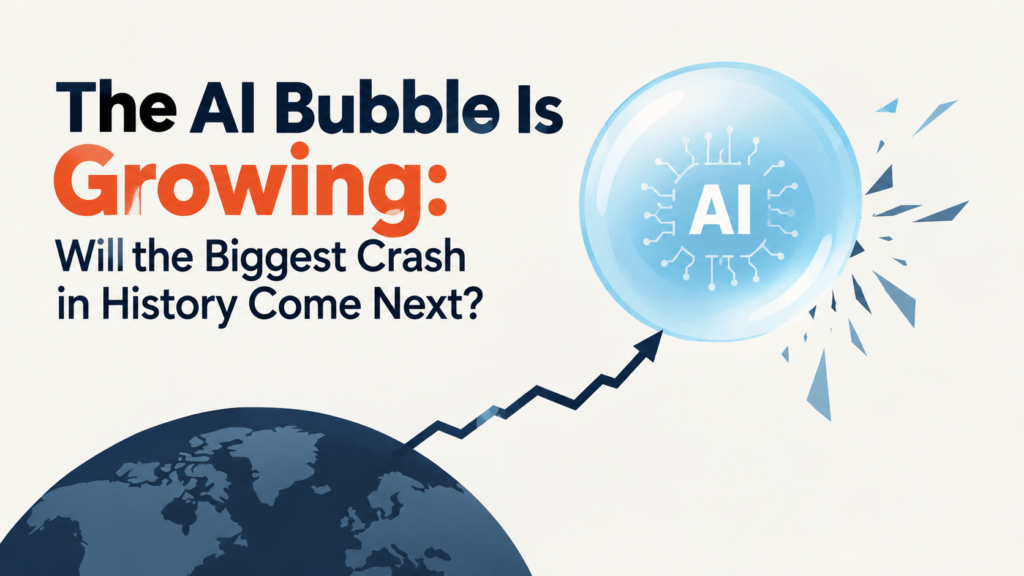
From Silicon Valley’s trillion-dollar ambitions to India’s IT jobs and stock markets, the growing debate around artificial intelligence raises an uncomfortable question: what happens if the money runs out before the promised returns arrive?
Artificial intelligence is changing how we work, communicate, create, and make decisions. From chatbots that write code to systems that assist medical research, AI is no longer a distant technological dream. It is becoming part of everyday life.
But behind the excitement lies a question that investors, business leaders, and policymakers are increasingly asking: Are we witnessing the birth of a revolutionary technology, or are we also building a financial bubble around it?
A technology can transform the world while the companies associated with it become dangerously overvalued. The internet did precisely that. During the dot-com boom of the late 1990s, investors poured money into internet businesses, convinced that the future belonged to anything connected to the web. The internet survived, but many companies did not. Investors suffered enormous losses when expectations collided with reality.
Today, artificial intelligence presents a similar dilemma. The technology is real, its potential is enormous, and its commercial possibilities continue to expand. Yet the amount of money being committed to AI infrastructure, startups, chips, and data centres has raised concerns about whether the financial expectations are moving faster than the actual returns.
And when even some of the industry’s most influential leaders begin discussing the possibility of a bubble, the conversation deserves attention.
1. When AI Leaders Start Questioning the AI Boom
Perhaps the most interesting aspect of the AI bubble debate is that it is not being driven solely by critics outside the technology industry. Several prominent executives have publicly acknowledged the risks of excessive enthusiasm, aggressive spending, and unrealistic valuations.
Their statements do not prove that a crash is coming. They do, however, reveal that the risks are being discussed by people who understand the industry from the inside.
- OpenAI CEO Sam Altman acknowledged in August 2025 that the AI industry could be experiencing bubble-like behaviour. He explained: “When bubbles happen, smart people get overexcited about a kernel of truth…”. Altman also maintained that AI could be one of the most important technological developments in a very long time. His argument captures the central contradiction of the current AI boom. The technology may genuinely change the world, but that does not mean every company, investment, or valuation associated with it will succeed.
- Anthropic CEO Dario Amodei raised concerns about the risks some companies are taking to secure the computing infrastructure needed to develop advanced AI systems. Speaking at The New York Times’ DealBook Summit in December 2025, he warned: “I think there are some players who are ‘YOLO’-ing, who pull the risk dial too far…”. The underlying issue is straightforward. Building AI infrastructure requires enormous investments, and those investments often need to be committed years before the expected returns become clear.
- Google and Alphabet CEO Sundar Pichai has also acknowledged the possibility of excessive investment. In a BBC interview in November 2025, Pichai said: “Given the potential of this technology, the excitement is very rational.” However, he also recognised that investment cycles can overshoot and that companies may need to work through the consequences of overinvestment. This is an important distinction. High spending does not automatically indicate irrationality. Companies need infrastructure to meet demand, develop products, and remain competitive.
- Google DeepMind CEO Demis Hassabis has also warned about bubble-like conditions in AI funding. His concern centres on startups receiving enormous valuations before establishing substantial products, operations, or commercial track records. When investors assign extraordinary values to businesses at very early stages, they are effectively betting on what those companies might become rather than what they have already demonstrated.
- NVIDIA supplies the advanced computing chips that power much of the AI industry. Huang’s broader position has emphasised that AI represents a fundamental infrastructure transition, rather than merely a passing software trend. This argument has substance. AI requires computing capacity, electricity, networking, storage, and specialised hardware. Building that infrastructure can create lasting economic value. But a genuine infrastructure revolution does not guarantee that every infrastructure investment will earn an adequate return.
2. The RBI Governor’s Warning Changes the Conversation
The debate becomes more significant when it moves beyond technology executives and into the world of central banking. On October 3, 2026, Reserve Bank of India Governor Sanjay Malhotra identified stretched asset valuations, particularly those linked to AI, as one of the emerging risks to global financial stability.
He warned that a slowdown in AI investment or earnings could trigger a sharp repricing of financial assets, particularly across the AI value chain. He also highlighted the role of increased leverage and weakening free cash flows in potentially amplifying market corrections.
The concern was reiterated in his remarks reported on October 7, 2026, when he discussed the downside risks associated with elevated AI-related valuations.
Why does this matter?
A central bank does not need to predict an imminent crash to recognise a financial vulnerability. Its responsibility is to understand how risks can spread through markets, institutions, borrowing, and investor behaviour.
The warning is not that AI must collapse. It is that financial markets could become vulnerable if expectations about future AI earnings prove too optimistic and if those expectations are embedded in large investments and leveraged financial positions, a correction could extend beyond individual technology companies.
3. How Does an AI Bubble Actually Burst?
A financial bubble rarely begins with everyone suddenly realising that an industry has no future. More often, it begins when expectations become disconnected from what businesses can realistically deliver.
Consider a simplified scenario.
Investors expect AI adoption to grow rapidly. Technology companies raise enormous amounts of capital to build data centres and acquire computing equipment. Investors then value these companies on the assumption that future demand and earnings will continue to expand.
For a while, the cycle reinforces itself.
More investment creates more infrastructure. More infrastructure supports more AI products. Strong investor enthusiasm makes it easier to raise additional capital.
But what happens if the expected returns arrive later than anticipated?
Several things could happen:
- Revenue disappoints: Businesses discover that customers are unwilling to pay enough for AI services to justify the cost of developing and operating them.
- Infrastructure becomes excessive: Data centres and computing capacity are built faster than sustainable demand develops.
- Technology becomes cheaper: Newer chips and more efficient AI models reduce the economic value of some existing investments.
- Borrowing becomes expensive: Companies that rely on debt face higher financing costs and greater pressure to generate cash.
- Investors lose confidence: Funding becomes harder to obtain, valuations decline, and businesses with weak finances struggle to survive.
These developments could reinforce one another. Falling valuations make fundraising harder, reduced funding forces companies to cut spending, and weaker spending affects businesses supplying chips, networking equipment, power, and infrastructure.
4. The Dot-Com Bubble: A Lesson for Today’s AI Investors
The late-1990s internet boom offers a useful comparison.
At the time, investors recognised that the internet would transform commerce, communication, advertising, and business operations. That underlying belief was largely correct.
What proved wrong was the assumption that every internet company would become profitable, that growth would arrive quickly enough to justify its valuation, and that competition would not destroy many business models.
When the bubble burst around 2000, technology stocks suffered severe losses and numerous companies failed.
Yet the internet continued to develop. Online shopping, digital payments, search engines, cloud computing, and social media eventually became central to the global economy.
AI could follow a comparable pattern: a period of excessive expectations followed by a painful correction, with the strongest technologies and businesses continuing to develop.
There are also important differences. Today’s AI investment cycle involves major established technology companies, specialised semiconductor suppliers, enormous physical infrastructure commitments, and potentially more complicated financing arrangements.
The lesson is not that history must repeat itself. It is that being right about a technology is not the same as being right about its price.
5. India: Why a Global AI Correction Matters Here
India is not at the centre of every major AI model or advanced semiconductor manufacturing chain. Nevertheless, it is deeply connected to the global technology economy through IT services, software exports, financial markets, infrastructure, and international investment.
That creates several channels through which a global AI correction could affect the country.
A. Indian IT Companies Could Face a Difficult Transition
Indian IT services companies have traditionally earned substantial revenue by helping global businesses maintain software, manage technology systems, modernise infrastructure, and operate business processes.
AI is changing that model.
Automation can reduce the time required to complete certain tasks, which may eventually put pressure on traditional billing models. At the same time, demand is growing for AI integration, cloud modernisation, data engineering, cybersecurity, and specialised consulting.
If global businesses respond to an AI investment correction by cutting technology budgets, Indian IT firms could face delayed projects, slower contract growth, and pressure on revenue.
However, the impact would not be uniform.
Companies that help clients implement AI could benefit from long-term demand, while businesses that depend heavily on work that becomes easier to automate may face greater adjustment pressures.
The outcome will depend on how quickly Indian IT companies adapt their services, pricing, and workforce skills.
B. Employment Could Feel the Pressure
For India’s young workforce, this is one of the most consequential parts of the debate.
Technology spending influences hiring, training, outsourcing contracts, and the number of employees required to deliver services.
If a global AI correction coincides with weaker corporate spending, companies may delay recruitment, reduce discretionary projects, or restructure teams.
AI adoption could also change the types of jobs companies need. Routine coding, testing, documentation, customer support, and repetitive business processes may become increasingly automated in some settings.
But a slowdown in AI investment would not automatically mean mass unemployment, nor would AI adoption eliminate every affected role.
New demand could emerge in AI governance, model evaluation, data management, security, integration, and domain-specific technology services.
For India, the challenge is to ensure that workers can transition into these emerging roles rather than bear the cost of a rapid change in business models.
C. Indian Stock Markets Could Experience Volatility
Global financial markets are interconnected. When investors become concerned about expensive technology stocks, they may reduce risk across several markets, including emerging economies.
Indian equities could face pressure through foreign portfolio investment flows, changes in global risk appetite, and repricing of companies associated with AI infrastructure.
There is an important nuance, however.
A global AI sell-off could hurt some Indian businesses while benefiting others. Investors might move capital away from expensive AI-linked companies towards businesses with more established earnings, depending on valuations and market conditions.
Indeed, on October 15, 2026, Reuters reported that India’s benchmark equity indices recorded their strongest daily gains in four months amid a global AI-linked stock decline, while some AI-related Indian companies remained under pressure.
D. India’s AI Infrastructure Investments Could Face a Reality Check
India is attracting investment in data centres, cloud infrastructure, power capacity, connectivity, and computing services.
These investments can support digitalisation and strengthen domestic technological capabilities.
However, they also require careful financial planning.
Data centres need reliable electricity, cooling, connectivity, equipment, and customers willing to pay for computing capacity. If projected demand grows more slowly than expected, investors could face lower returns and longer payback periods.
A slowdown in global AI spending could therefore affect Indian infrastructure projects, especially those that depend heavily on optimistic demand assumptions or expensive financing.
At the same time, India’s growing domestic digital economy and demand for computing capacity may support projects with sound business models.
The relevant question is whether each investment can generate sustainable returns—not whether the entire AI infrastructure sector should expand or contract.
E. Startups and Venture Capital Could Face Tighter Funding
AI startups often need substantial capital before they can establish stable revenues.
During a funding boom, investors may accept high valuations because they expect rapid growth and the possibility of market dominance.
If investor confidence weakens, funding rounds may become smaller, valuations may decline, and startups may have to demonstrate clearer paths to profitability.
This could affect Indian AI companies seeking funding from international investors.
Some promising businesses might struggle to raise money despite having useful products. Others could benefit as customers and investors become more selective and focus on measurable commercial value.
For founders, the lesson is straightforward: technological capability matters, but so do paying customers, disciplined spending, and a business model that can survive beyond the next funding round.
6. Could India Actually Benefit From an AI Bubble Burst?
Surprisingly, yes—in certain circumstances.
An AI market correction would not necessarily be entirely negative for India.
If global investors reduce their exposure to highly valued AI companies and seek opportunities in other markets, some capital could move towards Indian equities and businesses.
A correction could also lower the cost of acquiring certain technology assets, encourage more disciplined investment, and create opportunities for Indian companies to develop products without competing against unsustainable valuations.
But these benefits are not guaranteed.
If the correction triggers a broader global economic slowdown, international investors may withdraw capital from emerging markets, companies may reduce spending, and funding conditions could tighten.
India could therefore experience both positive and negative effects at the same time.
The outcome would depend on whether the correction remained concentrated in overvalued AI businesses or spread into credit markets, corporate investment, employment, and global demand.
India’s policy priorities should consequently extend beyond attracting investment. They should include building domestic technological capabilities, improving workforce adaptability, encouraging commercially viable innovation, and monitoring financial exposures.
7. What Should Indian Investors and Businesses Watch?
Rather than trying to predict the exact date of a crash, it is more useful to monitor the indicators that could reveal whether the AI investment cycle is becoming less sustainable.
For investors:
- Revenue growth relative to company valuations.
- Cash flow and profitability rather than announcements about future spending.
- Debt levels and the cost of refinancing.
- Customer demand for AI services and evidence of measurable returns.
- Concentration of investments in a small number of AI-linked companies.
For Indian businesses:
- Changes in international technology budgets and outsourcing demand.
- Hiring trends and project delays among major clients.
- The commercial utilisation of data centres and computing infrastructure.
- The pace of AI adoption in services and business processes.
- Access to funding for startups and technology infrastructure.
For policymakers and regulators:
- Exposure of financial institutions to highly leveraged technology investments.
- Potential spillovers from global market corrections.
- Cybersecurity risks associated with the growing use of AI.
- The resilience of domestic financial markets to foreign capital outflows.
- The need to develop skills and infrastructure that support sustainable technological growth.
These indicators will not predict every market movement. They can, however, help distinguish a temporary change in sentiment from a more serious deterioration in business and financial conditions.
The Mantras Take
The AI revolution may well be one of the defining technological shifts of our generation. It could transform industries, improve productivity, accelerate scientific discovery, and create entirely new categories of work. But technological progress does not grant financial markets immunity from greed, miscalculation, or overconfidence.
The warnings from AI executives and the Reserve Bank of India’s concerns about elevated valuations point towards a common lesson: the danger is not necessarily that artificial intelligence will fail, but that the financial expectations built around it may run too far ahead of what the technology can deliver profitably.
For India, the stakes extend beyond stock prices. They include the future of IT services, the security of technology jobs, the viability of infrastructure investments, and the country’s ability to turn AI adoption into broad-based economic progress. A global correction could create opportunities, but it could also expose vulnerabilities if businesses, investors, and policymakers mistake rapid growth for guaranteed success.
The right response is neither to celebrate an inevitable AI boom nor to predict an inevitable collapse. It is to ask harder questions about returns, resilience, employment, and long-term value. Because when the excitement eventually meets reality, the countries and companies best prepared will not necessarily be those that invested the most—they will be those that invested wisely.