
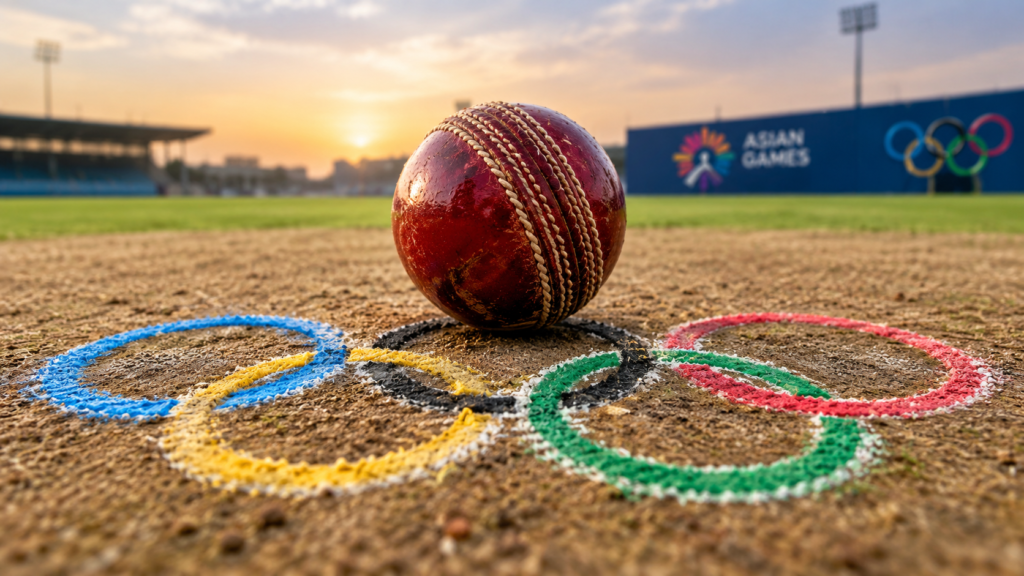
A few weeks ago, the BCCI and the Asian Cricket Council were reportedly close to downgrading India’s cricket squad in Japan to a second-string side. Not over form, or fitness, or fixtures. Over tents. The dressing rooms set up for the Aichi-Nagoya Games were tents, the washrooms were said to be roughly 500 metres away, and the hotel rooms allocated to players were apparently on the small side. An observer was sent to check things out before anyone committed a full squad.
Whatever that observer found, it clearly wasn’t a dealbreaker. India’s men’s team for the Asian Games 2026 includes Jasprit Bumrah — rested from India’s upcoming T20I tours of Ireland and England for workload management, but picked here anyway — and 15-year-old Vaibhav Sooryavanshi, fresh off an IPL season where he scored 776 runs at a strike rate above 237 and became the youngest Orange Cap winner in the tournament’s history. That’s not a squad you send to humor a multi-sport event you don’t really care about. That’s closer to a first-choice T20 side.
What’s actually happening this week
The men’s competition, played in T20 format at a newly built venue in Nisshin, runs from September 24 to October 3. India enters directly at the quarter-final stage on September 28 — tomorrow, as of writing — against the runner-up from Group A. Win that, and the semi-final follows on October 1, with the gold-medal match on October 3.
The women’s team has already delivered. On September 22, they beat Sri Lanka by 147 runs in the final, with Smriti Mandhana’s 79 off a team total of 216/3 — the highest total in the history of women’s cricket at the Asian Games. It’s India’s second straight Asian Games gold in the format, following Hangzhou in 2023, under captain Harmanpreet Kaur.
There’s also a bracket quirk worth knowing before the excitement gets ahead of the facts: India and Pakistan have been seeded on opposite sides of the men’s draw, which means the two teams can only meet in the gold-medal final or the bronze-medal match — not before. Both still have to win their way there first.
The part nobody’s headline is explaining
Here’s the actual story underneath the schedule. India hasn’t always taken multi-sport-event cricket this seriously. Squads sent to things like the Asian Games have historically leaned second-string, treating the tournament as a lower priority than bilateral series or the IPL calendar. This year is different, and the reason has a name: Los Angeles, 2028.
Cricket returns to the Olympics for the first time since a single match at Paris in 1900 — 128 years out of the Games and back in. That changes the calculus for boards like the BCCI, which now has actual incentive to treat short-format multi-sport tournaments as dress rehearsals rather than afterthoughts. Sending Bumrah, arguably the best fast bowler in the world right now, to an event you were prepared to skip over hotel logistics is not a subtle signal.
It’s also worth noticing who’s running things behind the scenes. VVS Laxman — who also coached the gold-winning 2023 squad — is back in charge of the men’s team in Japan, while regular head coach Gautam Gambhir stays home with the senior side for a home ODI series against the West Indies that starts the same week. Two coaching staffs, two competitions, running in parallel. That’s not a sign of a tournament being treated casually; it’s a sign of a cricket calendar so packed that even a full-strength Olympic dress rehearsal has to share a week with something else.
Why this actually matters beyond the medal
For BCCI selectors, a strong showing here is closer to a live audition than a trophy exercise. A T20 format, international opposition, and Olympic stakes two years out give selectors real data on how fringe players — Sooryavanshi included — handle pressure outside the IPL bubble. For a board that’s historically prioritized bilateral cricket and the IPL calendar above almost everything else, actually resourcing this properly is new behaviour, not routine.
There’s a genuine tension buried in the squad selection too. Bumrah was rested from the Ireland and England tours specifically to manage his workload ahead of the 2027 T20 World Cup — and then included here anyway, in a tournament that adds more overs to the same body during the same stretch of the calendar. Either the Asian Games has been reclassified as important enough to justify that risk, or workload management has quietly become more flexible than it’s usually described as being. Possibly both.
What’s still genuinely uncertain
An India-Pakistan gold-medal final is the storyline everyone wants, but it’s exactly that — a storyline, not a fixture. Both teams have to win a quarter-final and a semi-final first, against opposition that includes Sri Lanka, Bangladesh, and whichever side climbs out of the preliminary groups. Nothing about the draw guarantees it happens, and treating it as inevitable before a ball’s been bowled in the knockout rounds is getting ahead of the actual cricket.
What happens next
Quarter-finals play out September 28 and 29, semi-finals on October 1, and both the bronze and gold-medal matches on October 3 — all in one condensed final week. Watch the top order, where Sooryavanshi and Abhishek Sharma give India more firepower than most of the field, and watch whether Bumrah’s workload holds up across a tournament he wasn’t originally guaranteed to play.
Mantra’s Take
The real story here isn’t a hypothetical India-Pakistan final — it’s what India’s squad selection reveals about how much weight the BCCI now puts on a multi-sport tournament it was once ready to treat as optional. Sending your premier fast bowler and your most talked-about teenager to an event you nearly downgraded over tent-based dressing rooms is a clearer signal about Olympic priorities than any official statement would be. If India’s men do go all the way, the medal will make headlines. The squad list already told you what mattered more.
The squad selection itself, not a possible medal, is the real signal of how seriously the BCCI is taking cricket’s return to the Olympics in 2028.