
Episode 4
One Emergency Away from Collapse
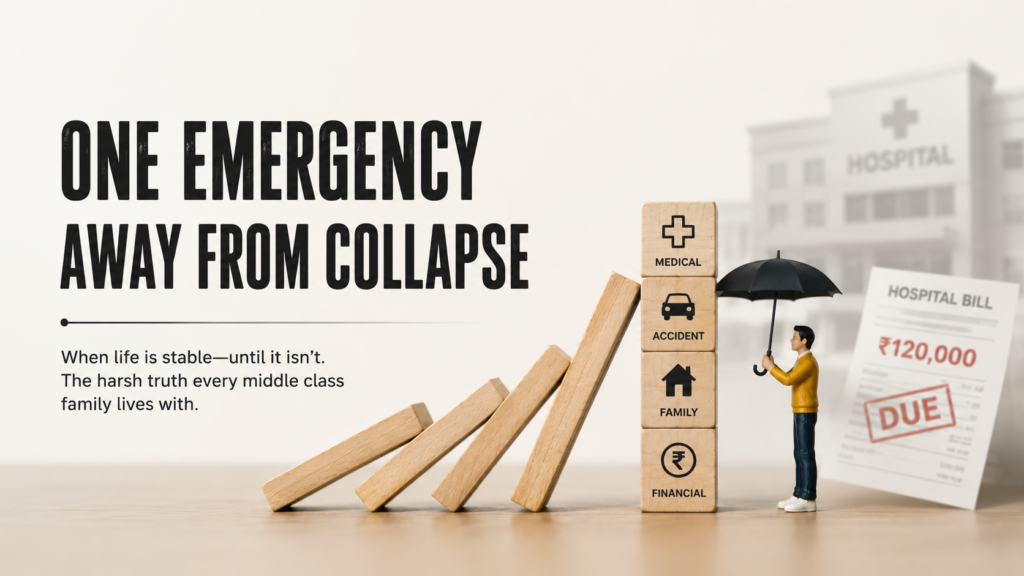
Pawan wasn’t afraid of the end of the month anymore. He wasn’t afraid of EMIs. He wasn’t even afraid of seeing a low bank balance because he has learnt to live with this. What scared him most was a phone call. The kind of phone call that begins with: “Come quickly” because deep down, he knew one truth that millions of middle-class Indians quietly live with every day: One emergency could change everything.
One day when Pawan was halfway through his shift his phone started ringing repeatedly, his heart skipped a beat. It was his neighbor. For a moment, dozens of thoughts raced through his mind.
Was it his father?
His mother?
An accident?
A hospital?
Thankfully, it turned out to be nothing serious but even after the call ended, the fear stayed not because he was emotional because he was financially vulnerable.
For many middle-class families, life works fine
Until it doesn’t.
One emergency.
One hospital visit.
One unexpected responsibility.
And suddenly, the struggle is no longer about saving money.
It’s about finding money because middle-class life often works perfectly until something unexpected happens.
Pawan noticed this pattern around him. A colleague had spent years paying off loans, then his father required surgery savings disappeared and Loans returned and another friend had finally started investing then a family medical emergency forced him to withdraw everything, three years of discipline vanished in three days.
Nobody talks about these stories online because emergencies don’t photograph well. There are no Instagram reels for financial panic or no LinkedIn posts saying: “Proud to announce I emptied my savings account for a medical emergency.” But these stories happen every day in our surroundings. Many fail to notice or understand it.
People often think financial freedom means:
- luxury cars,
- expensive vacations,
- large investments.
But for most middle-class families, financial freedom is much simpler. It means being able to handle bad news without financial panic. One evening, Pawan sat down and asked himself a difficult question: “If I lost my job tomorrow, how long could I survive?”
He opened his banking app, checked his savings, checked his obligations, checked his EMIs, The answer made him uncomfortable, he understood that he even can’t survive two months without job and that’s when he realized something important. Many people think they are one promotion away from comfort. In reality, they are one emergency away from crisis.
The reality is harsh
The middle class isn’t trapped because people make bad decisions, many are trapped only because they fail to take decisions, they always postponed to make decisions.
And yet every month continues as usual. People go to work, pay EMIs, attend weddings, post photos, smile, laugh, plan, pretend, while silently hoping that nothing goes wrong.
The Mantra Take
The biggest threat to the middle class is not a lack of income, it is a lack of margin for error most families are not struggling because they are careless, they are struggling because life has become expensive enough that even small setbacks can feel overwhelming.
A medical bill.
A job loss.
A family responsibility.
An unexpected repair.
Sometimes that’s all it takes to turn stability into stress.
The uncomfortable truth is that financial security is not built during emergencies. It is built before they arrive.
Mistakes to Avoid
- Believing “it won’t happen to me.”
- Depending entirely on your next salary.
- Using credit cards as an emergency fund.
- Ignoring health insurance and term insurance.
- Delaying savings until income increases.
- Assuming one source of income is enough forever.
The middle class often prepares for festivals.
For weddings.
For vacations.
For new phones.
But very few prepare for the day life goes off script. If there is one lesson from Pawan’s story, it is this: Build protection before you build lifestyle because a bigger phone can wait, a better bike can wait, even some dreams can wait but the ability to survive a crisis cannot because when an emergency arrives, it doesn’t ask how much you earn it only asks how prepared you are.
“If your budget allows, protecting yourself against a medical emergency should become a priority before upgrading your lifestyle.”