
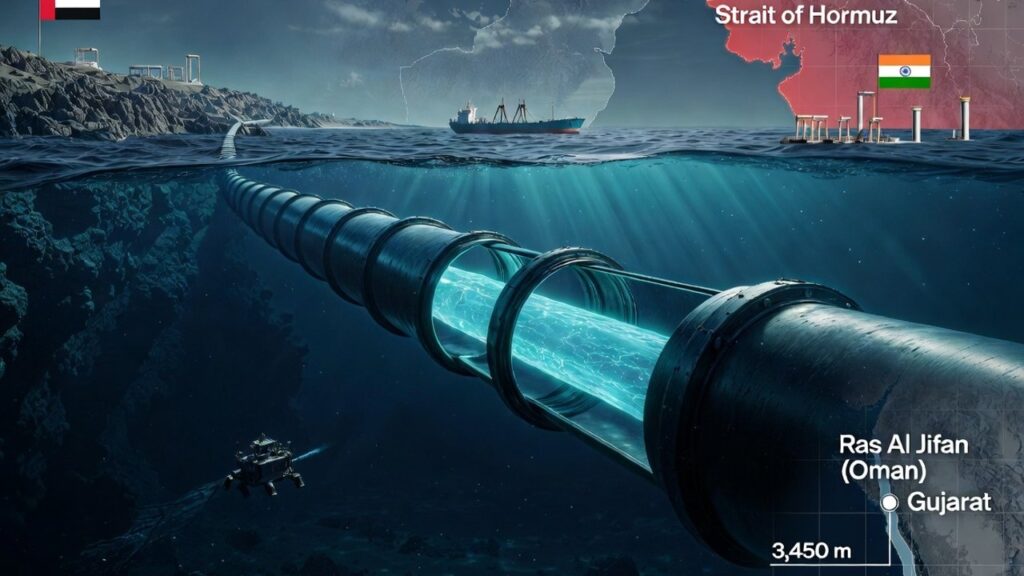
In the midst of the 2026 Strait of Hormuz crisis, India is accelerating one of the most ambitious energy-security projects in its history: a direct deep-sea gas pipeline linking the Gulf’s vast reserves to Gujarat. While Prime Minister Narendra Modi’s brief visit to Abu Dhabi on May 15 delivered immediate relief through storage and LPG deals, the real strategic masterstroke lies in this long-discussed underwater corridor a 2,000-kilometre “energy bridge” that would permanently bypass one of the world’s most dangerous chokepoints.
This is no ordinary pipeline. Plunging to depths of up to 3,450–3,500 metres among the deepest ever attempted the proposed Middle East-India Deepwater Pipeline (MEIDP) would connect Oman’s coast (with feeder lines through UAE waters) directly to India’s western seaboard, delivering up to 31 million standard cubic metres of gas per day.
A senior petroleum ministry official told The Economic Times this week: “We are fast-tracking the project to secure uninterrupted supplies… The current situation in the Strait of Hormuz has made it clear we cannot keep depending on vulnerable tanker routes forever.”
Why India Can No Longer Afford to Wait
India imports roughly 85% of its crude oil, LNG, and LPG from the Gulf region. Every shipment must pass through the narrow Strait of Hormuz, where recent Iran-related disruptions have sent freight rates, insurance premiums, and domestic fuel prices soaring. The result: a nationwide call for energy conservation and urgent diplomatic shuttling.
The proposed pipeline would change the game. Gas (and potentially oil/LPG in future phases) would flow straight from Ras Al Jifan in Oman and indirectly from UAE, Qatar, Saudi Arabia, Iran, and even Turkmenistan fields avoiding land borders and geopolitical flashpoints. Estimated cost: ₹40,000 crore ($4.8 billion). Construction timeline, if cleared: 5–7 years.
State-run giants GAIL, Engineers India Ltd, and Indian Oil Corporation have now been tasked with preparing detailed feasibility reports, building on pre-feasibility work by the private South Asia Gas Enterprise (SAGE) consortium.
Modi’s May 15 Visit: Solid Steps, But Not the Pipeline Deal
Today’s high-level meeting in Abu Dhabi produced concrete, immediate wins:
- A Memorandum of Understanding on expanding India’s Strategic Petroleum Reserves (including potential crude storage in Fujairah, UAE).
- New long-term LPG supply agreements with Indian Oil Corporation.
- A $5 billion UAE investment pledge across energy, defence, infrastructure, and technology.
- Fresh defence pacts on maritime security and cyber cooperation.
These are vital short-term shock absorbers. But they also lay the commercial and political groundwork for the far more ambitious pipeline project one that would lock in Gulf supplies for decades.
Deeper Observations: Why This Pipeline Is a Geopolitical and Economic Game-Changer
- Strategic Autonomy in Steel The project is classic Indian hedging. It reduces vulnerability to any single conflict, great-power rivalry, or blockade a lesson learned the hard way in 2026.
- India-GCC Evolution The UAE and Oman are no longer just energy sellers; they are becoming co-architects of India’s long-term security. This mirrors the India-Middle East-Europe Corridor but adds hard, subsea infrastructure.
- Economic Multipliers Lower landed costs for gas would ease pressure on fertiliser, power, and city-gas sectors. It would also spark a domestic boom in offshore engineering, pipe manufacturing, and EPC sectors India is aggressively localising.
- UAE’s Mirror Strategy Abu Dhabi is simultaneously accelerating its own new West-East oil pipeline to double exports through Fujairah by 2027. The two projects are natural partners.
Key Challenges Ahead (The Realism Check)
- Engineering Extremes: Laying pipe at 3,450-metre depths requires next-generation vessels, robotics, and corrosion-resistant materials. Seismic risks along the Owen Fracture Zone add complexity.
- Environmental & Diplomatic Hurdles: Intense scrutiny over marine ecosystems and the need for trilateral (India-Oman-UAE) agreements.
- Capital & Timeline: Even with momentum, final investment decision and construction mean early 2030s operations at the earliest.
The Bottom Line
The Oman-UAE-India deep-sea pipeline is rapidly moving from a decades-old concept to a fast-tracked national priority. India has now directed its top state-owned energy companies to prepare detailed feasibility reports, marking a clear shift from reactive tanker diplomacy to proactive, iron-clad infrastructure. This underwater lifeline will deliver more predictable and lower-cost energy supplies while permanently reducing dependence on the volatile Strait of Hormuz. In an era when energy is increasingly weaponised, securing this corridor is essential for India’s long-term economic growth and strategic autonomy. If built successfully, it will power homes, industries, and transport for 1.4 billion Indians well into the future. The only question that remains is how quickly New Delhi and its Gulf partners can complete the studies and move to construction before the next regional crisis strikes.