
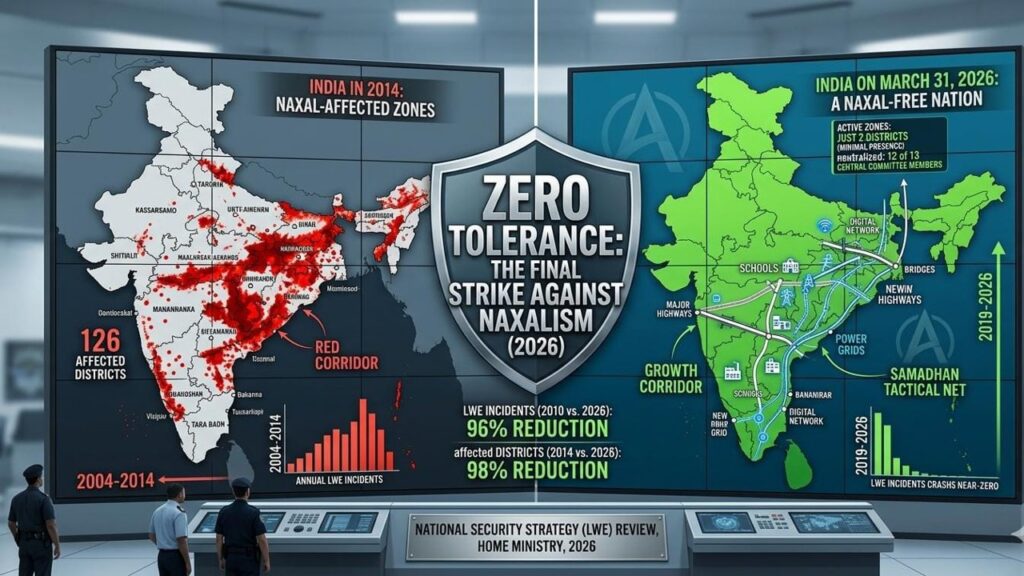
For 58 years, the ‘Red Corridor’ was a wound across the heart of India; today, March 31, 2026, that wound has finally healed into a corridor of progress
The Naxalite-Maoist insurgency, born in the 1967 uprising in Naxalbari village of West Bengal, evolved into one of India’s longest and deadliest internal security challenges. For nearly six decades, the Communist Party of India (Maoist) and its splinter groups waged a “people’s war” across the so-called Red Corridor stretching from the Nepal border in the north to parts of Andhra Pradesh in the south. What began as a peasant revolt against perceived feudal exploitation mutated into armed extremism that stalled development in vast tribal and forested regions of central and eastern India.
On March 31, 2026, India officially stands as a Naxal-free nation. The government has met its firm deadline to eradicate the organized menace. The transformation from over 126 affected districts in 2014 to a landscape where active presence is confined to just two districts is nothing short of historic. As Home Minister Amit Shah declared in the Lok Sabha yesterday, the “Red Corridor” has finally been replaced by a corridor of development.
The Human Cost: Over 12,000 Lives Lost
The Naxal movement exacted a devastating toll. According to data compiled by the South Asia Terrorism Portal (SATP) and recent Ministry updates, from March 2000 till this final week of March 2026, the conflict claimed 12,176 lives. This includes:
- 4,138 civilians
- 2,723 security force personnel
- 5,063 Naxalites/insurgents
- 252 not specified
These numbers represent not just statistics but shattered families and security personnel ambushed in dense forests. The insurgency deliberately targeted infrastructure projects, schools, and polling stations, keeping entire regions trapped in poverty. However, with the neutralization of the last remaining armed cadres this month, the cycle of violence has finally ceased.
Congress Governments and the “Soft Corner” Towards Naxalism
A recurring criticism of the Congress-led United Progressive Alliance (UPA) governments (2004–2014) was their inconsistent and often lenient approach. Senior Congress leaders frequently framed Naxals as “misguided youths” rather than a grave security threat. This “soft corner” created policy paralysis: while some Home Ministers acknowledged the danger, the lack of a unified strategy allowed the CPI(Maoist) to expand its “Red Corridor,” recruit cadres, and extort billions from mining and infrastructure projects.
Even after major attacks, such as the 2013 Darbha Valley ambush in Chhattisgarh that killed senior leadership, the central response remained hesitant. It was only after 2014 that the shift from “containment” to “elimination” began in earnest under a unified, national policy.
The NDA Era: A Firm, Multi-Pronged War on Naxalism
The shift came under the NDA government led by Prime Minister Narendra Modi. A clear policy of “zero tolerance” replaced ambiguity. The strategy, encapsulated in the SAMADHAN acronym (Smart leadership, Aggressive strategy, Motivation and training, Actionable intelligence, Dashboard-based KPIs, Harnessing technology, Action plan for each district, No access to financing), combined relentless security operations with accelerated development.
Key elements included:
- Infrastructure Push: Over 656 fortified police stations and 15,000 km of roads were built to pierce former “liberated zones,” most notably in the once-impenetrable Abujhmad forests.
- Intelligence & Tech: Coordinated operations by CRPF, BSF, and state police, supported by AI-enhanced drones and real-time satellite imagery.
- Financial Choking: Freezing Naxal funding networks through NIA and ED probes.
- Surrender and Rehabilitation: Aggressive policies that saw over 4,800 cadres lay down arms in the final three years alone.
Amit Shah’s Decisive Leadership as Home Minister
No single figure has been more instrumental in the final assault than Union Home Minister Amit Shah. Since assuming office in 2019, Shah provided the unwavering political will and a clear deadline: March 31, 2026.
In his address to the Lok Sabha yesterday, the Home Minister revealed a staggering success rate in decapitating the movement:
- Leadership Decimated: 12 out of the top 13 Maoist Central Committee members have been neutralized (killed or surrendered). Reports suggest the final top leader is currently in surrender negotiations.
- State Committees Wiped Out: Command structures in Telangana, Maharashtra, and Odisha have been cleared, leaving no functional “Military Commission.”
- Operation Black Forest: This decisive offensive in the Karreguta Hills (Chhattisgarh-Telangana border) was the “beginning of the end,” neutralizing the CPI-Maoist leadership and clearing a massive permanent insurgent stronghold.
The Final Chapter: A Naxal-Free India by March 31, 2026
As of today, March 31, 2026, organized Naxal activity has collapsed. The once-mighty Red Corridor is now a memory. Residual security concerns are handled under the new “Legacy and Thrust Districts” classification, ensuring that the influx of roads, hospitals, and schools continues until these regions are fully integrated into mainstream India.
While organized Naxalism has reached its end, the government remains vigilant against “lone-wolf” remnants or sleeper cells to ensure this hard-won peace remains permanent. The transition is now moving from conflict to “Post-Insurgency Governance,” ensuring tribals are finally seeing the fruits of a truly united Bharat.
Conclusion: A Victory for Resolve Over Romanticism
India’s journey to becoming Naxal-free is a testament to what decisive leadership and integrated policy can achieve. The thousands who died civilians and brave jawans alike did not perish in vain. Their sacrifice necessitated the firm hand that has finally restored the rule of law.
Home Minister Amit Shah’s unyielding commitment has delivered what previous regimes could not: the elimination of a 58-year-old threat. On this day, March 31, 2026, India writes the final chapter in the history of Naxalism—not with compromise, but with a total victory for democracy and the promise of a truly united, prosperous, and terror-free Bharat.