
From engine failures to HAL’s monopoly, understand the bottlenecks preventing true aerospace self-reliance in India’s fighter jet programs. Read more.
Published Date: 11/01/2026
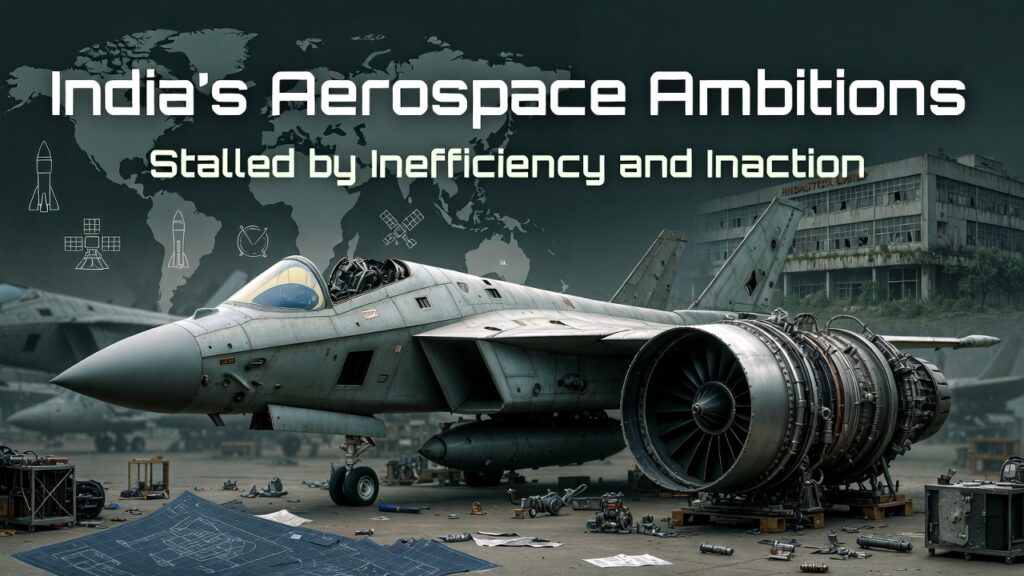
In a world where air power defines national strength, India’s struggle to master its own skies feels deeply unsettling. Despite decades of ambition, investment, and repeated promises of self-reliance, India still does not have a fully indigenous modern fighter jet powered by a homegrown jet engine. Instead, the Indian Air Force continues to depend heavily on foreign suppliers—an uncomfortable reality for a nation with global aspirations.
This is not just a story of missed deadlines or technical hurdles. It is a story of systemic inertia, fragmented responsibility, and an ecosystem that never quite learned how to convert ambition into execution. At the center of this narrative lies Hindustan Aeronautics Limited (HAL), the country’s aerospace giant, and a government machinery that critics say often operates in “sleeping mode” when long-term innovation is required.
Big Dreams, Slow Takeoffs: A Pattern Repeated for Decades
India’s indigenous fighter journey took flight in the 1980s with the Light Combat Aircraft (LCA) program—later named Tejas. It was meant to be a proud replacement for the aging MiG fleet and a symbol of technological maturity. Four decades later, Tejas is flying, but not in the way it was originally envisioned.
The aircraft depends heavily on imported systems, especially its engine. The indigenous Kaveri jet engine, once hailed as a breakthrough project by DRDO, failed to deliver the required thrust and reliability. Despite years of testing and billions in expenditure, it never became fighter-ready.
The story repeats itself today with the Advanced Medium Combat Aircraft (AMCA)—India’s proposed fifth-generation stealth fighter. The airframe design looks promising, but the engine remains a question mark. Without a reliable domestic powerplant, AMCA risks becoming another platform dependent on foreign approvals, spare parts, and geopolitical goodwill.
This lack of engine mastery is not a minor gap—it is the core of aerospace sovereignty. Nations that dominate the skies invested early in metallurgy, propulsion science, and materials engineering. India entered this race late, and the cost of catching up has been steep.
Government Inertia: When Vision Lacks Urgency
Successive governments have spoken passionately about Atmanirbhar Bharat, yet defense R&D funding tells a different story. Compared to countries like China, which poured massive state resources into aerospace over decades, India’s investment has been cautious, fragmented, and reactive.
Critical programs suffered from:
- Slow decision-making
- Bureaucratic delays
- Constant changes in requirements
- Inconsistent long-term funding
Instead of committing fully to indigenous development, India often chose short-term fixes—importing aircraft to meet urgent squadron shortages. Deals like Rafale strengthened immediate capability but did little to resolve long-term dependency, especially when technology transfer remained limited.
Defense procurement became a balancing act between urgency and caution, often resulting in paralysis. The mindset remained that of a buyer, not a builder.
HAL’s Central Role: Power Without Accountability
Hindustan Aeronautics Limited occupies a unique position. As India’s primary aerospace manufacturer, it holds enormous responsibility—and enormous influence. But with near-monopoly power comes a dangerous side effect: complacency.
Repeated audits, parliamentary observations, and even statements from former Air Force chiefs have pointed to:
- Production delays
- Quality concerns
- Cost overruns
- Poor coordination with the IAF and DRDO
Programs like Tejas and the Dhruv helicopter exposed deeper issues—organizational inertia, outdated processes, and limited absorption of advanced technologies. Critics argue that HAL often assembles rather than truly innovates, depending heavily on imported subsystems.
Private sector participation remains limited, partly because HAL dominates contracts. Without competition, efficiency and accountability suffer. Reform—whether through restructuring, partnerships, or performance-linked responsibility—is unavoidable if India wants to move forward.
The Cost of Staying Grounded
The consequences of this stalled progress go far beyond defense statistics.
- Strategic vulnerability to sanctions and supply disruptions
- Economic drain from repeated imports
- Missed opportunities for jobs, innovation, and exports
- Operational strain on the Air Force due to shrinking squadrons
In a volatile neighborhood, air superiority is not optional—it is essential. Every delay widens the gap between aspiration and reality.
A Path That Still Exists
India has proven capability in complex science—ISRO stands as living proof. Aerospace self-reliance is not impossible; it simply requires:
- Sustained political will
- Long-term funding commitment
- Genuine industry competition
- Accountability-driven reform at HAL
- Clear ownership of outcomes
The question is no longer whether India can do it—but whether it chooses to.
The Mantras Take (As Per Author’s View)
India’s failure in fighter jets and engines is not due to lack of talent—it is due to lack of urgency, accountability, and courage to reform. Nations don’t lose sovereignty overnight; they lose it slowly, through dependence that feels convenient today and dangerous tomorrow. True self-reliance is not built through slogans or imports, but through patience, persistence, and painful course correction. If India wants to rule its skies, it must first fix the systems that keep its ambitions grounded.