
India Fighter Jet Procurement reveals a crisis of delay, rising costs, and shrinking squadrons amid China-Pakistan threats. Learn how it happened.
Published on: 01/13/2026
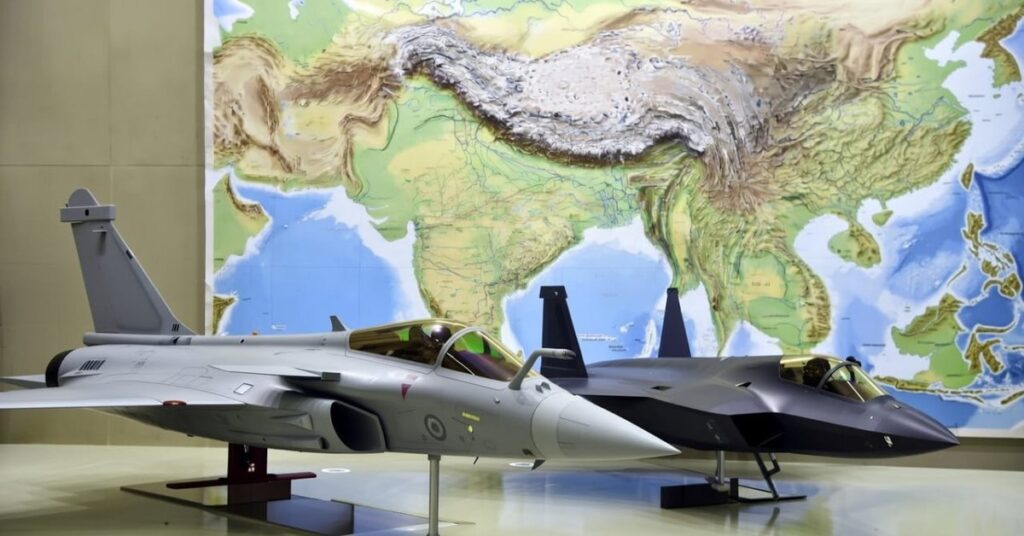
India’s fighter jet procurement story—especially the Medium Multi-Role Combat Aircraft (MMRCA) program and the repeated return to the Rafale—reads less like a strategic roadmap and more like a long, unfinished chapter in national security planning.
What began in the early 2000s as a clear and urgent requirement to modernize the Indian Air Force (IAF) has now stretched across two and a half decades. In 2026, India once again finds itself preparing to sign another large Rafale deal, under pressure from the IAF and rising geopolitical risks. The concern is not the aircraft itself—Rafale is among the best in its class—but the time lost, capability gaps created, and opportunities missed along the way.
This delay becomes even more troubling when viewed against India’s strategic environment: a militarily assertive China, a rapidly upgrading Pakistan, emerging regional frictions, and the reality that India’s flagship indigenous fighter project—the Advanced Medium Combat Aircraft (AMCA)—is still years away from operational readiness.
The Long Road of MMRCA: From Big Vision to Piecemeal Reality
The MMRCA program was launched in 2007, aiming to procure 126 multi-role fighter jets to replace ageing aircraft like the MiG-21 and to prepare the IAF for a potential two-front conflict. After one of the most exhaustive fighter evaluations in aviation history, the Dassault Rafale emerged victorious in 2012, selected as the lowest bidder based on life-cycle costs.
What followed, however, was a prolonged negotiation maze.
Disputes over technology transfer, pricing, and responsibility for aircraft manufactured by HAL—particularly Dassault’s reluctance to guarantee locally built jets—slowed progress to a crawl. By 2015, the newly elected government declared the deal “unworkable” and scrapped it altogether.
Instead, India opted for an emergency, off-the-shelf purchase of 36 Rafales, signed in 2016 for approximately €7.87 billion. Deliveries began in 2019 and concluded by 2022. While this helped plug an immediate gap, it was never a replacement for the original 126-aircraft vision.
Now, in 2026, history appears to be looping back.
India is advancing toward a 114-aircraft Rafale deal under the Multi-Role Fighter Aircraft (MRFA) program—essentially a rebadged revival of MMRCA. Talks are accelerating ahead of French President Emmanuel Macron’s expected visit in February 2026. The proposed deal includes:
- Government-to-government procurement
- Up to 60% indigenous content
- Local engine production via Safran collaboration
- An estimated cost exceeding ₹2 lakh crore ($25 billion)
The package reportedly includes 90 Rafale F4s with options for 24 advanced F5 variants.
The irony is hard to miss.
After abandoning a 126-jet deal in 2015, India is now inching back toward nearly the same number—114 new Rafales plus 36 already inducted for the IAF and 26 Rafale-Ms for the Navy—but at significantly higher costs and without the full manufacturing leverage once envisioned. The price of delay has been paid in time, money, and operational readiness.
The Squadron Crisis: When Numbers Tell a Dangerous Story
On paper, the IAF is sanctioned 42 fighter squadrons, each comprising 16–18 aircraft—considered the bare minimum to handle a two-front war against China and Pakistan.
In reality, the situation is far grimmer.
By early 2026:
- Operational squadrons stand at 29–32, depending on transitional counts
- MiG-21s have been fully phased out
- MiG-27s exited service earlier
This leaves a shortfall of more than 10 squadrons, a gap the IAF has repeatedly described as unsustainable.
Recent operational experiences—such as Operation Sindoor (2025)—have highlighted how stretched the force has become. Senior leadership is now openly discussing the need to raise sanctioned strength to 50–56 squadrons for credible deterrence.
The strategic environment only heightens the urgency:
- China continues rapid modernization with J-20 stealth fighters and advanced unmanned systems
- Pakistan is upgrading through JF-17 Block III and potential J-10C inductions
- Emerging border tensions with Bangladesh add a new layer of complexity
An understrength IAF risks losing air superiority, limits deep-strike options, and weakens deterrence—an unacceptable gamble in a volatile neighborhood.
AMCA: India’s Future Hope, Still Waiting for Its Engine
India’s long-term answer to import dependence lies in the Advanced Medium Combat Aircraft (AMCA)—a fifth-generation stealth fighter led by ADA and DRDO.
The project received CCS approval in March 2024, with a ₹15,000 crore allocation for prototype development. Current timelines suggest:
- Prototype rollout: late 2026–early 2027
- First flight: 2028–2029
- Induction: 2034–2035
Five prototypes are planned, involving HAL, private Indian firms, and foreign partners.
Yet, the program’s biggest uncertainty remains the engine.
Early AMCA variants may rely on imported GE F414 engines, but the true fifth-generation Mk-2 demands a 110–120+ kN indigenous engine with thrust vectoring. In 2025, India confirmed a co-development path with France’s Safran, promising full technology transfer and local production. Rolls-Royce has also proposed a new engine core.
As of 2026, however, no final contract is signed. Every year of delay risks pushing AMCA timelines further right—and extending India’s dependence on foreign engines well into the future.
Serious Negligence? Or a System That Refuses to Move Fast Enough
The MMRCA saga is not merely about one aircraft or one decision. It exposes deeper, systemic issues:
- Slow and fragmented decision-making
- Frequent policy resets
- Cost escalation driven by indecision
- Chronic underinvestment in aerospace R&D
What could have been 126+ Rafales built in India with deep technology transfer has turned into staggered purchases at higher prices and lower indigenization.
Going forward, priorities must be unmistakably clear:
- Fast-track the 114 Rafale MRFA deal with maximum Make-in-India content
- Finalize the AMCA engine without further drift
- Increase sanctioned squadron strength and ensure steady annual inductions (35–40 aircraft per year, as recommended by the IAF)
Without decisive action, India risks managing decline rather than building dominance.
The Mantras Take
National security does not wait for perfect policies, ideal paperwork, or endless negotiations. Spending 25 years debating a fighter requirement in one of the world’s most hostile strategic environments is not caution—it is costly hesitation.
Rafale is a necessary bandage, not a cure. India’s true air power will come only when decisions move faster than threats, and production replaces promises.
The window is still open—but it is closing fast.