
Even market leaders like Tata and Mahindra rely on imported tech, missing the chance to lead in homegrown EV innovation. Read More.
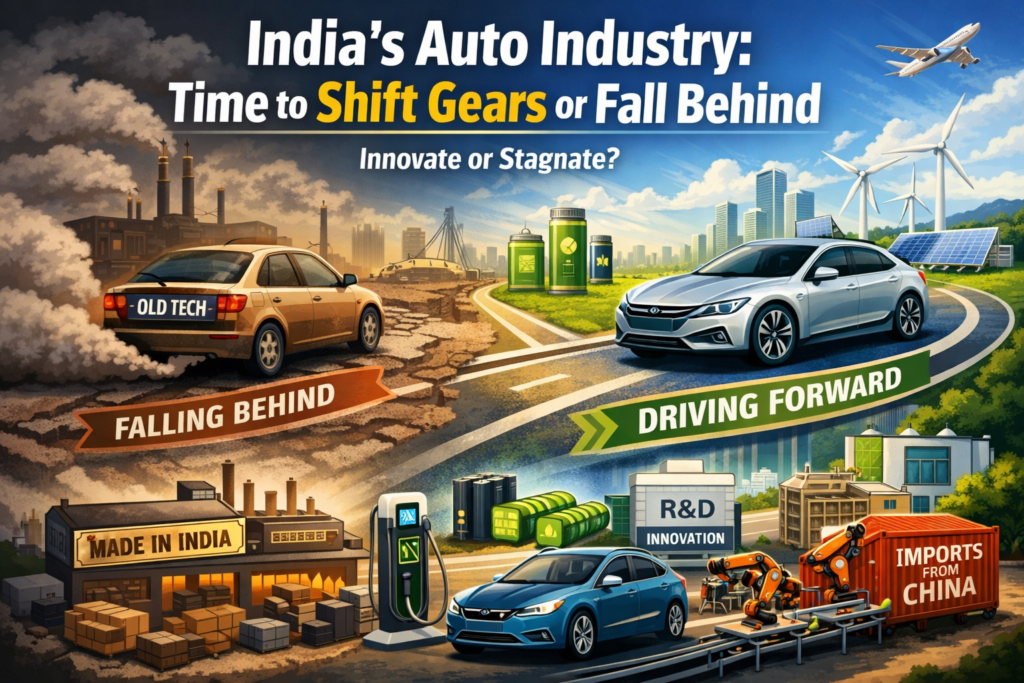
India’s automobile sector is no small player. Contributing about 7.1% to the country’s GDP and ranking as the world’s third-largest vehicle manufacturer, it’s a true powerhouse. In FY25, exports jumped 19% to over 5.3 million units, raking in billions — a clear sign the world wants Indian two-wheelers and passenger cars.
But here’s the twist: for a developed economy, autos drive growth through innovation, exports, and technology leadership. Think Germany’s Mercedes or Japan’s Toyota. Indian makers? Often the opposite. They stick to old formulas, delay upgrades, and miss future trends. Even in the EV revolution, big names like Tata Motors and Mahindra repeat old mistakes, leaning on imports and short-term fixes instead of homegrown innovation.
The Cost of Old-School Thinking
History tells the story. In the 1990s and 2000s, Indian cars lagged behind in safety, emissions, and tech — from ABS to airbags — only catching up when regulations forced the hand. The focus on low cost over innovation created models that struggled on the global stage. Today, the pattern continues with EVs.
India’s EV market is growing fast — sales reached 1.5 million in 2025 — but obstacles remain: high prices, poor charging infrastructure, and a fledgling domestic battery industry. Case in point: in 2026, the government extended a 5% duty on EV battery cells because local production is still limited.
Imports vs. Self-Reliance
Tata Motors and Mahindra dominate locally — Tata controls 53% of the EV car market, Mahindra close behind. But both rely heavily on imported technology. Tata’s Curvv and Mahindra’s BE 6e use batteries and parts mostly sourced from China and Europe. Mahindra’s batteries come from BYD’s Blade tech, efficient but not homegrown.
Tata announced a $1.5 billion gigafactory in 2025, aiming for battery localization by 2030 — yet most current models still depend on imports. Today, only 13% of Indian EVs qualify for government incentives, as battery cells (35-50% of costs) come from abroad. This dependence inflates prices, exposes supply chains to global shocks, and slows India’s journey to self-reliance.
The Design and Tech Gap
Indian EVs still lag behind global standards. Critics point out loud designs, high ground clearance, and interiors missing modern features like electronic parking brakes. Tata’s Harrier EV battery is a generation behind Mahindra’s BYD-sourced tech, losing 30% efficiency. Meanwhile, Chinese players like BYD innovate with affordable, high-tech EVs, capturing 30% of India’s market.
Mahindra is betting solely on EVs, skipping hybrids that could bridge gaps in charging infrastructure — a move echoing past mistakes of delaying innovation until competitors surged ahead.
Exports: Where India Shines — and Where It Misses
India exports half of its two-wheelers, showing global competitiveness. Cars, however, lag because of outdated tech. Developed nations export high-value vehicles, boosting jobs and transferring technology. India’s $23 billion auto parts exports face challenges like tariffs from the U.S., worsened by low localization. A stronger domestic production base could cut imports, save foreign exchange, and position India as a global hub.
What Needs to Change
To truly thrive, Indian automakers must shift gears:
- Invest boldly in R&D and modern design.
- Build battery plants now to reduce imports.
- Focus on quality and efficiency, not just cost-cutting.
- Adopt policies that go beyond subsidies, fostering long-term growth.
With EVs projected to hit $110 billion by 2029, the window to act is closing fast. The choice is clear: innovate now or risk falling behind again.
The Mantra Take
Here’s the guiding principle: innovation is the fuel, not just cost-cutting.
India’s auto sector has the talent, market, and global opportunity to lead — but only if it sheds old-school thinking. Technology should serve the people and the planet, not just short-term profits. By investing in homegrown batteries, modern designs, and global-standard quality, Indian automakers can create cars that every generation can be proud of, domestically and globally.
In short: stop following trends, start creating them. The future of mobility in India depends on bold action today — because the road waits for no one.