
While the world talks about AI, a quiet revolution is happening in the labs of Bengaluru and beyond. Quantum Computing has officially arrived in India, backed by a massive ₹6,003 crore National Mission. But how does this tech actually differ from the supercomputers we know? From Tata’s partnership with IBM to homegrown startups like QNu Labs, discover how India is securing its spot in the $40 billion global race to master the quantum realm.
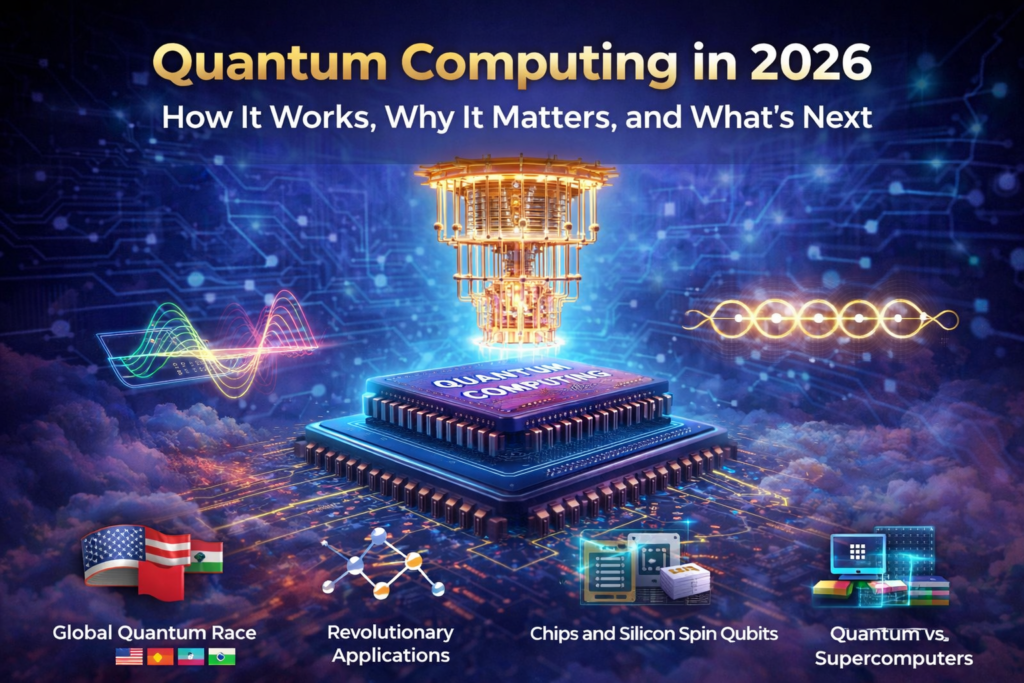
Quantum computing has emerged as one of the most talked-about frontiers in modern technology, captivating scientists, investors, and the public alike. Across platforms like X (formerly Twitter), discussions range from philosophical ideas—such as quantum entanglement mirroring human connections—to hard science, including error-correction breakthroughs and quantum-AI integration.
Once considered science fiction, quantum computing in 2026 is firmly grounded in reality, with practical applications beginning to reshape multiple industries.
Why Quantum Computing Is Dominating Global Conversations:
Current debates and trends include:
- Parallels between quantum entanglement and human connectivity
- Breakthroughs in quantum error correction
- Integration of quantum computing with machine learning
- Potential to solve unresolved physics mysteries:
- Wave–particle duality
- The quantum measurement problem
- Skepticism around overhyped applications, such as classical optimization problems like the Traveling Salesman Problem
Despite skepticism, momentum continues to build as hardware and software mature.
Quantum Computers vs Supercomputers: The Fundamental Difference
Supercomputers
Supercomputers dominate today’s high-performance computing landscape and are used for:
- Weather forecasting
- Climate simulations
- Nuclear modeling
- Large-scale scientific research
They rely on:
- Classical bits (0 or 1)
- Deterministic logic
- Massive parallel processing using thousands of CPUs/GPUs
Limitations:
They struggle with problems involving exponential complexity, where possibilities grow too fast to compute efficiently.
Quantum Computers
Quantum computers operate on entirely different principles:
- Qubits instead of bits
- Superposition – qubits exist in multiple states simultaneously
- Entanglement – qubits influence each other instantaneously
- Probabilistic outcomes instead of deterministic ones
Key advantages:
- Explore vast solution spaces simultaneously
- Exponential speedups for specific problem classes
- Ideal for quantum simulations, optimization, and cryptography
Key challenge:
- Fragility of qubits due to decoherence, requiring sophisticated error-correction systems
The Role of Chips: Bridging Classical and Quantum Worlds
Modern quantum computing is increasingly chip-driven, benefiting from advanced semiconductor manufacturing.
Key developments include:
- Quantum processors built on 300mm semiconductor wafers
- Technologies such as:
- Superconducting circuits
- Silicon spin qubits
- Photonic quantum chips
Industry collaborations:
- Quantinuum × Infineon – photonic-electronic hybrid chips
- SpinQ – vertically integrated quantum hardware
- Use of existing semiconductor supply chains for scalability
Benefits:
- Improved coherence times
- Reduced noise
- Faster commercialization
- Lower manufacturing barriers
Where Quantum Computing Will Change the World
Quantum computing’s real impact lies in industry-specific breakthroughs, including:
Healthcare & Drug Discovery
- Molecular simulations at atomic precision
- Faster discovery of treatments for complex diseases
Cryptography & Cybersecurity
- Threatens current encryption standards
- Enables quantum-safe and post-quantum cryptography
AI & Machine Learning
- Optimization of massive datasets
- Faster training of complex models
Climate & Materials Science
- Advanced climate modeling
- Discovery of new materials (superconductors, energy storage)
- Insights into dark energy and quantum materials
Logistics, Finance & Energy
- Real-time route optimization
- Portfolio risk modeling
- Smarter energy grids and sustainability solutions
Global Quantum Computing Race: Key Players in 2026
Global investments in quantum computing now exceed $40 billion, with intense international competition.
United States (US)
- Over 100,000 quantum patents
- Major players:
- IBM (Quantum System Two, fault-tolerant roadmap by 2029)
- Google (Sycamore processor)
- Microsoft (Majorana-1 topological qubit chip, 2025)
- IonQ (1,000+ qubit ambitions)
- Amazon (Braket)
- Honeywell / Quantinuum
China
- 56,000 patents
- $15 billion investment
- Strong focus on quantum communication and security
Europe
- Finland’s VTT & IQM launched Europe’s first 50-qubit system (2025)
- CERN-led collaborations promoting “quantum diplomacy”
Canada
- D-Wave – quantum annealing
- Xanadu – photonic quantum computing
India: A Rising Quantum Power
India is rapidly building a strong quantum ecosystem through the National Quantum Mission (NQM):
- Funding: ₹6,003 crore
- Four thematic hubs (operational since 2025):
- Quantum computing
- Quantum communication
- Quantum sensing
- Quantum materials
Key Indian players:
- QpiAI
- QNu Labs
- BQP
- SEALSQ (post-quantum semiconductor research)
Major collaboration:
- IBM × Tata – India’s largest quantum computer
India’s goal:
To lead globally in quantum software, applications, and ecosystem development
The Mantras Take: Quantum computing is no longer a theoretical experiment—it is a strategic technology shaping the future. While challenges like error rates and scalability remain, breakthroughs in chip integration, materials, and algorithms are accelerating progress.
As quantum systems mature and merge with classical infrastructure, they will redefine the limits of computation, reshaping science, industry, and geopolitics alike.
The quantum era has begun—and its impact will be profound.
Leave a comment below on your take:
Leave a Comment