By Puneeth Raj | February 21, 2026
India formally joined the US-led Pax Silica coalition on February 20, 2026, at the India AI Impact Summit, uniting trusted nations to build secure, resilient supply chains for AI hardware, semiconductors, and critical minerals—marking a pivotal step in India’s rise as a global tech powerhouse and deepening strategic ties with the United States.
In an era where artificial intelligence (AI) and advanced computing are fundamentally reshaping global economies, the Pax Silica initiative stands out as a strategic U.S.-led coalition dedicated to building secure, resilient, and innovation-driven supply chains for silicon-based technologies. Launched at a summit in Washington, D.C. in December 2025, Pax Silica derives its name from “Pax” (Latin for peace and prosperity) and “Silica” (silicon dioxide, the foundational material for semiconductors and AI hardware). The coalition unites trusted partner nations to safeguard the entire “silicon stack”—from critical minerals to AI infrastructure—against vulnerabilities such as over concentration and economic coercion in global supply chains.
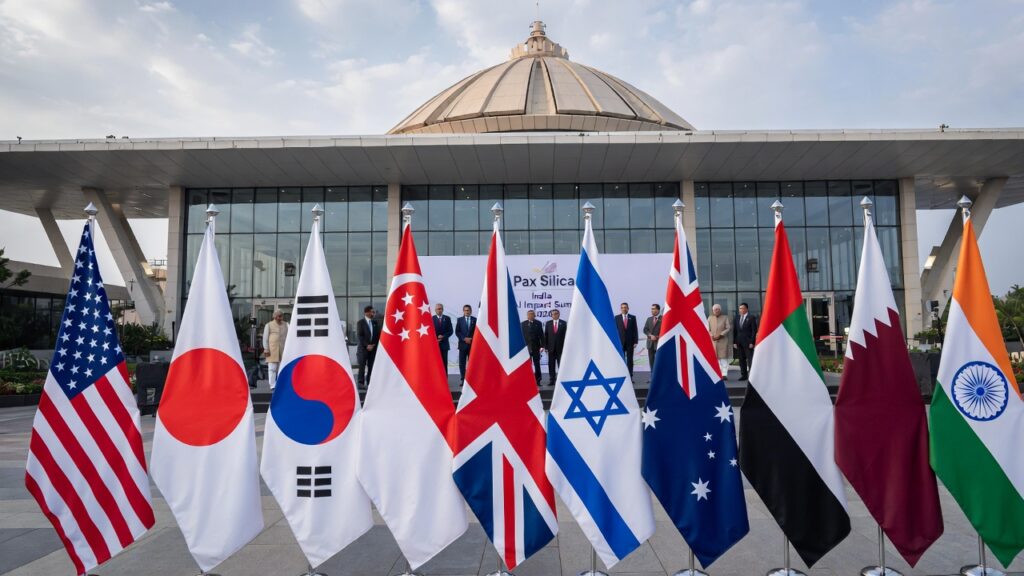
As of February 2026, the coalition comprises ten full members: the United States (lead), Japan, Republic of Korea, Singapore, United Kingdom, Israel, Australia, United Arab Emirates, Qatar, and India, which formally joined on February 20, 2026, during the India AI Impact Summit in New Delhi.
Pax Silica is a non-binding declaration of shared intent, emphasizing private-sector-led growth and “positive-sum” cooperation among aligned democracies. For India, this partnership is a powerful accelerator for its domestic semiconductor and AI ambitions, aligning international collaboration with national self-reliance goals.
Objectives of Pax Silica :
The Pax Silica Declaration articulates clear, ambitious objectives to ensure partner nations can harness the transformative potential of AI while minimizing systemic risks:
- Eliminate Coercive Dependencies — Reduce vulnerabilities arising from extreme concentration in supply chains, where single regions control over 65% of market share in more than 50 critical choke points across the semiconductor–AI value chain.
- Secure the Full Silicon Stack — Establish resilient, trusted flows of critical minerals (rare earths, lithium, cobalt), energy inputs, advanced manufacturing capacity, semiconductor fabrication, AI compute hardware, data centers, networks, and logistics.
- Drive Innovation and Shared Prosperity — Promote private-sector investment, ethical AI development, joint R&D, long-term resource offtake agreements, and new market creation in an AI-reorganized world economy.
- Advance Democratic Technology Governance — Align open societies to set responsible standards, build trustworthy digital infrastructure, and counter dominance by non-aligned actors in frontier technologies.
These goals blend industrial policy with strategic foreign affairs, creating a framework where complementary national strengths (e.g., mineral reserves, design talent, manufacturing expertise) reinforce collective security and competitiveness.
India’s Entry into Pax Silica
India joined Pax Silica as its tenth full member on February 20, 2026. The signing ceremony—attended by Ministry of Electronics and IT Secretary S. Krishnan, U.S. Ambassador Sergio Gor, and Under Secretary of State Jacob Helberg—marked a deepening of U.S.-India technology ties. U.S. officials described India’s participation as “strategic and essential,” highlighting its:
- World-class engineering and AI talent pool
- Rapidly expanding semiconductor design and fab ecosystem
- Third-largest global reserves of rare earth elements (~8.52 million tonnes)
The move complements India’s independent foreign policy while strengthening its position within like-minded democratic tech blocs.
Benefits for India’s Semiconductor Mission :
The India Semiconductor Mission (ISM), launched in 2021 with an initial ₹76,000 crore commitment and now evolving into ISM 2.0, seeks to build a complete domestic ecosystem spanning design, fabrication, assembly, testing, packaging, and materials. Pax Silica directly amplifies ISM’s progress by addressing key external constraints:
- Access to Restricted Advanced Tools — Smoother procurement of EUV lithography equipment, process know-how, and high-end GPUs, overcoming current global supply bottlenecks.
- Supply-Chain De-Risking — Diversification of critical mineral and rare-earth sourcing away from concentrated suppliers, aligning seamlessly with India’s National Critical Mineral Mission.
- Accelerated FDI and Partnerships — Enhanced investor confidence and joint-venture opportunities with coalition members, boosting schemes such as Production-Linked Incentives (PLI) and generating high-skill employment.
- Strategic Leverage in Global Standards — Greater influence in international technology governance, reducing long-term import dependence and positioning India as a high-value manufacturing hub.
Union IT Minister Ashwini Vaishnaw has emphasized that Pax Silica helps create a “complete ecosystem” for electronics, enabling compounding economic growth and semiconductor leadership.
Recent Budget Allocations and Their Synergy with Pax Silica :
The Union Budget 2026-27 (presented February 1, 2026) delivers targeted fiscal firepower that perfectly complements Pax Silica’s international framework. Key provisions include:
- India Semiconductor Mission 2.0 — ₹1,000 crore for FY 2026-27, focusing on domestic production of semiconductor equipment, wafer/materials, specialty chemicals, full-stack Indian IP, expanded design ecosystem, and industry-led talent/research centers.
- Modified Programme for Semiconductor & Display Manufacturing Ecosystem — ₹8,000 crore allocated for 2026-27 (up from ₹4,300 crore revised estimate), supporting ongoing fabs, ATMP/OSAT facilities, and projected ₹15,000+ crore in private investments.
- Electronics Components Manufacturing Scheme (ECMS) — Overall outlay nearly doubled to ₹40,000 crore, incentivizing domestic hardware, components, and critical-minerals processing (149 applications already received).
- Rare Earth Corridors — Dedicated mining–processing–manufacturing corridors in Odisha, Kerala, Andhra Pradesh, and Tamil Nadu, backed by full customs duty exemptions on processing machinery and the ₹7,280 crore Rare Earth Permanent Magnet (REPM) scheme (6,000 MTPA capacity target).
- AI & Compute Infrastructure — ₹1,000 crore for IndiaAI Mission (focused on compute expansion, R&D, applications), plus long-term tax holidays (until 2047) for foreign cloud providers utilizing Indian data centers, and sector-specific AI projects under Bharat-VISTAAR.
These allocations (~₹50,000+ crore across targeted tech sectors) provide the domestic financial engine to turn Pax Silica’s strategic access into tangible manufacturing and AI scale-up.
Pax Silica’s Major Role in Chip Supply and AI for India :
Pax Silica, reinforced by the 2026-27 Budget, positions India to play a transformative role in global chip supply chains and AI deployment:
- Resilient Chip Supply — Trusted coalition networks + domestic REE corridors and ISM 2.0 materials/equipment manufacturing reduce vulnerabilities and enable India to supply reliable semiconductors for AI compute worldwide.
- Scalable AI Infrastructure — Priority access to frontier GPUs/hardware + budget-backed data-center/cloud incentives create secure, high-capacity domestic compute, supporting massive AI rollout across sectors.
- Indigenous IP & Talent Leadership — Collaborative R&D frameworks + ISM talent initiatives build a million-strong skilled workforce and full-stack Indian chip/AI IP, driving long-term competitiveness.
- Geopolitical & Economic Security — Integrated domestic–international capabilities mitigate coercion risks, strengthen global governance influence, and unlock sustained FDI.
- Secure, Export-Oriented Chip Ecosystem — Combined effect turns import dependence into export capability, stabilizing coalition-wide supply chains amid geopolitical disruptions.
- Sector-Wide AI Leadership — Massive compute scaling + Bharat-VISTAAR-style applications in agriculture, healthcare, governance, and defense create broad-based economic multipliers in an AI-driven world.
The Mantra’s take :
Pax Silica represents a foundational step toward a secure, democratic AI-powered global order. For India, it is a timely strategic multiplier—bridging international de-risking with robust domestic investment to propel the Semiconductor Mission and IndiaAI ecosystem forward. With Pax Silica’s geopolitical alignment and the 2026-27 Budget’s fiscal momentum, India stands poised to evolve from a design and talent powerhouse into a full-spectrum leader in semiconductors and AI—contributing decisively to, and benefiting richly from, a resilient and prosperous technology future for free societies.