
Milky Way Galaxy discoveries reveal how stars, dark matter, and life connect. Dive into our galaxy’s hidden story. Learn how.
Published on: 11/01/2026
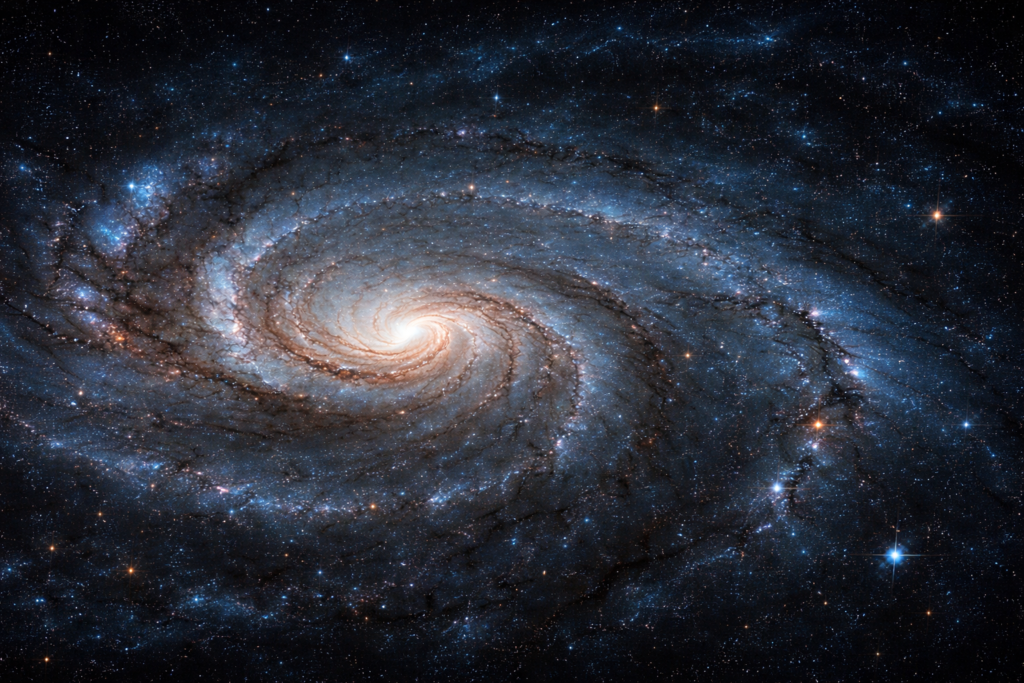
The Milky Way: Our Cosmic Home and Its Hidden Secrets
On a clear, moonless night, if you look up from a quiet place away from city lights, you’ll see a soft, glowing river of stars stretching across the sky. That pale band is the Milky Way—our cosmic address in an unimaginably vast universe. For ancient civilizations, it was myth and mystery. For modern science, it is a living laboratory filled with secrets still waiting to be uncovered.
The Milky Way is a barred spiral galaxy, a graceful swirl of stars, gas, and dust shaped by gravity over billions of years. Scientists estimate it contains 100 to 400 billion stars, many with planets of their own. Somewhere in one of its quieter corners lies our Solar System, circling the galactic center like a tiny boat on an enormous cosmic ocean.
The Quiet Giant at the Heart of the Galaxy
At the very center of the Milky Way sits Sagittarius A—a supermassive black hole with a mass about four million times that of our Sun. In 2022, humanity saw its shadow for the first time, thanks to the Event Horizon Telescope, offering dramatic confirmation of Einstein’s theories under extreme conditions.
Yet this cosmic giant behaves surprisingly calmly. Unlike black holes in distant galaxies that blaze brightly as they devour nearby matter, Sagittarius A* is relatively quiet. Why it feeds so slowly remains one of astronomy’s most intriguing puzzles.
A Galaxy That Isn’t Flat or Calm
For a long time, astronomers imagined the Milky Way as a neat, flat spiral. Reality is far more fascinating.
The galaxy has a central bar, two major spiral arms, and several smaller ones. Our Solar System sits in the Orion Arm, about 26,000 light-years from the center—far enough to enjoy a relatively peaceful cosmic neighborhood.
Thanks to data from the Gaia spacecraft, we now know the Milky Way is warped and twisted, like a bent vinyl record. These distortions likely come from past collisions with smaller galaxies and ongoing gravitational interactions. Our galaxy is not a quiet island—it’s shaped by cosmic encounters.
The Invisible Glue Holding Everything Together
One of the Milky Way’s greatest mysteries is dark matter.
Although invisible, dark matter makes up about 85% of the galaxy’s mass. It acts like an unseen framework, holding stars in their orbits and preventing the galaxy from tearing itself apart. Without dark matter, the Milky Way as we know it wouldn’t exist.
Despite decades of experiments, scientists still don’t know what dark matter is made of. The leading candidates—exotic particles like WIMPs or axions—remain elusive, reminding us how much of the universe lies beyond our current understanding.
A Galactic Recycling System
The Milky Way is not just a collection of stars—it’s a cosmic recycler.
Stars are born in vast clouds of gas and dust called nebulae, shine for billions of years, and die in dramatic explosions or gentle fades. When massive stars explode as supernovae, they scatter heavy elements across space—elements like carbon, oxygen, and iron.
Every atom in your body was forged in ancient stars. In a very real sense, we are made of recycled stardust, linked to cosmic events that happened long before Earth existed.
The Big Question: Where Is Everyone?
Given the Milky Way’s size and age, many scientists wonder why we haven’t found evidence of intelligent alien civilizations. This puzzle is known as the Fermi Paradox.
Some theories suggest intelligent life is extremely rare. Others propose that advanced civilizations tend to destroy themselves, or that they choose not to communicate. The vast distances of the galaxy—where light itself takes tens of thousands of years to travel—may also mean signals simply haven’t reached us yet.
For now, the Milky Way keeps its secrets close.
A Galaxy Still Growing—and Headed for a Collision
The Milky Way is not finished forming. Data from Gaia has revealed streams of stars left behind by smaller galaxies that were absorbed long ago. Even today, the galaxy continues to grow through these slow cosmic mergers.
Looking far into the future, about 4.5 billion years from now, the Milky Way will collide with the neighboring Andromeda Galaxy. The result will be a massive new galaxy, reshaping the night sky forever. Our Solar System is expected to survive, though it may be flung into a completely new region of space.
A Story Still Being Written
With powerful tools like the James Webb Space Telescope and upcoming observatories, astronomers are peeling back the layers of our galaxy faster than ever before. Each discovery rewrites what we thought we knew.
The Milky Way is not just where we live—it’s a reminder that even in a universe filled with billions of galaxies, home itself is full of wonder.
The Mantras Take
The Milky Way teaches us humility. In a galaxy billions of years old and billions of stars wide, humanity is both insignificant and extraordinary. We are small enough to be stardust, yet curious enough to understand the stars that created us. The more we explore our galaxy, the clearer one truth becomes: knowledge expands not by answers alone, but by our courage to keep asking questions about where we come from—and where we might one day go.