
Written By: Vaishak Kaverappa| March 1st, 2026
When headlines say “Missile Strikes” or “Regional Escalation,” markets react in seconds. But behind those numbers are real people — construction workers in Dubai, nurses in Doha, taxi drivers in Kuwait City, airline staff in Abu Dhabi — wondering if their job, their salary, or their safety is at risk.
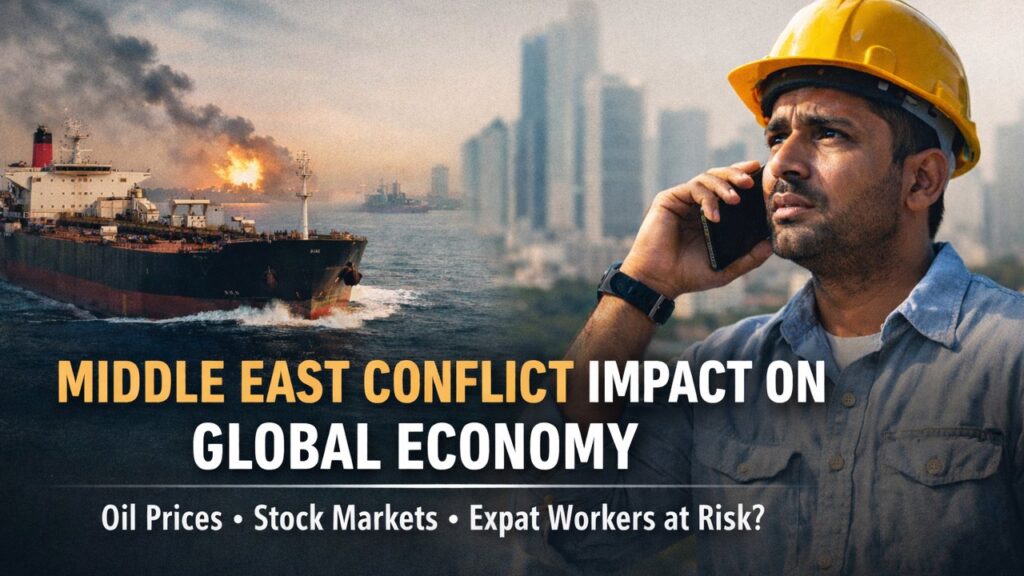
At 3:17 AM, a construction worker in Dubai wakes up to breaking news alerts.
“Missile interceptions over Gulf airspace”
His wife in India has already messaged him:
Are you safe? Should you come back?
For global investors, this is a geopolitical headline. For him, it’s about school fees, loan payments, and job security.
This is the real Middle East conflict impact on global economy — not just falling stock markets, but rising fear in ordinary homes.
When tensions rise in the Gulf, the world reacts within minutes. Oil prices move. Global markets shake. Inflation risks return. And millions of expat workers in Gulf countries start worrying about their future.
Let’s break it down.
How Middle East Conflict Impacts Global Markets
The moment conflict escalates, global investors become nervous.
Money moves out of risky assets like stocks and into safer options like gold and the US dollar. This is why you often see:
- Stock markets falling
- Gold prices rising
- Emerging markets under pressure
The impact of Gulf tensions on stock market is immediate because markets hate uncertainty.
Even if the conflict is limited, fear spreads faster than facts.
Why Oil Prices Surge During Gulf Tensions
One of the biggest reasons global markets react is oil.
The Gulf region supplies a large share of the world’s crude oil. When there is instability, traders fear supply disruptions. As a result, we see an oil price surge due to war.
When oil prices rise:
- Petrol and diesel become expensive
- Airline tickets increase
- Food transport costs rise
- Inflation returns
This is how Middle East tensions affect oil prices and eventually your monthly budget.
Countries like India, Japan, and many European nations depend heavily on Gulf oil. So the Middle East conflict impact on global economy directly affects oil-importing countries.
Global Energy Supply Risk
A narrow waterway called the Strait of Hormuz carries a significant portion of the world’s oil supply. If tensions threaten this route:
- Shipping insurance costs rise
- Tanker movement slows
- Global energy supply becomes uncertain
Even the possibility of disruption can push oil higher.
Impact on Expat Workers in UAE, Qatar, and Kuwait
This is where the story becomes personal.
Millions of expatriates work in the United Arab Emirates, Qatar, and Kuwait. They work in:
- Construction
- Hospitality
- Healthcare
- Aviation
- Retail
- IT
During short-term tension, life continues carefully. But if instability continues:
- New projects get delayed
- Companies freeze hiring
- Overtime disappears
- Contract renewals slow down
The impact on expat workers in Gulf countries is not immediate job loss — it’s growing uncertainty.
Families back home depend on remittances. If hiring slows, the remittance impact from Gulf countries affects small towns and rural economies.
For many households, this is not politics. It is survival.
Airlines, Tourism & Business Slowdown
The Gulf is one of the world’s busiest aviation hubs. Cities like Dubai and Doha connect continents.
If airspace restrictions happen:
- Flights are rerouted
- Travel becomes expensive
- Tourism slows
- Airlines face losses
This adds to the economic pressure.
Even business investments slow down during uncertainty.
How Middle East Crisis Affects India and Other Emerging Markets
Let’s look at how Middle East war affects India.
India imports a large amount of oil from the Gulf. So when oil rises:
- Fuel prices increase
- Transport costs rise
- Food becomes expensive
- Inflation pressure builds
This weakens purchasing power.
Emerging markets often see currency pressure during geopolitical shocks. Investors pull money out, which increases volatility.
So the global markets and Middle East crisis are closely linked to emerging economies.
Best Case vs Worst Case Scenario
Best Case
- Limited escalation
- Quick diplomatic talks
- Oil stabilizes
- Global markets recover
- Worker confidence returns
Markets usually recover when uncertainty reduces.
Worst Case
- Prolonged regional instability
- Major oil supply disruption
- Oil crossing extreme levels
- Hiring freeze in Gulf countries
- Inflation surge globally
In that case, the Middle East conflict impact on global economy becomes long-term and structural.
The Mantras Take:
The global markets and Middle East crisis story is not only about governments. It is about workers, families, and monthly budgets. Markets may recover. Diplomats may negotiate. Leaders may change strategies. But ordinary people carry the real weight of global instability.