
By 2040, India’s skies could be defended by a layered force of homegrown AMCA stealth fighters acting as ‘mothers’ to swarms of loyal drones, leapfrogged to sixth-generation superiority through a bold French partnership—yet today, with barely 29 squadrons against a sanctioned 42 and China’s J-20 fleet surging past 300, the IAF faces its most urgent modernization race in decades: bridge the gap now, or risk deterrence failure.
By Puneeth Raj | February 2026
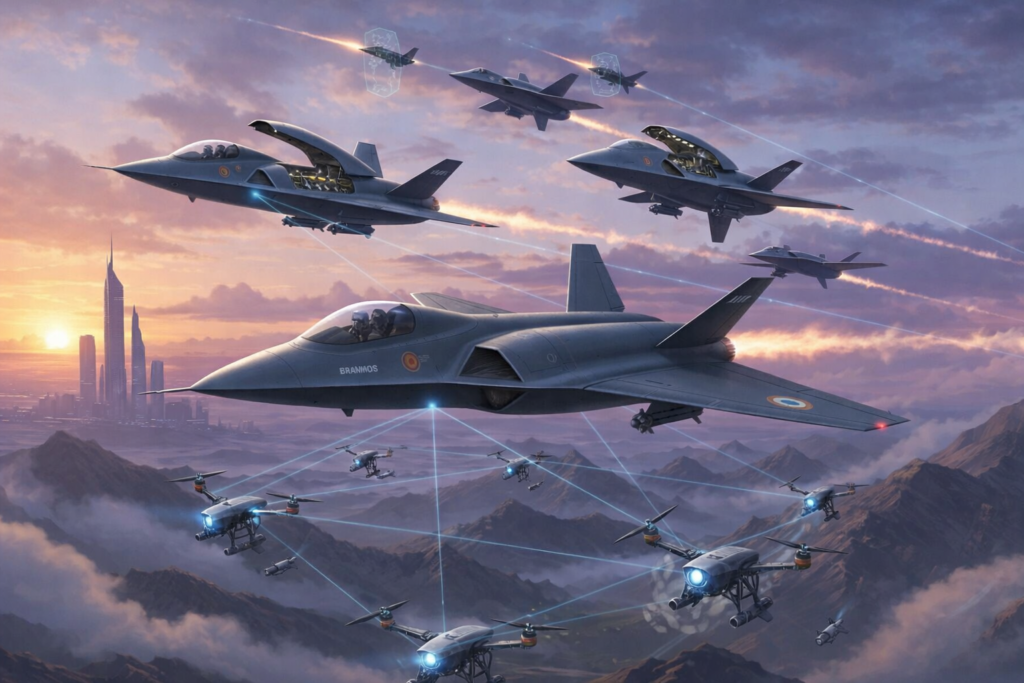
As of late February 2026, the Indian Air Force (IAF) stands at a strategic crossroads. Operating with approximately 29 combat squadrons (roughly 450–520 fighters), the force remains significantly below its long-sanctioned strength of 42 squadrons. This shortfall—a gap of nearly 200 aircraft—is the result of a “perfect storm”: the full retirement of the MiG-21 fleet in September 2025, the ongoing phase-out of legacy Jaguars and Mirage-2000s, and persistent delays in indigenous programs. Recent technical hurdles, including the grounding of approximately 30 Tejas Mk1 aircraft, have further strained operational readiness.
The Elephant in the Hangar: The China Challenge
The primary driver for India’s modernization is the rapid expansion of the People’s Liberation Army Air Force (PLAAF). Fielding over 3,150 aircraft, China’s fifth-generation growth is unprecedented. Estimates place the J-20 stealth fighter fleet at over 300 units as of late 2025, with production rates suggesting a force of 1,000 by 2030. When coupled with emerging J-35 variants and H-20 strategic bombers, the IAF faces an asymmetric threat that necessitates a total fleet restoration to at least 42–50 squadrons to maintain credible Indo-Pacific deterrence.
To address this, India is navigating three interconnected tracks: an interim stealth bridge, the indigenous AMCA backbone, and a leap into sixth-generation collaboration.
1. The Interim Bridge: The Su-57E Dilemma
Russia’s Su-57E remains a technically potent contender for India’s near-term stealth needs. Negotiations have reached an advanced stage, involving potential joint production at HAL Nashik and full source-code access. Russia has offered 36–40 units via a government-to-government deal to serve as a bridge to India’s own stealth programs.
However, geopolitical reality has stalled the engines. Acquisition is effectively postponed until the resolution of the Ukraine conflict to mitigate sanctions-related risks regarding spares and logistics. Consequently, the IAF has excluded the Su-57E from the Multi-Role Fighter Aircraft (MRFA) program, prioritizing the scaling of the Rafale ecosystem for operational continuity. The Su-57E remains a “niche interim” possibility, secondary to Western and indigenous priorities.
2. The Indigenous Backbone: AMCA Mk1 & Mk2
The Advanced Medium Combat Aircraft (AMCA) is the crown jewel of India’s strategic autonomy. With ₹15,000 crore approved for five prototypes, a private-sector-led consortium (including Tata, L&T, and Bharat Forge) is working alongside HAL to accelerate execution.
- AMCA Mk1 (The Entry Point): Powered by the GE F414 engine, the Mk1 serves as the foundational fifth-generation platform. With prototype assembly slated for late 2027 and a first flight in 2029, the IAF expects low-rate production by 2034.
- AMCA Mk2 (The “Mother of Drones”): This 5.5-generation variant will feature superior thrust, AI-driven sensor fusion, and Manned-Unmanned Teaming (MUM-T) capabilities. It is designed to act as a hub, commanding “Loyal Wingman” drones like the Ghatak UCAV and CATS Warrior in high-threat environments.
The Engine Breakthrough
The most critical milestone is the November 2025 agreement with France’s Safran to co-develop a clean-sheet 120–140 kN turbofan engine. Unlike previous deals, this includes 100% technology transfer and Indian IP rights. With final CCS clearance expected by mid-2026, this sovereign engine will power the Mk2, though validation risks may push full induction toward the late 2030s.
3. The Sixth-Generation Horizon: FCAS and France
As the European Future Combat Air System (FCAS) faces internal friction between France, Germany, and Spain, India has emerged as a high-value “Tier 1” partner. Leveraging the 2026 India-France Year of Innovation, New Delhi is exploring a 33–40% workshare in the program.
A partnership in FCAS offers a “hedge” against AMCA delays and provides a leapfrog into sixth-generation technologies: hypersonic weapons, sovereign tactical clouds, and AI swarms. This aligns with a layered fleet strategy: AMCA as the fifth-gen core, supported by a sixth-gen FCAS overlay.
The Path Forward: Pragmatism vs. Ambition
The IAF’s trajectory for 2040 requires a delicate balancing act:
- Immediate: Rapidly scale the Rafale fleet via the MRFA program to arrest squadron depletion.
- Mid-Term: Solidify the private-sector-led AMCA Mk1 production line.
- Long-Term: Secure air sovereignty through the Safran engine deal and sixth-generation global partnerships.
By blending aggressive indigenous development with strategic Western alliances, India is moving away from “buyer” status and toward becoming a global aerospace power capable of deterring a peer-competitor in the high-stakes theater of the 21st century.