
India can launch missions to Mars and the Moon—but moving goods faster across the country required a revolution on the ground. That revolution is the Dedicated Freight Corridor (DFC).
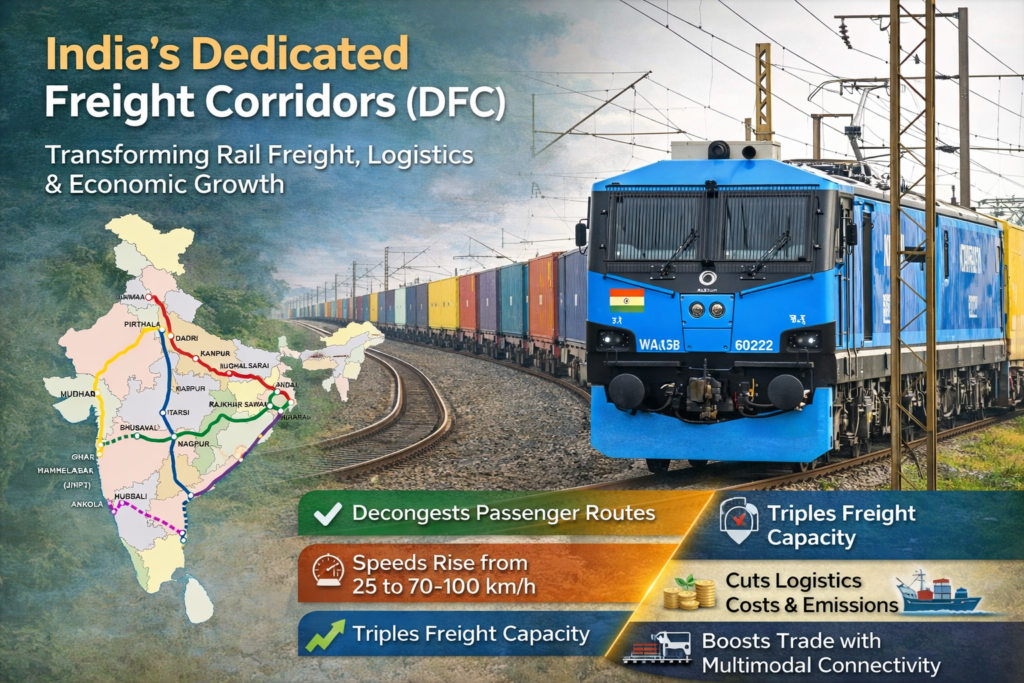
India’s Dedicated Freight Corridors (DFC) are a flagship infrastructure initiative by the Dedicated Freight Corridor Corporation of India Limited (DFCCIL), under the Ministry of Railways. These electrified, double-line tracks are exclusively for freight trains, separating them from passenger services to eliminate congestion and boost efficiency. Designed for heavy axle loads (up to 25 tonnes) and speeds of 100 km/h, the corridors support double-stack containers and longer trains. As of early 2026, the Eastern Dedicated Freight Corridor (EDFC) is fully operational, while the Western Dedicated Freight Corridor (WDFC) is over 96% commissioned, with full completion expected soon.
Key Routes:
Project Status (As of Early 2026)
- Eastern Dedicated Freight Corridor (EDFC) is fully operational.
- Western Dedicated Freight Corridor (WDFC) is over 96% commissioned, with full completion expected soon.
Eastern Dedicated Freight Corridor (EDFC)
- Total length: Approximately 1,337 km
- Route: Sahnewal (near Ludhiana, Punjab) to Sonnagar (Bihar)
(Extensions planned up to Dankuni, West Bengal)
Major Sections:
- Sahnewal to Khurja – 401 km
- Khurja to Bhaupur – 351 km
- Bhaupur to Deen Dayal Upadhyay Junction – 402 km
- Deen Dayal Upadhyay Junction to Sonnagar – 137 km
- Khurja to Dadri branch – 46 km
States Covered:
- Punjab
- Haryana
- Uttar Pradesh
- Bihar
- Jharkhand
Primary Focus:
- Transportation of coal, fertilizers, and food grains
- Connecting eastern mineral-rich regions to northern consumption centers
Western Dedicated Freight Corridor (WDFC)
- Total length: Approximately 1,506 km
- Route: Dadri (Uttar Pradesh) to Jawaharlal Nehru Port Trust – JNPT (Maharashtra)
Key Route Path:
- Dadri → Rewari → Ajmer → Ahmedabad → Vadodara → Surat → JNPT
States Covered:
- Uttar Pradesh
- Haryana
- Rajasthan
- Gujarat
- Maharashtra
Primary Focus:
- Container traffic
- Boosting exports and imports by linking western ports to the northern hinterland
Future expansions include East-West, East-Coast, and North-South corridors for a nationwide freight grid.
How DFC Enhances India’s Transport System:
The DFC project is transforming logistics by shifting freight from roads to rails, aligning with sustainable growth goals:
- Decongestion: Frees existing railway lines for more passenger trains, reducing delays.
- Faster Transit: Average freight speeds increase from 25–30 km/h to 70–100 km/h, cutting journey time by half.
- Higher Capacity: Handles trains up to 13,000 tonnes with double-stack operations, potentially tripling freight volumes.
- Cost & Environmental Benefits:
Logistics costs reduced by 20–30%
Lower fuel consumption and reduced carbon emissions
- Multimodal Connectivity: Seamless integration with ports, highways, and industrial hubs
India’s Powerful Railway Goods Engines:
Leading the charge on DFCs is the WAG-12B, India’s most powerful electric freight locomotive with 12,000 horsepower. Built under the Make in India initiative at Madhepura, Bihar, in collaboration with Alstom, it hauls over 6,000-tonne trains at up to 120 km/h. Features include regenerative braking, advanced IGBT technology, and crew comforts like air conditioning. Over 550 units are in service as of 2025, enabling heavy-haul efficiency on these corridors.
In essence, the DFCs are pivotal for India’s ambition to become a logistics powerhouse, supporting Viksit Bharat by 2047 through efficient, green freight movement.
What are your thoughts on this massive infrastructure shift? Let us know in the comments!
Leave a Comment