
India Youth Unemployment exposes the gap between education and jobs. Discover government planning and Zoho-style skill models. Read more.
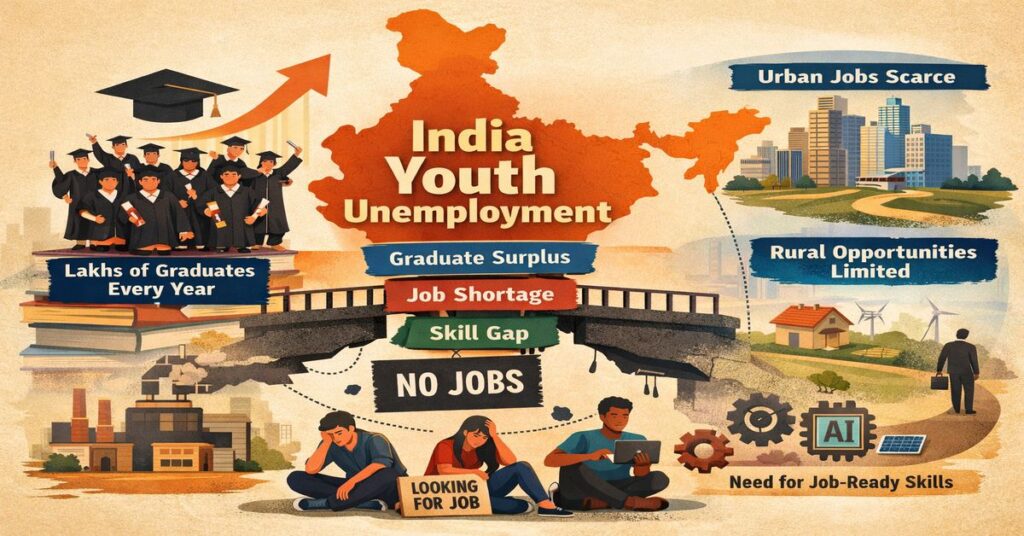
India’s youth unemployment challenge continues to be a pressing concern, even as overall jobless rates show signs of improvement. As of November 2025, unemployment dipped to 4.7%, reflecting better labour force participation. However, this headline number hides a deeper structural issue—millions of young graduates entering the job market each year without matching opportunities.
Every year, lakhs of students graduate from Indian colleges and universities. Unfortunately, many of them struggle to find suitable employment. The root cause isn’t a lack of education, but a mismatch between what students learn and what employers actually need. This gap often results in underemployment, delayed careers, or complete joblessness.
The good news? This problem is predictable—and therefore preventable.
Since the government already tracks student enrollments and knows the duration of most degree programs (typically 3–5 years), it can forecast how many graduates will enter the workforce well in advance. With better planning, this data can be aligned with job creation and skill development initiatives.
This article explores how government-led workforce planning, combined with industry-driven training models like Zoho’s, can help ensure students graduate not just with degrees—but with jobs.
Understanding the Education–Employment Mismatch
India has one of the largest higher education systems in the world, with over 1,000 universities producing millions of graduates every year. Tools such as the All-India Survey on Higher Education (AISHE) capture enrollment and graduation data, but they stop short of linking education outcomes with employment demand.
Urban unemployment stands at 5.2%, higher than the rural rate of 4.2%, highlighting the pressure on city job markets where most graduates migrate. Surveys like the Periodic Labour Force Survey (PLFS) offer insights into past employment trends, but they are largely reactive. What India needs is forward-looking workforce planning, not post-crisis analysis.
Without anticipation, the country risks producing excess graduates in saturated fields while industries struggle to find skilled talent in emerging sectors.
How the Government Can Plan Ahead—Not Play Catch-Up
To prevent future unemployment spikes, India needs a unified system that connects education data with labour market forecasting.
1. Track Students from Enrollment to Graduation
Platforms like the National Career Service (NCS) can be expanded to follow students from college entry to graduation. This would allow policymakers to predict how many graduates will enter the job market by discipline, region, and skill set—and identify oversupply early (for example, too many commerce graduates when tech roles are growing).
2. Forecast Job Demand in Advance
Regular collaboration with industry bodies such as NASSCOM and annual PLFS-based assessments can help estimate future job demand. If 10 lakh engineers are graduating but only 6 lakh jobs are projected, the government can proactively encourage job creation in emerging fields like AI, green energy, semiconductor manufacturing, and renewables.
3. Create Jobs Where They’re Needed Most
Schemes like the Employment-Linked Incentive (ELI)—with an allocation of ₹1 trillion and a target of 3.5 crore jobs—should focus on regions with high unemployment. Incentivizing industries to invest in states like Bihar and Jharkhand can reduce migration pressure and promote balanced growth.
Preparing Students Before They Graduate: Learning from Zoho’s Model
Planning alone isn’t enough. A major gap lies in how students are prepared during their studies.
Traditional education in India still prioritizes theory and examinations over practical, job-ready skills. This is where industry-led training models—like Zoho’s—offer valuable lessons.
Zoho, one of India’s leading technology companies, has demonstrated that skills matter more than degrees. Through its Zoho Schools of Learning, the company trains students straight out of school (after 10+2) and college students through an alternative education path.
The program includes:
- One year of intensive classroom training
- A paid internship
- No tuition fees
- No mandatory university degree
By removing degree barriers and focusing on hands-on learning, Zoho has successfully built a highly skilled workforce—especially by nurturing rural and local talent.
Scaling Industry-Led Training Across India
To replicate this success nationwide, government and institutions can take the following steps:
1. Embed Industry Training into College Curricula
Universities should partner with companies like Zoho to offer in-college bootcamps, apprenticeships, and certification programs, especially in final years. Skills like software development, data analytics, cloud computing, and digital marketing can be taught alongside regular coursework.
2. Promote Skill-First, Earn-While-Learn Models
Students should be encouraged to earn stipends while learning practical skills. Government initiatives under Skill India can subsidize such programs, ensuring students start building employability from their first year of college—not after graduation.
3. Mentorship and Real-World Projects
Pairing students with industry mentors and live projects can transform education. Zoho’s emphasis on real-world problem-solving over rote learning shows how graduates can become productive from day one.
4. Policy Support for Nationwide Adoption
Universities should be mandated to allocate curriculum time for skill development, while companies that participate should receive tax benefits or incentives. Such reforms can significantly reduce graduate unemployment and make education outcome-driven.
The Mantra Take
We have one of the largest education systems in the world. But a degree is just a piece of paper if it doesn’t come with a paycheck.
To build a Viksit Bharat (Developed India), we need to stop obsessing over “Rankings” and start obsessing over “Readiness.” Whether it is through government planning or the Zoho model, the goal is clear: Don’t just make them Graduates. Make them Employable—or better yet, make them Entrepreneurs.
Leave a Comment