
By Puneeth Raj | February 22, 2026
In calendar year 2025, India achieved a historic milestone: total electronics exports crossed a record $47 billion (≈ ₹4.15 lakh crore) for the first time, surging 37% from $34.93 billion in 2024.
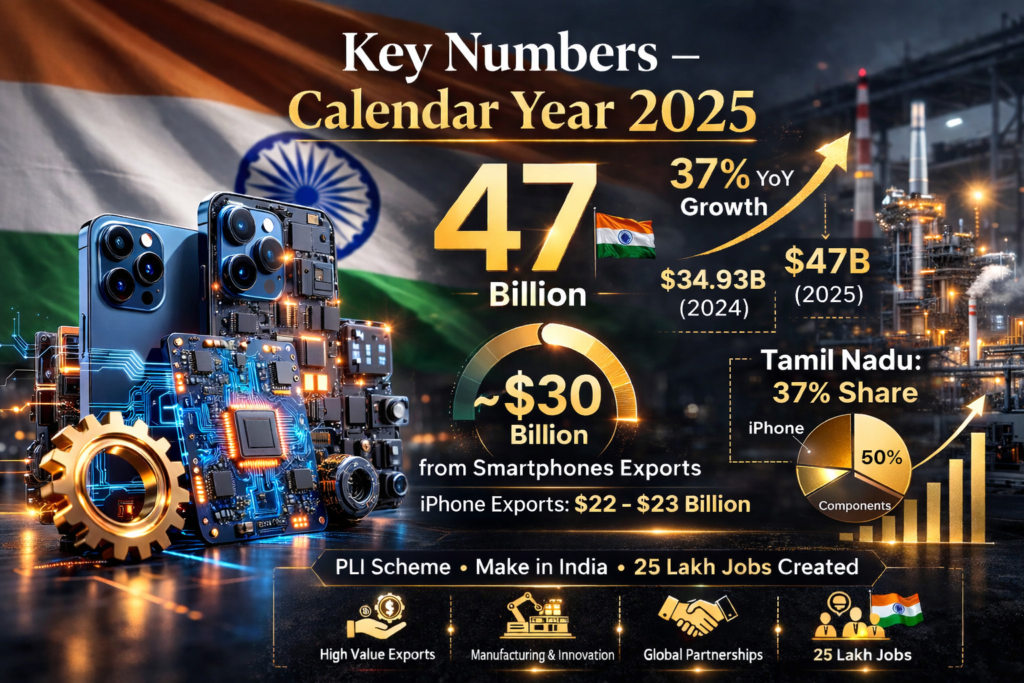
India’s electronics manufacturing sector has delivered one of the most impressive industrial turnarounds of the past decade. Once almost entirely dependent on imports for consumer electronics, India is now the world’s second-largest smartphone producer and a rapidly growing net exporter. In calendar year 2025, total electronics exports reached a historic $47 billion (≈ ₹4.15 lakh crore), a strong 37% increase from $34.93 billion in 2024, according to official Department of Commerce data and Union Minister Ashwini Vaishnaw’s January 2026 announcement.
Smartphones drove roughly two-thirds of this total (~$30 billion), with Apple’s iPhone exports from India alone estimated at $22–23 billion — accounting for nearly half of all electronics exports in 2025. The journey from negligible exports in the mid-2010s to this landmark figure is a clear demonstration of what aligned industrial policy, private capital, and global supply-chain realignment can achieve under Make in India and Atmanirbhar Bharat.
The Turning Point: Policy + Geopolitics + Market Scale
The transformation accelerated with:
- Make in India (2014) — Enabled 100% FDI in electronics and created foundational policy momentum.
- Production-Linked Incentive (PLI) scheme for Large Scale Electronics Manufacturing (2020) — Provided 4–6% incentives on incremental sales, attracted massive investments, and enforced deeper local value addition through phased manufacturing requirements.
- Geopolitical tailwinds — US–China trade tensions, tariffs on Chinese goods, and the global “China+1” diversification strategy made India an attractive alternative hub.
By 2025, over 99% of smartphones sold in the domestic market were assembled locally. The PLI scheme — widely regarded as one of the most effective among the 14 sectors covered — has delivered:
- Cumulative investments of ~₹2.16 lakh crore across PLI sectors
- Production/sales of ~₹20.41 lakh crore
- Exports of ~₹8.3 lakh crore
- Direct employment of ~1.44 million people (as of late 2025)
In 2025, electronics emerged as one of India’s top three export categories, frequently ranking third behind petroleum products and gems & jewellery.
Key Numbers – Calendar Year 2025
- Total electronics exports: $47 billion (~₹4.15 lakh crore)
- Smartphone exports: ~$30 billion
- Apple iPhone exports from India: ~$22–23 billion (up ~85% YoY)
- Cumulative iPhone exports under PLI by end-2025: >$50 billion
- Share of India-made smartphones exported: ~1 in 4 units produced
- Leading exporting state: Tamil Nadu (~37% of national electronics exports in FY 2025)
- Early FY2026 momentum: ~$22.2 billion in electronics exports in H1 (Apr–Sep 2025)
Major Players Powering the Export Surge
India’s scale relies heavily on contract manufacturing (EMS – Electronics Manufacturing Services), where global brands partner with large factories.
| Player | Type | Key Contributions (2025) | Recent Updates (Early 2026) |
|---|---|---|---|
| Apple | Brand | Exported ~$23 billion iPhones (~75% of smartphone exports, up 85% YoY); cumulative PLI exports >$50 billion by Dec 2025. Assembled iPhone 16 series in India. | Expanded to five factories (3 Tata, 2 Foxconn); Q1 FY26 exports ~$6 billion (78% of total smartphones). |
| Samsung | Brand/Own Plants | Mid/premium exports via Noida/Tamil Nadu facilities; ~12% of smartphone exports. | Exported ~$17 billion under PLI; plans capacity doubling for foldables. |
| Foxconn (Hon Hai) | EMS | Apple’s primary partner; Tamil Nadu/Andhra facilities drove iPhone surge (25-30 million exports targeted). | Doubling output; new Chennai plant operational, focusing on AI servers. |
| Tata Electronics | EMS | Acquired Pegatron/Wistron stakes; handles ~30% iPhone output. | Three key plants; Morigaon OSAT ramping for AI accelerators. |
| Pegatron | EMS | Tamil Nadu facilities; integrated with Tata. | Expanded via partnerships; Q4 2025 output up 40%. |
| Dixon Technologies | EMS (Domestic) | Q2 2025 volume leader (22% share, 196% YoY growth); assembles for Xiaomi, Vivo, etc.; FY26 target: 40 million units. | New Uttar Pradesh facility; ECMS beneficiary for PCBs. |
| Others (e.g., Padget, Optiemus, Bhagwati) | EMS | Support Android brands like Transsion, Motorola. | Padget: $175 million exports in Q1 FY26. |
Other key EMS players supporting Android brands include Padget Electronics, Optiemus, Bhagwati Products, and partners for Xiaomi, Vivo, Oppo, Realme, Transsion, Motorola, and OnePlus.
Challenges & Criticisms – The Work Still Ahead
Despite the impressive headline figures, several structural and executional challenges persist:
- Low domestic value addition — Remains at 18–20% (compared to 40–50% in mature manufacturing hubs); 70–80% of components (displays, PCBs, chipsets, capacitors) are still imported, primarily from China, Korea, and Taiwan.
- Higher production costs — 10–20% above competing Asian locations due to capital costs (8–10%), power reliability issues, ultra-pure water requirements, logistics bottlenecks, and gaps in advanced manufacturing skills.
- PLI scheme critiques — Only ~12% of the total outlay disbursed by late 2025; smaller Indian firms frequently miss aggressive thresholds; benefits disproportionately favor large foreign players.
- Import paradox — Component imports actually increased sharply during the PLI period, prompting critics (including former RBI Governor Raghuram Rajan) to label it potentially “a failure in the making” unless backward integration accelerates.
- Job quality & innovation gap — The model excels at semi-skilled assembly jobs but has created fewer high-value R&D and design roles than promised; India risks remaining a low-margin final-assembly location rather than an innovation leader.
2026 Momentum & Policy Boosters
The Union Budget 2026 (presented February 2026) delivered several important tailwinds:
- Electronics Components Manufacturing Scheme (ECMS) outlay expanded to ₹40,000 crore to incentivize domestic production of PCBs, displays, camera modules, batteries, and other critical parts.
- Tax exemptions on machinery imports for local manufacturers — a major win for Apple, Foxconn, Tata, Dixon, and others.
- Introduction of Rare Earth Corridors to reduce dependence on China for magnets and critical materials.
- India Semiconductor Mission 2.0 — ₹1,000 crore initial allocation; emphasis on design IP, equipment, speciality chemicals, industrial gases, and wafers.
- Commercial production beginning or scaling in 2026 from four semiconductor facilities (Micron, CG Power, Kaynes Semicon, Tata Assam OSAT).
These measures, combined with Apple’s aggressive India expansion and ongoing discussions around PLI extensions, position the sector to target:
- $300 billion in electronics production by 2026
- $500 billion by 2030–31
- Electronics exports potentially crossing $55–60 billion in 2026
Final Thought
India’s leap from near-total importer to $47 billion electronics exporter in 2025 is a proud milestone in the Atmanirbhar Bharat journey. It shows that coherent industrial policy — when timed with global opportunities — can deliver rapid, large-scale results.
The next 3–5 years will be decisive: success in component localisation, semiconductor ecosystem build-out, and moving up the value chain from assembly to design and innovation will determine whether India becomes a genuine full-stack manufacturing powerhouse.
What do you think — can India realistically reach $500 billion in electronics manufacturing by 2030?
Feel free to share this post or leave your thoughts in the comments!