
Hydrogen fuel powers Toyota’s future vision beyond EVs. Explore its potential, limits, and real-world impact. Learn how.
Published on: 12/01/2026
Hydrogen Fuel: The Silent Challenger to Fossil Fuels
Imagine a vehicle that moves silently, refuels in minutes like a petrol car, travels long distances, and leaves behind nothing but clean water. No smoke. No soot. No carbon guilt.
This isn’t science fiction—it’s the promise of hydrogen fuel cell vehicles (FCVs).
As the world races to break free from fossil fuels, hydrogen has quietly entered the conversation as a serious contender, especially in transportation. While electric vehicles dominate headlines, hydrogen works behind the scenes, offering a different path to a cleaner future—one that could matter most where batteries struggle.
But can hydrogen really change the game, or is it just a beautiful idea stuck in the future?
How Hydrogen Vehicles Work (Without the Jargon)
At the heart of a hydrogen fuel cell vehicle is a simple but elegant reaction. Hydrogen gas stored in tanks reacts with oxygen from the air inside a fuel cell. This reaction produces electricity, which powers the vehicle’s electric motor.
The byproduct?
Water vapor and heat. That’s it.
Unlike battery electric vehicles (BEVs), which rely on large, heavy battery packs and long charging times, hydrogen vehicles refuel in 3–5 minutes and can offer longer driving ranges—especially useful for buses, trucks, and commercial fleets that can’t afford downtime.
Think of hydrogen as electric driving without the waiting.
Toyota’s Big Bet on Hydrogen
While most automakers sprint toward battery-only futures, Toyota has chosen a different race strategy.
The company’s philosophy is called a “multi-path approach”—the belief that no single technology can decarbonize the entire world. Batteries, hybrids, hydrogen, and even hydrogen combustion engines all have roles to play.
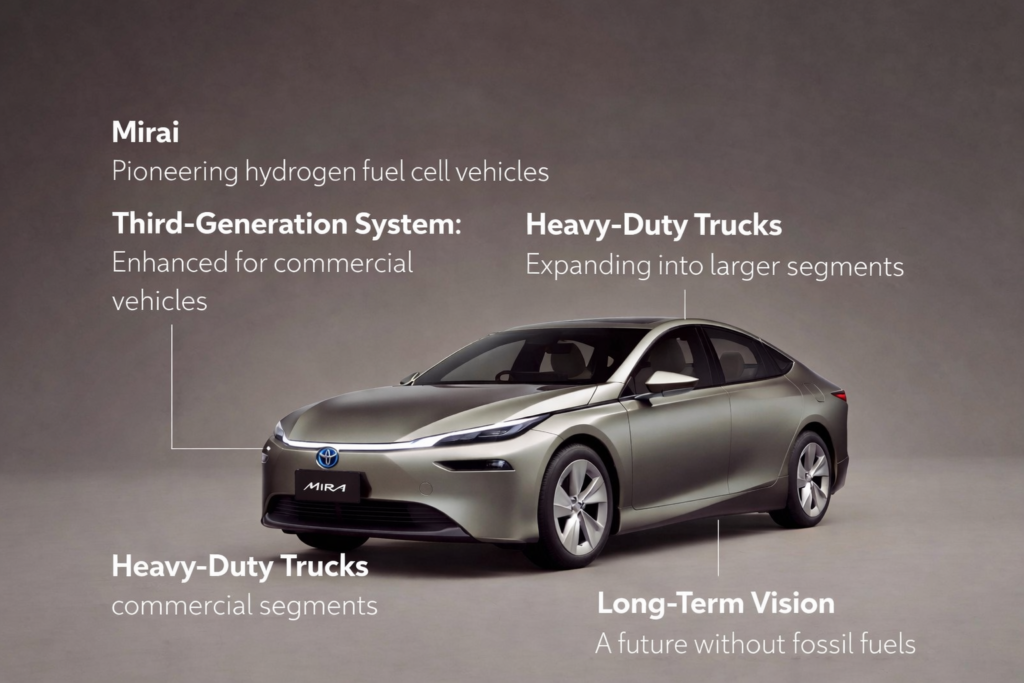
Toyota proved its commitment with the Mirai, one of the world’s first mass-produced hydrogen cars, launched in 2014. Though sales remain modest (around 20,000 globally), the Mirai was never just about volume—it was about proving hydrogen works on real roads.
In 2025, Toyota doubled down by unveiling its third-generation fuel cell system, designed not just for cars, but for heavy-duty trucks and commercial vehicles, offering durability comparable to diesel engines.
Toyota is also experimenting with:
- Portable hydrogen cartridges
- Hydrogen-powered industrial equipment
- Hydrogen combustion engines (especially for Japan’s energy security)
To Toyota, hydrogen isn’t competition for batteries—it’s their backup where batteries fall short.
The Critics Are Loud—and Not Wrong
Toyota’s hydrogen-first mindset has attracted criticism.
As battery electric vehicles exploded in popularity, critics accused Toyota of moving too slowly on full EVs. Environmental groups even claimed the company lobbied against aggressive EV mandates to protect its hybrid market.
There are real problems too:
- Hydrogen vehicles are expensive
- Refueling stations are rare—only about 700 worldwide in 2025
- Most hydrogen today is “gray hydrogen”, made from natural gas and still emits CO₂
Without clean hydrogen and widespread infrastructure, FCVs struggle to scale.
In contrast, BEVs now account for over 20% of global vehicle sales, while hydrogen vehicles remain below 1%.
The gap is real—and growing.
The Real Problem Isn’t the Car—It’s the Hydrogen
Hydrogen’s biggest challenge isn’t technology. It’s how we make it.
Today, most hydrogen is produced using fossil fuels, which defeats its environmental purpose. The clean alternative—green hydrogen, made using renewable electricity—is still expensive, energy-intensive, and difficult to scale.
Other hurdles include:
- Storage challenges (hydrogen needs high pressure)
- Safety concerns (it’s highly flammable)
- Infrastructure costs that could reach trillions of dollars
Because of this, experts don’t expect hydrogen to replace fossil fuels overnight. Instead, they see hydrogen carving out specific roles—long-haul trucking, shipping, industrial transport—where batteries struggle with weight and charging time.
So… Will Hydrogen Replace Fossil Fuels?
Not tomorrow. Not everywhere.
But hydrogen doesn’t need to win the whole race to matter.
By most forecasts:
- Hydrogen adoption could grow meaningfully between 2030–2040
- Major impact on fossil fuels may come closer to 2050
- Costs must drop by 50–70% for mass adoption
If green hydrogen scales and infrastructure follows, hydrogen could become the backbone of clean heavy transport—while batteries dominate personal vehicles.
It’s not an either-or future.
It’s a both-and future.
The Mantras Take
The future of clean mobility will not be shaped by one perfect solution, but by pragmatic choices rooted in reality. Hydrogen is not a miracle replacement for fossil fuels—but neither is it a dead end. Its true strength lies where patience, scale, and purpose intersect: heavy transport, energy resilience, and long-term sustainability.
Toyota’s hydrogen bet may look slow in a world obsessed with speed, but history often favors those who build foundations, not headlines. The real question isn’t whether hydrogen will replace fossil fuels—it’s whether humanity is willing to invest today for solutions that mature tomorrow.
The energy transition is not a sprint.
It’s a marathon—and hydrogen is running it quietly, steadily, and with intent.