
India Wastewater Crisis shows how city sewage poisons rivers, farms, and food we eat. See why this silent threat affects everyone. Read more.
Published on: 01/13/2026
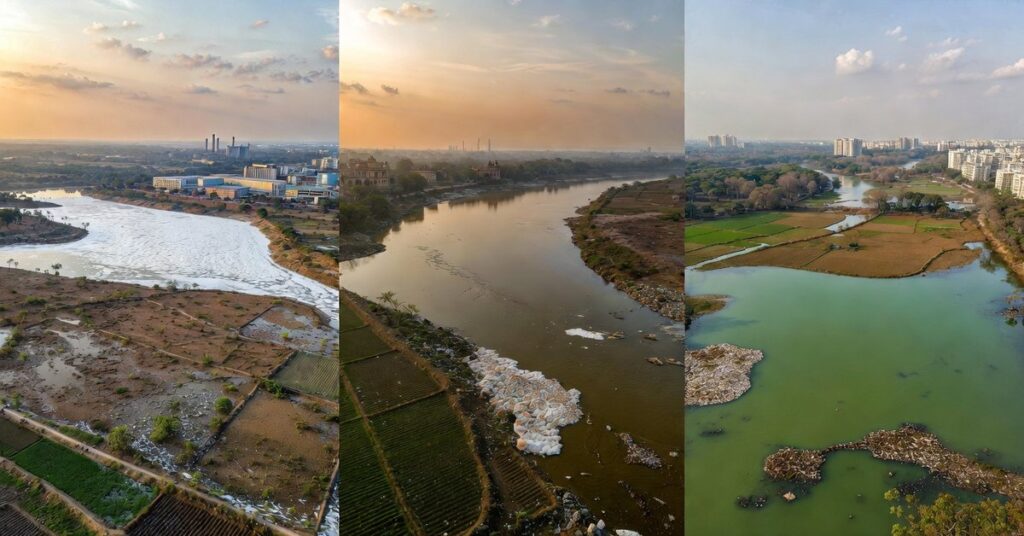
India’s Wastewater Crisis: How Our Cities Are Poisoning Rivers, Farms, and Food
India’s cities are growing faster than their ability to manage something as basic—and critical—as wastewater. What should be an invisible, well-managed system has instead become a silent public health and environmental emergency.
Every day, India’s urban areas generate nearly 72,000 million liters of sewage. Shockingly, less than one-third of it is properly treated. The rest flows untreated or partially treated into rivers, lakes, canals, and open drains. These polluted waters don’t stop at city boundaries. They travel downstream—into rural villages, agricultural fields, groundwater aquifers, and ultimately, our food plates.
The consequences are severe. Pathogens, nitrates, heavy metals, pharmaceuticals, and industrial toxins seep into soil and water. Crops absorb them. Dairy animals ingest them. Humans consume them—often unknowingly. This is no longer just about dirty rivers. It is about food safety, drinking water security, and long-term public health.
And nowhere is this crisis more visible than in India’s largest cities.
Bengaluru: When Lakes Turn into Toxic Sinks
Bengaluru was once known as the “City of Lakes.” Today, more than 85% of its lakes are severely polluted.
Lakes like Bellandur and Varthur receive hundreds of millions of liters of sewage every day—much of it untreated. Despite diversion projects, estimates suggest 250–500 MLD of polluted inflow still enters Varthur Lake alone. High biological oxygen demand (BOD), toxic phosphates, heavy metals, and near-zero dissolved oxygen have turned these lakes into chemical soups.
The result has been surreal and alarming: toxic foam overflowing onto roads, massive fish kills, and even surface fires.
The damage doesn’t end there. Polluted lake water seeps into surrounding groundwater, contaminating borewells with nitrates, pathogens, and emerging chemicals like PFAS. Farmers downstream unknowingly use this water for irrigation, passing contamination into vegetables and grains that end up in city markets.
Delhi: The Yamuna’s Breaking Point
If Bengaluru’s lakes tell one story, Delhi’s Yamuna tells another—far more tragic—one.
Delhi generates about 3,600 MLD of sewage, and a significant portion still enters the Yamuna untreated through major drains. Recent monitoring shows fecal coliform levels dozens of times above safe limits, along with dangerously high BOD levels. The river’s 22-km stretch through Delhi alone carries nearly 80% of its total pollution load.
Each winter, toxic foam reappears—an unmistakable sign of untreated sewage and industrial waste mixing with low river flows.
Downstream, rural communities suffer quietly. Farmers irrigate with polluted river water. Heavy metals like lead and cadmium accumulate in soil and crops. Groundwater becomes nitrate-rich, contributing to health conditions like “blue baby syndrome” and increasing long-term cancer risks.
Mumbai: The Mithi River, an Open Sewer
Mumbai’s Mithi River was once a freshwater stream. Today, it functions largely as an open sewer.
An estimated 85% of its pollution load comes from untreated sewage, with the rest from industrial effluents. Water quality indicators routinely classify it as “heavily polluted.” The river eventually drains into Mahim Creek, damaging mangroves and coastal ecosystems that protect Mumbai from flooding.
Despite ongoing diversion and interception projects, pollution continues to leak into surrounding soils and groundwater—affecting peri-urban communities that depend on wells and small farms.
When Urban Pollution Becomes Rural Suffering
The most devastating aspect of this crisis is that its worst victims often live far from the cities that cause it.
- Groundwater contamination: Nitrate levels far exceed safe limits in many peri-urban and rural areas. Pathogens and toxic chemicals make drinking water unsafe.
- Soil degradation: Continuous irrigation with polluted water leads to salinity, nutrient imbalance, and heavy metal buildup—slowly killing soil fertility.
- Food safety risks: Vegetables and grains absorb contaminants, leading to bioaccumulation. Consumers face gastrointestinal illnesses, heavy-metal toxicity, and rising antimicrobial resistance.
- Economic and health costs: Healthcare burdens, lost productivity, and environmental damage cost India lakhs of crores every year.
Despite action plans, new treatment plants, and river-cleaning missions, gaps in sewer connectivity, poor maintenance, weak enforcement, and overloaded infrastructure allow pollution to continue unchecked.
The Way Forward: Fixing What We Can No Longer Ignore
This crisis is solvable—but only with urgent, coordinated action:
- Treat 100% of urban sewage and mandate reuse targets.
- Intercept direct discharges before they reach rivers.
- Promote safe reuse of treated wastewater for agriculture and industry.
- Enforce strict industrial effluent standards.
- Monitor groundwater and soils regularly.
- Empower communities to restore and protect local water bodies.
The Mantras Take
India’s wastewater crisis is not just an environmental failure—it is a moral and governance failure. When cities grow without caring where their waste goes, rivers die, soils weaken, and food turns unsafe. The tragedy is that the poorest—rural farmers and downstream communities—pay the highest price for urban neglect.
Clean rivers do not begin at riverbanks; they begin under our streets, in treatment plants, pipes, and political will. If India can build world-class cities and digital infrastructure, it can certainly treat its sewage. The choice is no longer about cost—it is about consequences.
The longer we delay, the more invisible poisons we consume. The time to act is not tomorrow or the next plan—it is now, before the damage becomes permanent.