
ISRO NGLV turns India’s “Naughty Boy” rocket story into a reusable future with heavy-lift power and lower costs. Discover what changes next. Read more.
Published on: 01/13/2026
In the rich history of India’s space program, very few rockets have earned a nickname as memorable—or as honest—as the Geosynchronous Satellite Launch Vehicle (GSLV). Fondly called the “Naughty Boy” by ISRO scientists, the GSLV earned this tag not out of mischief, but because of its early struggles and unpredictable performance.
Like a rebellious child who refuses to listen at first but eventually grows into responsibility, the GSLV matured over time. After a difficult beginning, it went on to power crucial missions and strengthen India’s space capabilities. Today, ISRO stands at the threshold of the next leap—preparing a successor that builds on these lessons. Enter the Next Generation Launch Vehicle (NGLV), humorously dubbed Naughty Boy 2.0.
This new rocket is not just an upgrade—it represents a shift in mindset. With reusability, heavier payload capacity, and sharper cost efficiency, NGLV aims to redefine how India reaches space.
The Legacy of the Original “Naughty Boy”
The GSLV’s story began in the early 2000s, a time when India was still mastering one of the most complex challenges in rocketry: cryogenic engine technology. Early missions were riddled with setbacks, and several of the first 15 launches failed. The nickname “naughty” stuck—not as criticism, but as a candid reflection of how difficult the journey was.
Former ISRO Chairman Dr. K. Sivan famously referred to GSLV as the “naughty boy of ISRO,” later adding that it became “adorable” once it started succeeding consistently.
And succeed it did.
Despite its rough start, GSLV eventually became a reliable launcher, placing satellites like INSAT-3DS into orbit and supporting India’s lunar ambitions. Its transformation from a troubled experiment into a dependable workhorse stands as proof of ISRO’s persistence, patience, and engineering discipline.
Introducing NGLV: The Next Chapter Begins
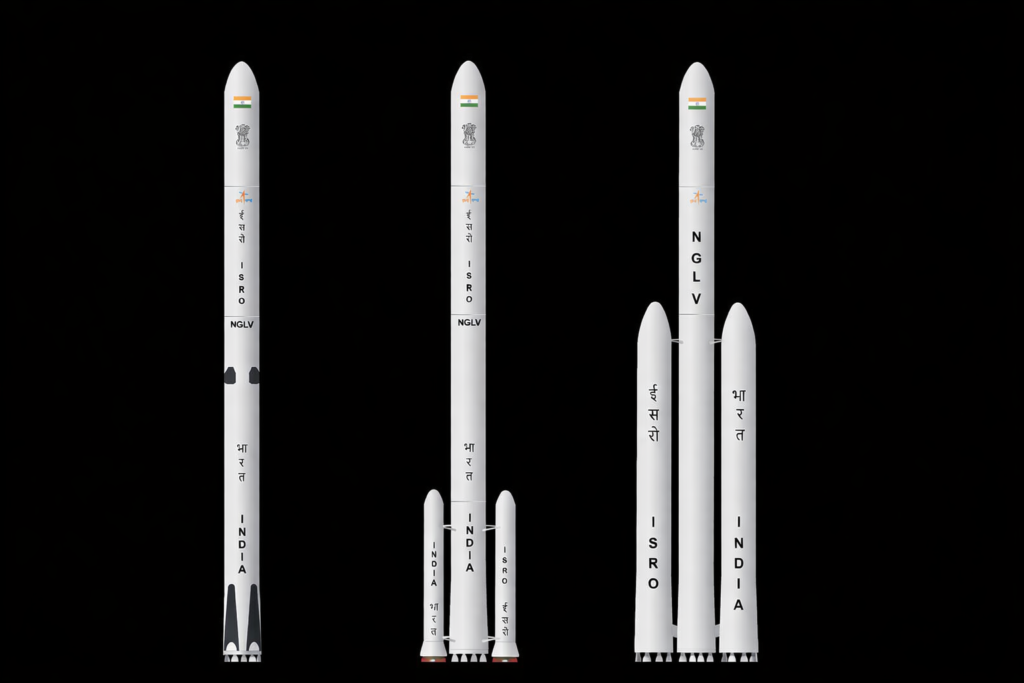
With the Next Generation Launch Vehicle (NGLV)—also referred to as “Soorya” in recent proposals—ISRO is preparing for a bold future. Officially approved for development, NGLV is designed to eventually replace existing systems like the LVM3, while incorporating every lesson learned from the GSLV era.
This is a three-stage, modular rocket, built for faster manufacturing and quicker turnaround between launches. ISRO plans multiple configurations: a core-only variant and versions with strap-on boosters, allowing flexibility across missions—from scientific payloads to human spaceflight.
NGLV is not about incremental improvement. It is about starting fresh, with reliability and scale designed in from day one.
Key Features and Innovations That Set It Apart
At the heart of NGLV lies a powerful engine cluster—nine engines in the first stage and two in the second—delivering robust thrust and redundancy. One of its defining features is reusability, with plans to recover and reuse the first stage, a concept inspired by global leaders like SpaceX.
The design philosophy is refreshingly clear:
- Simplicity over complexity
- Modularity over customization
- Speed over prolonged turnaround
ISRO is also exploring advanced materials, electric propulsion elements, and cleaner design architectures to improve efficiency. This “Naughty Boy 2.0” is engineered to behave better—not through caution, but through smarter design choices.
Payload and Performance: A Giant Leap Forward
What truly makes NGLV a game-changer is its payload capacity.
The rocket is expected to carry up to 30 tonnes to Low Earth Orbit (LEO)—nearly three times the capacity of LVM3, at only about 1.5 times the cost. For geosynchronous missions, it can handle significantly heavier satellites, opening doors to global commercial launches.
This capability directly supports:
- Gaganyaan human spaceflight missions
- Lunar sample return programs
- Deep-space and asteroid exploration
By integrating ideas from earlier concepts like the Heavy Modular Launch Vehicle (HMLV), ISRO ensures that NGLV remains scalable for decades to come.
Reusability and Cost Efficiency: The Real Disruption
If payload is the muscle, reusability is the brain.
Unlike the expendable GSLV, NGLV’s recoverable stages could reduce launch costs by up to 50%. This shift aligns perfectly with India’s long-standing philosophy of doing more with less.
Lower costs mean:
- Affordable access to space
- Greater participation from private companies
- A stronger Indian space economy
As satellite constellations and commercial demand explode globally, NGLV positions India not just as a participant—but as a serious competitor.
Future Missions and Long-Term Impact
Looking ahead, NGLV is expected to power some of India’s most ambitious dreams:
- A sustained lunar presence
- Advanced Mars missions
- Interplanetary exploration beyond Earth orbit
- Crewed missions deeper into space by the 2030s
Beyond science, the ripple effects are equally important—job creation, technology spin-offs, international partnerships, and global prestige.
If the original Naughty Boy taught ISRO resilience, Naughty Boy 2.0 reflects confidence and ambition.
In a major boost, the Union Cabinet approved ₹8,240 crore for the NGLV development program in 2024, covering design, three developmental flights, essential facilities, and program management over an 8-year timeline. This dedicated funding, part of the broader Department of Space allocation of ₹13,416 crore in the 2025-26 Union Budget, underscores the government’s commitment to ambitious projects like the Bharatiya Antariksh Station and crewed lunar missions by 2040. Maximum industry participation is encouraged, with private players expected to invest further in manufacturing and infrastructure.
The Mantras Take
The story of GSLV and NGLV is not just about rockets—it is about mindset.
Failures did not weaken ISRO; they sharpened it. The GSLV proved that persistence can turn unpredictability into reliability. NGLV goes one step further—it signals that India no longer wants to merely reach space, but to lead sustainably and affordably.
Naughty Boy 2.0 is not here to misbehave. It is here to perform—quietly, consistently, and at scale. If ISRO executes this vision with the discipline it is known for, India’s future in space will not just be ambitious—it will be unstoppable.