
By Puneeth Raj | February 22, 2026
Blood and Water Cannot Flow Together: How a Deadly Terror Attack Ended 65 Years of Water Peace Between India and Pakistan.
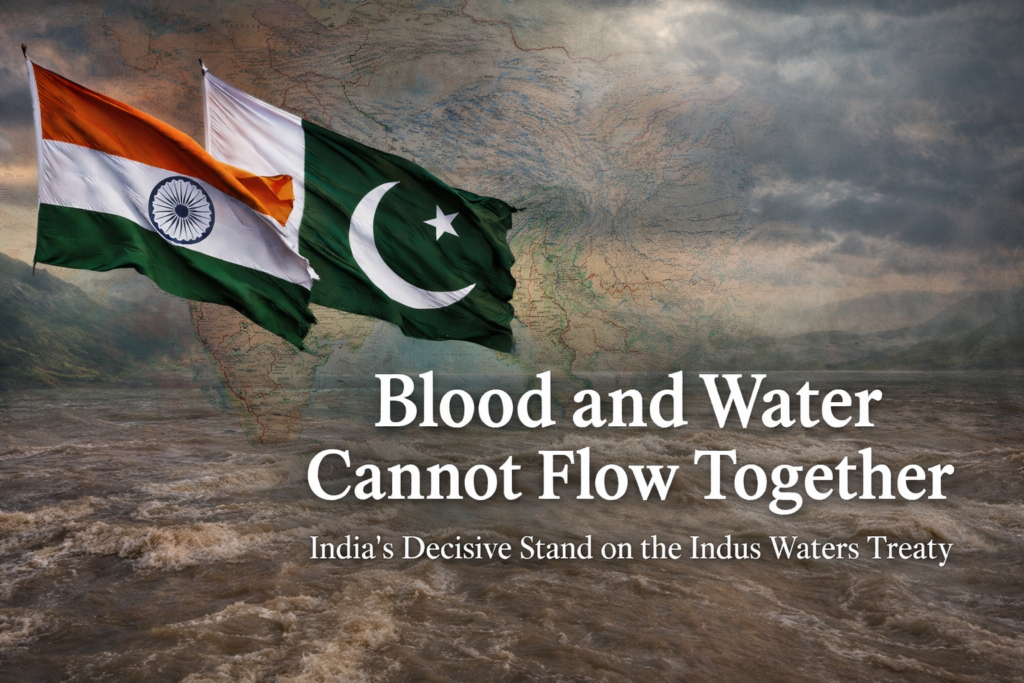
In the wake of the tragic Pahalgam terrorist attack on April 22, 2025, which claimed the lives of 26 civilians in Jammu and Kashmir, India took a historic step: it placed the 1960 Indus Waters Treaty (IWT) in abeyance. This suspension, announced the very next day, marked a sharp departure from decades of water-sharing cooperation between the two nuclear-armed neighbors. Prime Minister Narendra Modi, External Affairs Minister S. Jaishankar, and Home Minister Amit Shah have repeatedly invoked the powerful mantra: “Blood and water cannot flow together.”
The phrase, first prominently used by Modi after the 2016 Uri attack, encapsulates India’s position that cross-border terrorism and peaceful transboundary cooperation cannot coexist. As Jaishankar stated in 2025 parliamentary discussions, the treaty—unique in allowing major rivers to flow unrestricted to Pakistan—will remain suspended until Pakistan “credibly and irreversibly” ends its support for terrorism. Modi reinforced this on Independence Day 2025, calling the IWT “unjust and one-sided” and asserting that India’s water must now serve its own farmers and progress.
Ending Decades of Underutilization
At its core, this shift is not about weaponizing water against Pakistan but about India finally exercising its full legal entitlements under the treaty. The IWT allocated the eastern rivers (Ravi, Beas, Sutlej) exclusively to India for unrestricted use—irrigation, storage, and hydropower—while the western rivers (Indus, Jhelum, Chenab) went primarily to Pakistan.
Historically, India utilized about 95% of its eastern rivers share, but inefficiencies persisted. Surplus water from the Ravi—estimated at around 2 million acre-feet annually—flowed unused downstream into Pakistan due to prolonged inter-state disputes (between Punjab and Jammu & Kashmir), funding delays, and bureaucratic hurdles. Projects like the Shahpur Kandi Dam/Barrage, conceived in 1979 and stalled for decades over water-sharing and benefit disputes, exemplified this neglect.
The 2025 suspension removed procedural obstacles—data sharing, consultations, and objections—accelerating domestic infrastructure. This is pragmatic resource management: “use it or lose it” in the face of growing domestic needs, climate variability, and groundwater depletion.
Key Ongoing Projects and State Benefits
India has fast-tracked several major projects in the Indus basin, focusing on eastern rivers for full utilization and run-of-the-river (RoR) hydropower on western rivers for power generation (with limited storage, ensuring downstream flows remain largely unchanged per treaty rules). Here are the prominent ongoing ones as of February 2026:
Eastern Rivers Projects (Ravi Basin – Full Indian Rights):
- Shahpur Kandi Dam/Barrage (on Ravi River, Punjab-J&K border): Nearing completion; firmly targeted for full operation by March 31, 2026 (dam component complete, reservoir filling underway, final works/tests in progress per J&K Minister Javed Ahmed Rana’s February 2026 statements). Multipurpose: irrigation + ~206 MW hydropower. Stops surplus Ravi water from flowing unused to Pakistan. Benefits: Irrigates ~32,000+ hectares in drought-prone Kathua and Samba districts of J&K + ~5,000 hectares in Punjab; ~206 MW power to northern grid (J&K gets ~20% share, ~41 MW). From April 2026, surplus flows will be redirected during summer/monsoon seasons. States benefiting: Jammu & Kashmir (primary irrigation in border/Kandi areas), Punjab (irrigation and power).
- Ujh Multipurpose Project (on Ujh River, Ravi tributary, Kathua district, J&K): Revival and fast-tracking in progress (National Project status; canal system approved to utilize surplus and prevent flow to Pakistan). Multipurpose: ~89.5–100 MW hydropower, irrigation, drinking water. Benefits: Irrigates ~90,000 hectares across regions; supports local agriculture and drinking needs. States benefiting: Jammu & Kashmir (primary: Kathua/Samba/Pathankot areas), indirectly Punjab, Haryana, and Rajasthan via proposed canal extensions/links.
Western Rivers RoR Hydropower Projects (Chenab Basin, J&K – Accelerated Post-Suspension):
These non-consumptive RoR schemes add significant power to the northern grid.
- Pakal Dul (1,000 MW, on Marusudar tributary of Chenab, Kishtwar district): Under construction; targeted commissioning by December 2026 (non-negotiable deadline emphasized by officials).
- Kiru (624 MW, on Chenab, Kishtwar district): Under construction; targeted by December 2026.
- Kwar (540 MW, on Chenab): Under construction; targeted by March 2028.
- Ratle (850 MW, on Chenab, Kishtwar district): Construction fast-tracked (foundation for concreting laid 2025–2026); targeted by late 2028.
- Sawalkote (Sawalkot) (1,856 MW total, on Chenab, Udhampur/Ramban districts; two stages: 1,406 MW + 450 MW): Tenders invited February 2026 (~₹5,129 crore by NHPC); work initiated; first major new project green-lit post-suspension; long-term completion (9+ years estimated).
- Dulhasti Stage-II (260 MW extension, on Chenab, Kishtwar): Environmental clearance granted December 2025; advancing.
Benefits (all power-focused): Generate clean energy for northern grid; create jobs in remote districts. States benefiting: Jammu & Kashmir (direct power/jobs in Kishtwar/Udhampur/Ramban; local grid supply), indirectly Punjab, Haryana, and northern India via national grid.
Additional proposals (feasibility/early stage): Inter-basin transfers (e.g., studies on linking Chenab surplus to Ravi-Beas-Sutlej); other Chenab projects like Bursar, Kirthai-I/II.
A Pragmatic Yet High-Stakes Move:
From India’s viewpoint, this is justified: a sovereign right to maximize its share, triggered by security imperatives, and focused on eastern rivers without breaching core allocations on western ones (where India lacks the infrastructure for major diversions anyway). The policy signals zero tolerance for terrorism while prioritizing national interests.
Critics, including Pakistan and some international observers, argue the unilateral suspension lacks clear legal basis under the treaty or Vienna Convention, potentially risking escalation or precedents for other shared rivers. Pakistan has called it “water warfare” and pursued arbitration (which India rejects). Yet, no drastic flow reductions on western rivers have occurred—actions remain within India’s entitlements historically allowed.
In essence, “blood and water cannot flow together” is more than rhetoric—it’s a doctrine linking national security to resource sovereignty. After years of underutilization due to domestic politics and caution, India is reclaiming what is legally its own through these accelerated projects. With Shahpur Kandi on track for March 31, 2026, the practical impact will soon be evident: water and power flowing for India’s farmers and energy needs, not wasted across borders.
This isn’t the end of diplomacy, but a firm reset—one that demands credible action against terrorism for any return to cooperation. In a changing geopolitical and climatic landscape, effective utilization of resources is no longer optional—it’s essential.