
The PLI Scheme is transforming India’s manufacturing and exports. Explore its impact, challenges, and future potential. Read more
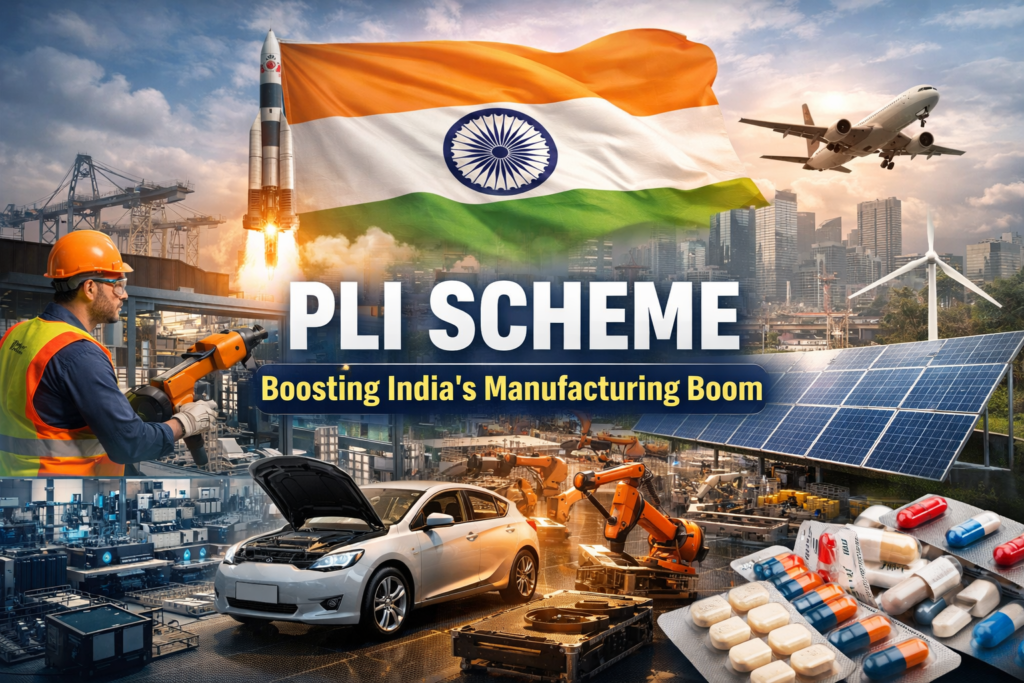
The PLI Scheme: How India Sparked a Manufacturing Comeback—and What Comes Next
In just a few years, India’s Production Linked Incentive (PLI) scheme has rewritten the story of Indian manufacturing. Launched in 2020 under the Atmanirbhar Bharat vision, PLI was designed with a simple but powerful idea: reward companies not for promises, but for performance. With a massive outlay of ₹1.97 lakh crore across 14 strategic sectors, the scheme links incentives directly to incremental production and sales.
This approach has quietly but decisively shifted India’s industrial landscape. From smartphones and automobiles to pharmaceuticals and solar panels, factories are expanding, investments are flowing in, and global companies are taking India seriously—not just as a market, but as a manufacturing base. What once felt like an aspiration is now becoming a reality: India positioning itself as a global manufacturing hub.
Why PLI Worked Where Others Struggled
For decades, manufacturing remained India’s weak spot. Despite employing millions, it contributed only 15–17% of GDP, far below global peers. High costs, fragmented supply chains, and fierce global competition made scaling difficult. PLI addressed this head-on by encouraging scale, efficiency, and competitiveness.
Instead of blanket subsidies, companies earn incentives only when they produce more and sell more. This has pushed firms to modernize plants, adopt automation, improve quality, and optimize supply chains. The result? Higher productivity, better capital utilization, and stronger global integration.
Electronics, Solar, and Auto: Proof on the Ground
The electronics sector tells the most visible success story. Mobile phone manufacturing in India has exploded, with exports rising sharply. Global and domestic players invested in advanced assembly lines, skilled labor, and localized supply chains—transforming India from an importer into a serious exporter.
Solar manufacturing is another standout. PLI has accelerated domestic capacity creation, reducing dependence on imports while attracting high-tech investments. Firms are achieving cost efficiencies and scaling faster, supported by Industry 4.0 tools like AI, IoT, and predictive maintenance.
In automobiles, especially electric vehicles and advanced components, PLI has driven innovation. Precision engineering, EV batteries, and next-gen mobility solutions are no longer futuristic concepts—they’re being built here.
Beyond Manufacturing: A Blueprint for the Future
What makes PLI truly exciting is its potential beyond factories.
- Green sectors like EV batteries, green hydrogen, aerospace components, and precision tooling could benefit from tailored PLI models.
- Agriculture, which employs nearly 45% of India’s workforce, could see a transformation through incentives for agro-processing, cold chains, organic farming, and export-driven crops—boosting farmer incomes and cutting post-harvest losses.
- Services, especially IT, AI, and deep tech, could adopt a PLI-like structure that rewards innovation, exports, and intellectual property creation—helping India retain talent and global leadership.
The toy sector already offers a glimpse of this future. Once dominated by imports, it’s now emerging as a competitive export segment thanks to focused incentives. Textiles and drones tell similar stories.
The Roadblocks That Still Matter
PLI is not without challenges. Bureaucratic delays, skill shortages, and infrastructure gaps still slow momentum in some sectors. Incentives alone cannot replace the need for skilled manpower, reliable logistics, and policy clarity. But even with these hurdles, the scheme’s results—strong exports, rising investments, and improved firm performance—prove its effectiveness.
The Mantras Take
The PLI scheme is more than an industrial policy—it’s a mindset shift. It shows that India doesn’t need endless subsidies; it needs smart incentives that reward execution, scale, and ambition. PLI proves that when policy aligns with performance, industries respond with speed and confidence.
If expanded thoughtfully—balancing innovation, sustainability, and inclusion—PLI can become the backbone of India’s next growth chapter. Not just self-reliance, but global relevance. Not just factories, but future-ready ecosystems. The message is clear: when India bets on its potential with discipline and vision, prosperity follows.