
Are We Trading Progress for Votes?
How vote-bank politics can stall progress and unity. Explore the risks and the path forward. Read more.
Published on: 11/01/2026
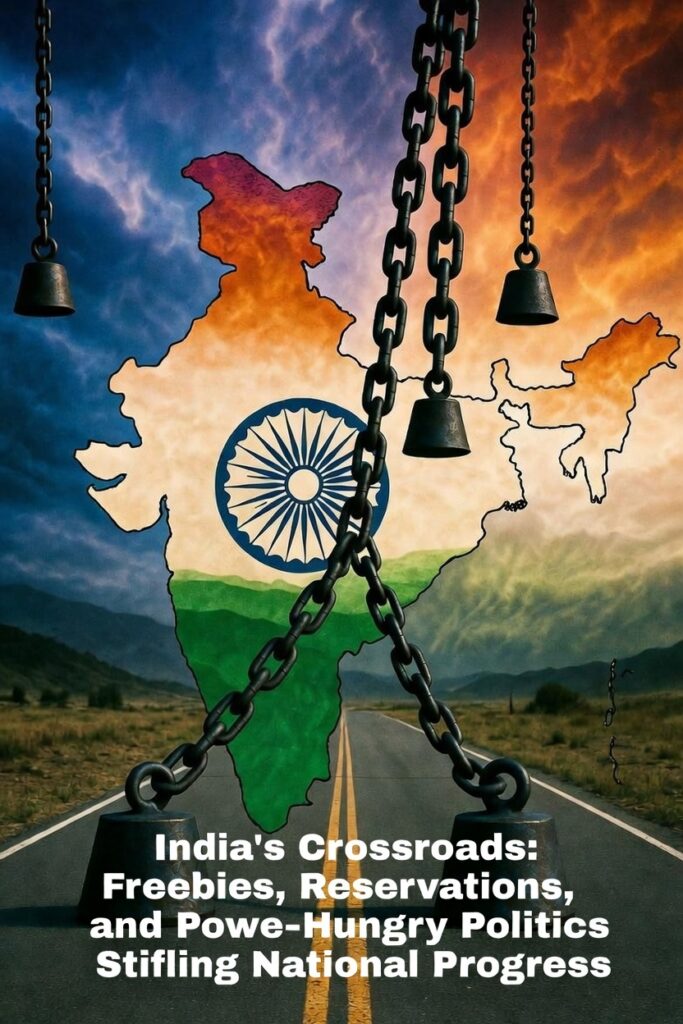
As India steps into 2026, the nation stands at a decisive moment in its journey. With the world’s largest youth population, a growing economy, and rising global influence, India should be accelerating toward becoming a true global powerhouse. Instead, it finds itself slowed down by familiar patterns—populist freebies, never-ending reservation debates, and political desperation that prioritizes power over progress.
These issues are not new. But their intensity, frequency, and scale have reached a point where they are no longer just political strategies—they are structural roadblocks. Disguised as welfare, justice, or ideology, they are quietly weakening fiscal discipline, meritocracy, and long-term national vision. If left unchecked, India risks drifting toward dependency, division, and delayed development.
The Freebies Trap: Relief Today, Burden Tomorrow
Across recent elections—from Bihar to Maharashtra—freebies have become the most powerful campaign weapon. Free electricity, water, cash transfers, gadgets, and transport passes promise instant relief and quick votes. For families struggling to survive, such support feels necessary and humane.
But beneath the surface lies a deeper concern.
Every rupee spent on unsustainable giveaways is a rupee diverted from building roads, improving schools, strengthening hospitals, or creating jobs. In 2025 alone, several states saw subsidy bills balloon beyond their productive revenues, forcing cuts in capital expenditure—the very engine of long-term growth.
Economists and institutions like the Reserve Bank of India have repeatedly warned: unchecked freebies risk creating a dependency economy, where citizens wait for handouts instead of opportunities. Instead of empowering people to earn, innovate, and grow, the system quietly trains them to expect support without sustainability.
Nations that rose economically invested in productivity, skills, and innovation. If India continues to trade long-term growth for short-term votes, it risks becoming a “freebie economy” rather than a competitive one.
Reservations Debate: Justice, Identity, and the Merit Question
Caste-based reservations were born out of necessity—to correct historical injustice and give marginalized communities a fair chance. That moral foundation remains valid. However, decades later, the system has expanded into a political flashpoint rather than a reform tool.
By 2025, demands for caste censuses and expanded quotas dominated public discourse. In some states, reservations exceed 50%, triggering concerns about efficiency, institutional performance, and social harmony.
The problem is not inclusion—it is rigidity.
When reservations become permanent, identity-based, and politically negotiable, they stop being instruments of upliftment and become symbols of division. Merit takes a backseat, resentment grows, and talented youth—across communities—begin looking outside India for fair opportunities.
India’s ambition of becoming a $5 trillion economy cannot be fulfilled through constant social fragmentation. Social justice and merit do not have to be enemies—but without reform, the current model risks serving neither fully.
Power Over Progress: The Politics of Desperation
At the heart of freebies and reservation politics lies a deeper issue—desperation for power.
Indian politics in 2025 was marked by aggressive narratives, constitutional debates, and constant election-mode governance. Across parties—national and regional—the focus shifted from governance to survival.
Dynastic politics continued to dominate, limiting fresh leadership and accountability. Opposition parties struggled to present credible development alternatives, while ruling parties leaned on welfare optics and identity narratives to maintain control.
This obsession with electoral victory fuels:
- Short-term policymaking
- Vote-bank engineering
- Institutional erosion
- Policy paralysis
Development, jobs, innovation, and national security quietly slip down the priority list.
When power becomes the goal instead of a responsibility, governance turns reactive, not visionary.
Where Is India Heading?
If current trends continue unchecked, India risks entering the next decade with:
- Rising state debt
- Deepening social divisions
- Brain drain of skilled youth
- Slower innovation and productivity
Yet, hope remains.
India has proven—through reforms, digital infrastructure, and competitive federalism—that progress is possible when leadership focuses on outcomes, not optics. The missing ingredient is collective maturity—from political parties and voters.
True change will come when citizens demand:
- Jobs over freebies
- Opportunity over identity
- Accountability over slogans
The Mantras Take
India does not suffer from a lack of potential—it suffers from a lack of courage to choose the hard path. Freebies may win elections, reservations may mobilize identities, and power politics may dominate headlines—but none of these build a strong nation. A developed India will not emerge from dependency or division, but from dignity through work, fairness through reform, and leadership with long-term vision. The future belongs not to those who promise the most, but to those who prepare the nation to stand on its own feet.