
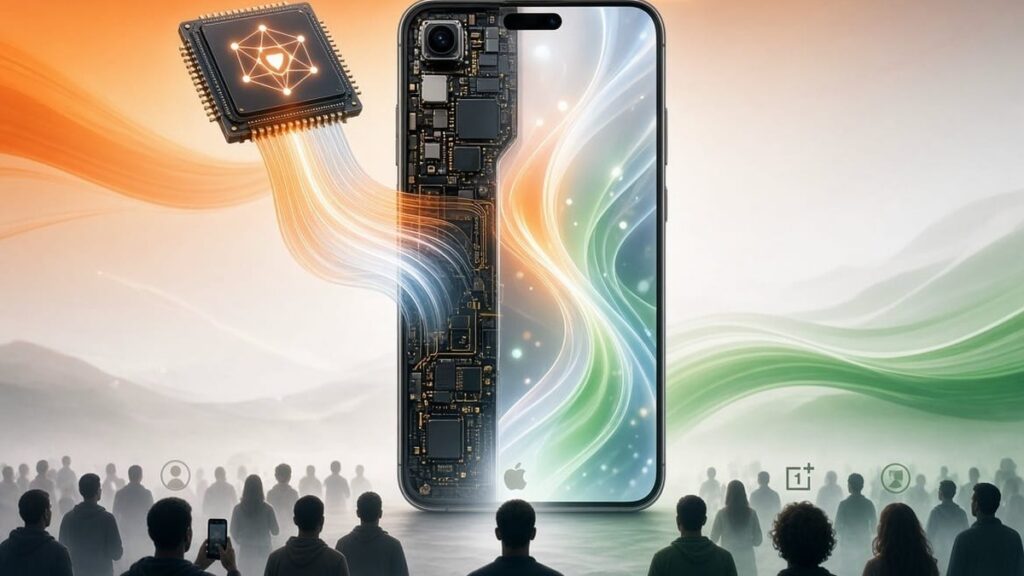
India can assemble nearly every phone it sells. Designing one that people actually prefer is a different challenge.
In October 2026, India’s IT Minister Ashwini Vaishnaw said the country should have phones that are designed in India, made in India, and sold under an Indian brand by 23 October 2028. The government is supporting this with large schemes worth tens of thousands of crores. The idea is to move past simple assembly and own more of the design and intellectual property.
This is a serious goal. Some parts are realistic. Others are much harder than they sound.
India already assembles most phones, but that is only the first step
India now assembles nearly all the smartphones sold in the country. It also builds a large share of iPhones for the world. Factories, workers, and basic production lines exist. This is real progress.
But most of the expensive parts still come from outside. The main chip, high-end screen, advanced cameras, and memory are usually imported. Domestic value addition is still low, often under 20–25 percent of the total cost of the phone. Putting the parts together is easier than designing the board, making key components locally, and controlling quality at large scale. Many countries can assemble phones. Far fewer can design them well and make the whole product competitive.
Chips will take longer and will not match the leaders quickly
India’s first big chip factory (Tata’s plant in Dholera) is being built. It will start with older, more mature process nodes such as 28 nm. Commercial production is expected around 2028. The longer-term plan is to reach 5 nm and 3 nm by the early-to-mid 2030s. Packaging plants are already running, and India has strong chip design talent.
Reaching a process node is only the start. A good mobile chip needs high yields, careful process control, strong custom designs for the CPU and GPU, and years of fine-tuning. Snapdragon, MediaTek, and Apple chips are strong in gaming, battery life, and smooth everyday use. Even Samsung, which has its own factories and large research budgets, has spent many years trying to close the gap with Qualcomm and MediaTek. Its Exynos chips have often lagged in efficiency and sustained performance. By the time a new player reaches a certain level, the leaders have usually moved further ahead. For phones in 2028, Indian brands will almost certainly still use chips from Qualcomm, MediaTek, or similar companies. Fully competitive Indian high-end chips are a longer and more uncertain project.
Smooth software is difficult and many brands have failed at it
Today’s phones are expected to feel smooth, last well, take consistent photos, and get regular software updates for years. This requires careful work between the hardware and software teams, managing heat, power, memory, and animations so the phone does not stutter or slow down.
This is hard. Many Chinese brands that once grew fast later struggled or disappeared because they could not keep software quality, update support, and service reliable. Even big Android brands have released laggy or bloated software in some years. Apple’s smoothness comes from controlling the chip, the software, and the hardware together for a long time. A new Indian brand can use Android with its own skin, and some companies have shown that clean software is possible. But good software needs ongoing investment. It does not happen just because the phone is assembled in India. A completely new Indian operating system is not part of the 2028 plan and would be even harder to make competitive.
Cost and scale decide whether the phone can succeed
Even if the design and factory work is done, the phone has to be priced in a way that users will buy and the company can still make money. The chip, screen, and cameras are the biggest costs. Big global brands spread their research and software costs across tens of millions of phones. A newer brand starts with lower volumes, so the same costs make each phone more expensive or less profitable. Government support helps, but it does not automatically create a strong price-to-performance product. Many brands have been able to manufacture phones yet still failed because the economics did not work over time.
Most existing users will not switch easily
People who are happy with Samsung, Apple, or OnePlus are unlikely to move quickly to a new Indian brand, especially if they paid a premium price. A modern phone is judged on real-world things: how smooth it stays after months of use, how reliable the camera is, how long the battery lasts, how quickly software updates arrive, how good the service is, and what the resale value will be. Apple users in particular stay with the brand at very high rates because of the overall system of devices and services. Samsung users are also loyal. Android users switch more often, but they usually move between known brands.
New brands usually have a better chance first in the mid-range and value segments, where price matters more and buyers are more open to trying something new. Earlier Indian brands gained some share when the market was younger, then lost ground when stronger products and marketing arrived from elsewhere. Building trust takes years of consistent performance, good service networks, and clear reasons for people to choose the phone again. Simply being “Indian” has not been enough in the past.
What this means
By 2028, phones that are designed in India, made in India, and sold under an Indian brand are possible. The country already has factories and growing design skills. Deeper component manufacturing, competitive high-end chips, polished long-term software, competitive costs at scale, and winning users away from established brands are much harder. These are areas where even experienced companies have struggled for years.
Real progress will come from steady execution: better design that actually improves the product, reliable software and updates, careful cost control, and a brand that earns trust through everyday performance and service. Partial success on Indian-designed phones is realistic. Matching the full combination of performance, polish, price, and consumer preference that the current leaders offer is a longer challenge. The market will judge the results, not the announcement.