
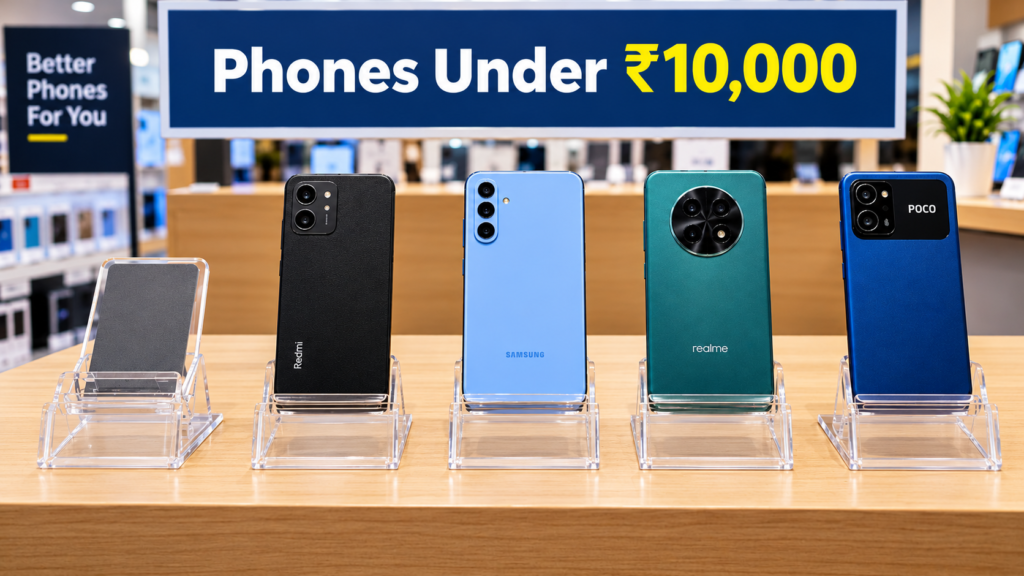
A year ago, roughly 18% of all smartphones sold in India cost under ₹10,000. By the second quarter of this year, that share had shrunk to about 4%. Nearly one in five phones became one in 25.
Nobody banned cheap phones, and no tax changed overnight. What changed is the price of a component most buyers never think about, memory. The reason has less to do with phones than with the data centres being built to run AI.
That’s the quiet disappointment waiting in phone shops this festive season, and it isn’t only an Indian story. Below: what the numbers show, why the cheapest phones break first, and what nobody knows yet.
What’s actually happening
IDC’s latest figures show India’s smartphone shipments fell 11.1% year-on-year to 33.2 million units in Q2 2026, making the first half the weakest in five years, while the average selling price rose 14.4%. Shipments are falling and prices are rising at the same time, which is not how a market normally behaves.
The entry level took the worst of it. IDC found sub-$100 phone sales fell 74% year-on-year in Q2, with that segment’s share dropping to 4.5% from 15.6%. IDC’s line is $100 (roughly ₹10,000) and Counterpoint’s is ₹10,000 flat, so the cut-offs differ slightly. Both show the same cliff.
Prices moved too. Business Today’s tracking found that even phones under ₹10,000 saw price increases of 6% to 25%, and that laptops from Dell, HP and Lenovo were up 15% to 30% this year.
Why the cheapest phones break first
Phones, laptops and AI servers all use DRAM and flash memory, and memory makers only have so many production lines. According to Madhur Singhal of Praxis Global Alliance, global chip capacity is shifting structurally toward AI infrastructure, with hyperscalers locking in supply early and manufacturers favouring higher-margin AI memory over consumer chips. TrendForce’s September industry note says much the same: AI servers are driving strong demand for conventional DRAM and HBM, tightening supply and pushing contract prices up.
Phone makers get what’s left, at higher prices. TrendForce estimated that in Q2 LPDDR4X prices rose at least 70–75% quarter-on-quarter, and LPDDR5X prices 78–83%.
Here’s why budget phones are hit hardest. Counterpoint says memory’s share of an entry-level phone’s bill of materials jumped from 15–20% to over 45% as of June 2026. When one part eats nearly half the cost, you can’t cut your way out. There’s no more camera to downgrade. So brands are moving entry-level models into higher price bands rather than absorbing the increase.
Specs are slipping too. TrendForce notes low-end phones are converging around 4GB of RAM while high-end models scale back from 16GB to 12GB.
A caution on the numbers. Estimates of how far memory prices have risen don’t line up. One analysis cites a 4.5x increase from last year. Counterpoint’s analysis, as reported by Communications Today, points to a nine-fold surge over nine months. Business Today put it at DRAM prices nearly doubling over the past year. These cover different memory types, windows and market segments, so don’t average them. What the sources agree on is the direction.
Why this matters beyond phones
IDC notes that budget and entry-level buyers form the backbone of India’s smartphone market, so this isn’t a niche segment shrinking. For many first-time buyers, the cheapest new phone is now a few thousand rupees further away.
Some will defer. CMR projects a 10–12% full-year decline for India’s smartphone market in 2026, with price-sensitive buyers postponing upgrades. IDC expects shipments to fall by over 15% in the second half, with full-year volumes around 128–130 million units. Others will go second-hand: refurbished phones are expected to gain popularity as buyers look for affordable options.
The ₹10,000–20,000 band is holding up, slipping only from 47% to 46% share between Q4 2025 and Q2 2026, because former entry-level models are migrating into it. In practice that band has become the new entry level.
Globally, IDC forecast in March that worldwide smartphone shipments would drop 12.9% to 1.12 billion units in 2026, from 1.26 billion in 2025. TrendForce’s early-year forecast was a 10% drop, with a bear case of 15%.
The other side
Is this a permanent reset or a squeeze that eases? IDC’s Nabila Popal calls it a structural reset, and warns the sub-$100 segment may become permanently uneconomical.
There are signs of moderation, though. TrendForce said mobile DRAM price gains would slow in 3Q26, and that front-loaded buying, as consumers rushed to beat price hikes, narrowed its expected annual decline. Its October 22 note on eMMC/UFS flash storage points to buyer pushback at peak costs and prices plateauing in the 1Q27 off-season. That covers flash storage, not DRAM, and I only have the report summaries, not the full reports.
There’s also a framing point. Because brands are re-pricing entry-level models into higher bands, part of the “disappearance” is a threshold effect. A phone that sold at ₹9,499 last year and now sells at ₹10,999 hasn’t vanished. It has crossed a line on a chart. The squeeze on buyers is real, but the statistic exaggerates how much cheap hardware has literally gone away.
What’s still unresolved
- How long it lasts. An early TrendForce view from November 2025 was that the structural memory shortage would last until the end of 2026. I found nothing from October that calls time on it.
- Whether prices rise again. One report on September 25 said Apple’s memory costs may rise another 30–40% in Q1 2027. It’s labelled “reportedly” and I couldn’t confirm it.
- Q3 data. The latest hard quarterly India figures are Q2, and I found no Q3 data yet.
What happens next
- Diwali falls on November 8, but the big online sales have already run. Amazon’s Great Indian Festival began October 8, and Flipkart’s Big Billion Days opened October 9, with early access on October 8. IDC had warned that festive discounts looked unlikely this year.
Watch two things next: the Q3 shipment tallies when they land, and whether any brand tries a genuine sub-₹10,000 relaunch at current memory prices. If none does, that tells you what manufacturers think about how long this lasts.
Mantra’s Take
Everyone is arguing about what AI will do to jobs, schools and elections. One of its first bills has already arrived somewhere nobody was looking: the price of a first smartphone.
The ₹10,000 phone isn’t gone because people stopped wanting it. Memory makers can earn more selling to AI data centres, and phone buyers are what’s left over. Whether that’s a squeeze or a permanent reset decides if India’s cheapest on-ramp to the internet gets a replacement. The honest answer from the data so far is that nobody knows yet.