
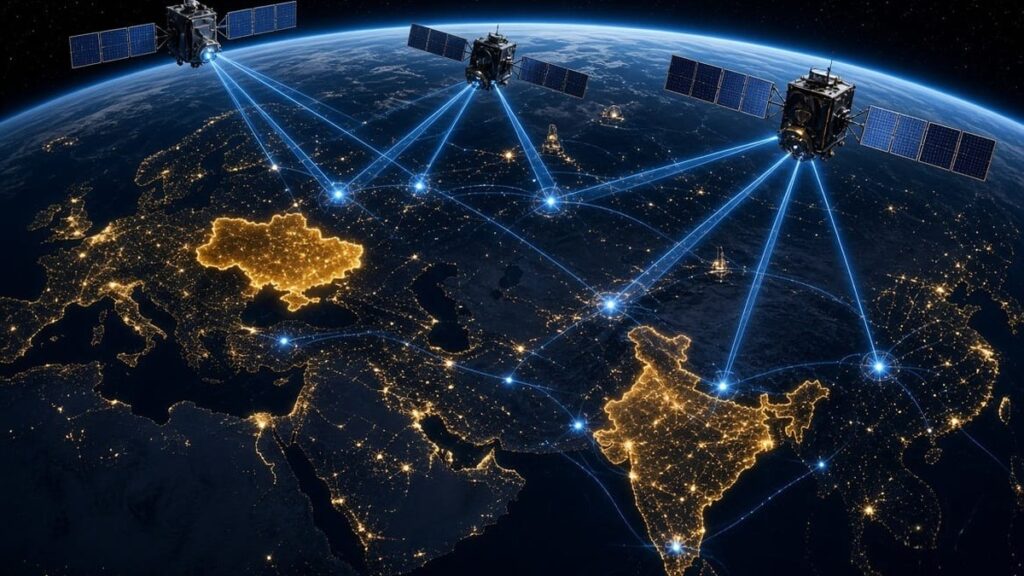
When the United States denied India precise GPS data during the 1999 Kargil War, and later restricted Ukraine’s military Starlink terminals in 2026, both countries learned the same hard lesson: in a crisis, the nation that does not control its own satellite communications does not fully control its own battlefield.
Critical communications and navigation networks are no longer ordinary utilities. In an era of hybrid warfare, sanctions, political shifts, and infrastructure attacks, they function as strategic assets. Countries that own or tightly control their telecom systems — particularly satellite-based ones — gain operational autonomy, resilience, and freedom from external vetoes that pure reliance on foreign commercial or allied providers cannot deliver. Two clear historical cases illustrate the point: the United States’ refusal to provide precise GPS support to India during the 1999 Kargil War, and Ukraine’s recent experience of sudden restrictions on military Starlink service amid ongoing conflict.
The Case for National Control
Owning or decisively controlling telecom and satellite infrastructure provides several practical advantages.
Governments can set priorities, encryption standards, coverage rules, and usage policies without seeking permission from a foreign company or capital. In a crisis, military, emergency, and critical civilian traffic can be protected or prioritized first. National control also reduces the risk that service will be throttled, degraded, or cut for political reasons. Data routing, ground stations, encryption keys, and signal accuracy remain under domestic jurisdiction rather than the laws or policy preferences of another country.
Satellite layers add a further dimension of resilience. Unlike terrestrial networks, they are far harder for an adversary to destroy completely. When designed with anti-jam features and national gateways, they serve as a reliable backup when ground infrastructure fails. Over time, domestic ownership also builds industrial capacity, retains technical expertise, and keeps strategic revenue and technology inside the country.
Full self-sufficiency is costly and slow. Most nations therefore adopt hybrid models: commercial scale for everyday capacity combined with sovereign elements (dedicated bandwidth, national control planes, domestic gateways, priority rights, or joint ventures). What matters most is retaining the ability to operate independently when external systems become unreliable.
Kargil 1999: When GPS Support Was Denied
During the 1999 Kargil War, Indian forces operating in the high Himalayas sought precise positioning data for targeting, troop movement, and operations. Widely reported accounts state that the United States denied or did not provide military-grade GPS support for the conflict zone. At the time, civilian GPS operated under Selective Availability, a U.S. policy that deliberately degraded accuracy worldwide to roughly 100 meters. The encrypted precision signal remained restricted to U.S. forces and selected partners.
Indian units therefore relied more heavily on traditional maps and ground intelligence. Indian space officials and subsequent reporting have repeatedly cited this experience as a catalyst for developing an independent system. The result was NavIC (Navigation with Indian Constellation), a regional satellite navigation system built by ISRO. It now provides independent positioning, navigation, and timing over India and a surrounding region of about 1,500 km, with both open civilian and restricted military signals. The episode demonstrated that even a technologically advanced partner-controlled system can be unavailable or insufficient precisely when it is needed most.
Ukraine and Starlink: Help That Created Vulnerability
After Russia’s full-scale invasion in 2022, Starlink terminals became essential for Ukraine. They restored connectivity for civilians, hospitals, local government, and the military after terrestrial networks were damaged. Kyivstar, Ukraine’s largest mobile operator (owned by the international group VEON), integrated Starlink technology, including early direct-to-cell service. Military units deployed thousands of terminals for command-and-control, drone operations, logistics, and reconnaissance. The system was a genuine force multiplier.
It also created a structural dependency. The military-grade version used by Ukrainian forces (Starshield) is controlled by the U.S. government rather than solely by SpaceX. In mid-October 2026, Ukrainian officials reported sudden, unannounced restrictions: terminals lost connectivity when moving above certain speeds (initially around 100 mph / 160 km/h). The limitations disrupted attack and air-defense drone missions. Elon Musk stated that limits on the military system were decided by the U.S. military and ultimately the president. The episode occurred amid broader tensions over U.S. support and intelligence sharing.
European alternatives exist but lack immediate equivalent capacity, terminal compatibility, and performance for high-mobility military use. Replacing thousands of proprietary terminals is neither quick nor simple. The disruption reinforced a basic lesson: dependence on a single foreign-controlled system, however useful, leaves critical operations exposed to external policy decisions.
Similar ownership questions surround Kyivstar itself. As a strategically vital operator still controlled through a foreign parent with complex historical ownership links, it has prompted ongoing Ukrainian debates about tighter state influence or nationalization.
Ukraine’s Response: Building Sovereign Capacity
Ukraine has moved to reduce this vulnerability. President Zelenskyy has stated that the country is developing capabilities “similar to Starlink.” The leading project is UASAT, a joint venture between the Ukrainian company Stetman and Danish manufacturer GomSpace. Plans envision a low-Earth-orbit constellation (roughly 120 satellites by 2027, scaling toward 300–360). The first satellite launched in early October 2026. The system is intended primarily for government and military users, designed to resist electronic warfare, and planned for eventual production localization in Ukraine. Larger versions have been estimated at around $1.1 billion. Coverage is focused on Europe, North Africa, and parts of the Middle East.
UASAT is not yet a commercial mega-constellation, and building fully independent capacity remains a multi-year, capital-intensive task. It nevertheless represents a deliberate shift toward operational autonomy: nationally controlled communications that cannot be unilaterally restricted by a foreign government or private actor. Parallel European programs aim to supply additional resilient options.
The Consistent Pattern and Practical Path Forward
The Kargil GPS limitations of 1999 and Ukraine’s Starlink restrictions of 2026 form a consistent pattern across decades and technologies. Foreign-controlled satellite systems for navigation or communications can be withheld, degraded, or restricted according to the owning power’s priorities. India responded with NavIC. Ukraine is responding with UASAT and related efforts.
Full national mega-constellations remain realistic mainly for larger economies or coalitions. Most countries can still achieve meaningful sovereignty through domestic or joint-venture ownership of key satellites and ground infrastructure, contractual priority rights over commercial capacity, national encryption and gateways, and diversified multi-orbit architectures.
Building sovereign capability is expensive. Discovering during a crisis that critical links or navigation data can be throttled or cut by outsiders is more expensive still. The pattern from Kargil to Ukraine is clear: decisive control over telecom and satellite infrastructure is practical insurance for sovereignty, operational freedom, and national resilience.