
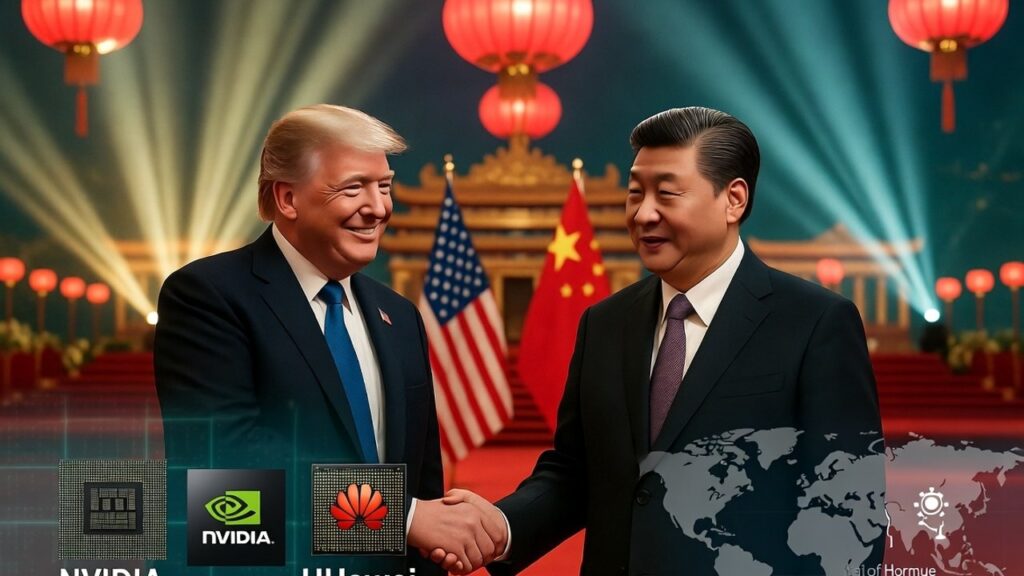
As President Donald Trump touched down in Beijing on May 15, 2026, he arrived not as the undisputed leader of the world’s sole superpower, but as a president urgently seeking China’s help to stabilise global oil markets amid the Iran war and Xi Jinping made sure the power imbalance was impossible to miss
President Donald Trump concluded his high-stakes state visit to China on May 15, 2026, after two days of talks with President Xi Jinping in Beijing. The first U.S. presidential trip to China in nearly a decade was filled with lavish ceremonies: a 21-gun salute, a private garden tour of the secretive Zhongnanhai leadership compound, a grand welcome at the Great Hall of the People, and a state banquet featuring Beijing roast duck. Trump described the summit as “extremely positive and productive,” highlighting “fantastic trade deals” and warm personal rapport with Xi. Yet as Air Force One lifted off from Beijing, a broad chorus of critics from Republican hawks to bipartisan foreign-policy experts is calling the outcome exactly what many had predicted: heavy on symbolism and optics, light on concrete concessions, with China quietly emerging with the clearer strategic edge.
What Actually Happened in Beijing The agenda covered the usual flashpoints: trade tariffs, advanced semiconductors, rare-earth minerals, artificial intelligence, Taiwan, and most urgently China’s influence over the ongoing U.S.-Israel conflict with Iran and the resulting Strait of Hormuz energy crisis. Trump arrived accompanied by a high-powered business delegation that included Apple CEO Tim Cook, Tesla’s Elon Musk, and Nvidia’s Jensen Huang, signalling a strong commercial focus.
Public outcomes were modest. Both sides claimed progress in “stabilising” bilateral relations and agreed to ease tariffs on selected non-sensitive goods. Trump touted possible Boeing aircraft sales and better market access for U.S. businesses. On Iran, Beijing reiterated calls for peace but stopped short of committing to pressure Tehran. On Taiwan, Xi delivered a pointed warning: mishandling the issue could lead to “clashes and even conflict,” according to Chinese officials. No major breakthroughs were announced. Instead, the two leaders exchanged invitations Trump asked Xi to visit the White House in autumn.
Critics Speak Out: “All Show, No Substance” The reaction was swift and pointed. Republican hardliners criticised Trump for appearing too conciliatory while U.S. forces remain stretched by the Iran conflict. Analysts at the Council on Foreign Relations, Brookings Institution, and major outlets described the summit as a carefully choreographed exercise in damage control. “Xi is playing the long game,” noted one China watcher. “He gave Trump the pageantry he craves while conceding almost nothing.” Even some members of Trump’s own delegation privately acknowledged that the visit delivered more photo-ops than deliverables. Chinese state media, by contrast, framed it as a “milestone” that demonstrated Beijing’s steady hand and global indispensability.
Deeper Observations: How China Secured the Upper Hand Several structural realities tilted the balance in Beijing’s favour before Trump even landed and the semiconductors file offers the clearest proof:
The NVIDIA Chips Reality Check Despite the high-profile presence of NVIDIA CEO Jensen Huang in Beijing, the highly anticipated “H200 thaw” remains frozen in bureaucratic limbo. While Washington recently shifted to a “case-by-case” review for H200 exports prompting Chinese tech giants to place orders for over 2 million units not a single chip has actually crossed the Pacific. The bottleneck isn’t a lack of Chinese demand, but a final “security review” by the U.S. State Department and strict new requirements to ensure U.S. domestic supply isn’t compromised.
This delay plays directly into Beijing’s hands. While Chinese firms wait for U.S. approvals that may never clear, the “cold shoulder” is coming from the regulators, not the buyers. This uncertainty provides the perfect air cover for Beijing to accelerate the deployment of homegrown alternatives like the Huawei Ascend 920 series, ensuring that by the time the U.S. security reviews are complete, the market may have already moved on. Huawei alone is on track to generate $12 billion in AI-chip revenue in 2026, according to internal industry projections shared with state media.
The Iran Distraction The ongoing U.S. involvement in the Middle East has consumed American bandwidth and leverage. Chinese sources viewed the conflict as having strengthened Beijing’s negotiating position. With its own massive oil reserves and diversified supply routes, China could afford to wait while Washington urgently needed stability in energy markets.
Economic Resilience vs. U.S. Domestic Pressure Despite its slowdown, China has weathered recent trade frictions better than expected. U.S. inflation hit 3.8% in April 2026, and Trump’s need for visible “wins” to calm domestic markets gave Xi’s team room to manoeuvre without major giveaways.
Symbolism as Power By granting rare access to Zhongnanhai and staging an extravagant welcome, China projected confidence and normalcy. It bought time to consolidate its technological and strategic advantages while indulging Trump’s preference for personal diplomacy.
Trump’s Shift in Tone The president who once branded China an economic predator arrived as a self-described “chamber-of-commerce booster.” Xi capitalised on that, offering warm words and limited commercial gestures while keeping core interests (Taiwan, tech dominance, Iran ties) firmly protected.
Realism Check: What This Means Going Forward The summit achieved its minimum objective: preventing a total breakdown in relations and keeping channels open. Yet it also exposed the limits of summitry when fundamental divergences — on Taiwan, technology decoupling, and regional influence — remain unresolved. Xi’s invitation to the U.S. later this year ensures the diplomatic calendar stays full, but follow-through will be the real test.
The Quantum/AI Overlap: The 2029 Encryption Deadline Perhaps the most significant undercurrent of this semiconductor standoff is the looming “Quantum Wake-Up Call.” Analysts increasingly view the battle over high-end GPUs not just as a race for AI supremacy, but as a prerequisite for the quantum transition expected by 2029. By that year, experts warn that quantum computing capabilities could reach a threshold capable of breaking current RSA and ECC encryption standards—the bedrock of global financial and military communications.
Beijing’s drive for self-reliance in advanced chips is directly linked to this security timeline. To build the cryptographic defenses and the quantum-resistant infrastructure needed by the end of the decade, China requires the massive computational power that only high-end silicon can provide. By freezing out U.S. chips today, China is betting that its domestic ecosystem will be mature enough to secure its national data before the 2029 window opens. This tech standoff is no longer just about trade balances; it is a frantic race to ensure that by 2029, the “Great Firewall” is quantum-proof, regardless of whether Washington provides the hardware to build it.
The Bottom Line
Trump’s Beijing visit unfolded exactly as many seasoned observers expected: impressive pageantry, warm handshakes, and very little tangible progress on the issues that matter most. On semiconductors alone, the stalled delivery of NVIDIA H200 chips despite massive Chinese demand underscored the persistent distrust and regulatory friction that defines the relationship. Leveraging America’s Middle East distractions and its own economic resilience, China emerged with the clearer strategic advantage buying time and stability while offering only modest commercial sweeteners. In an era of great-power competition, this was less a breakthrough than a carefully managed pause. Trump returns home claiming victory in optics; Xi leaves the table looking calm, resolute, and firmly in control. The hard questions on trade, technology, Taiwan, and global influence remain unanswered and the real test will come not in the banquet hall, but in the months of quiet, grinding diplomacy that follow.