
By Puneeth Raj | March 5, 2026
Imagine slashing Mumbai to Ahmedabad travel from 7 hours to under 2 hours on an indigenous train hitting 250 kmph — and then envision the same journey in a vacuum tube at over 1,000 km/h. In 2026, India isn’t just dreaming of this future; it’s building it — from BEML’s first Made-in-India bullet train prototypes rolling out by December to TuTr Hyperloop’s world-first commercial cargo system already under contract.
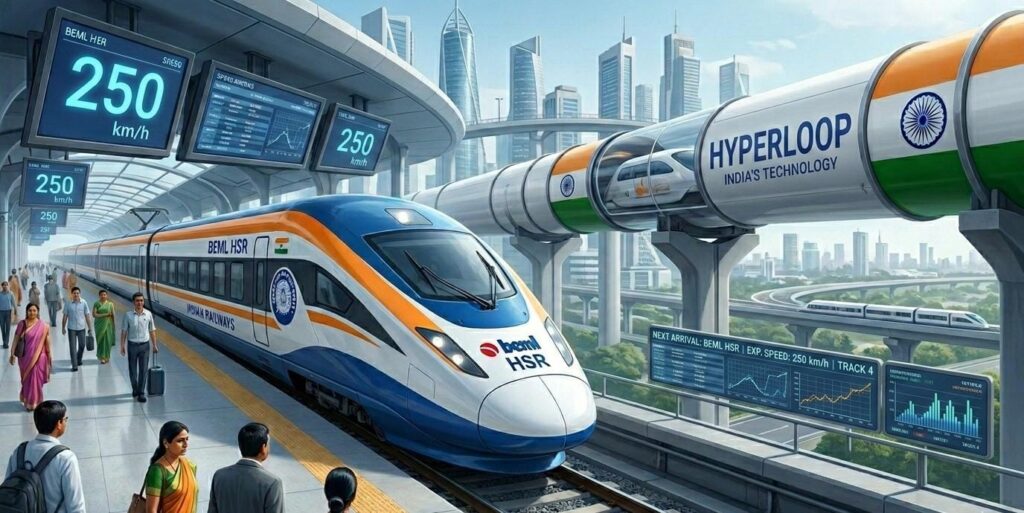
India’s transportation sector is on an exciting trajectory, blending proven high-speed rail capabilities with pioneering ultra-high-speed innovations. The indigenous high-speed rail (HSR) program, spearheaded by BEML, is delivering tangible progress toward operational 250 kmph trains. This solid foundation naturally extends to next-generation concepts — vacuum-tube systems that eliminate air resistance for potential speeds over 1,000 km/h, drawing on HSR advancements in electrification, aerodynamics, contactless propulsion (like maglev elements), and scalable infrastructure to achieve revolutionary efficiency and speed for intercity and logistics needs.
BEML’s Progress on Indigenous High-Speed Rail Trains
BEML Limited, partnering with the Integral Coach Factory (ICF) and Medha Servo Drives, is leading India’s push to manufacture its first fully indigenous high-speed trainsets. This “Make in India” effort combines global safety standards with domestic design and production, primarily for the Mumbai-Ahmedabad High-Speed Rail (MAHSR) corridor, while supporting future national expansions.
- Key Contract & Specifications: Awarded in October 2024, the contract covers designing, manufacturing, and commissioning two prototype 8-coach chair-car trainsets. These boast a design/maximum speed of 280 kmph and an operational/service speed of 250 kmph, featuring full air-conditioning, distributed power systems, aerodynamic profiles, and premium passenger amenities. Notably, these units represent India’s first successful engineering of high-speed Standard Gauge bogies—a departure from the traditional Broad Gauge network to align with international HSR standards.
- Latest Progress (as of early 2026): The design phase is nearly frozen. Manufacturing is set to commence at BEML’s Bengaluru facility (carbody shells) and Medha’s Hyderabad plant (bogies) around mid-2026. The first full prototype is targeted for rollout by December 2026, followed by oscillation, speed trials, and certification over 7–8 months on the actual MAHSR corridor (initially Surat–Bilimora section). Crucially, these trials will test the integration of “Kavach 2.0,” India’s indigenous Automatic Train Protection system, specifically adapted for the high-frequency signaling required at 250 kmph. These prototypes will support reliability trials starting around 2027.
- Broader Impact & Plans: India plans to procure 16 additional domestically built trainsets for MAHSR, operating alongside initial imported Japanese Shinkansen sets (expected by 2029–30). MAHSR physical progress stands at approximately 71–72% for viaducts (with over 290–320 km completed in recent updates), alongside advancing station foundations (e.g., 8 of 12 stations with completed foundations in Gujarat) and other civil works; the full line remains targeted for completion by December 2029, with potential phased openings (e.g., Gujarat sections earlier). This indigenous approach delivers 40–50% long-term cost savings per coach, creates thousands of jobs, cuts foreign exchange outflows, builds high-tech expertise, and enables faster rollout of the seven new corridors announced in recent budgets. This milestone underscores India’s pragmatic self-reliance: leveraging proven tech for safe launches while mastering domestic production.
India’s Progress with Next-Generation Ultra-High-Speed Transport (Hyperloop Ecosystem)
Extending HSR’s momentum, Indian innovators are advancing vacuum-tube ultra-high-speed systems through indigenous deep-tech, prioritizing freight for early commercialization and real-world proof. This “Green Mobility” push aims for energy-efficient, low-carbon operations, with conceptual designs exploring solar cladding on tubes to contribute toward energy neutrality and power electromagnetic propulsion.
The ecosystem centers on the IIT Madras hub:
- TuTr Hyperloop (incubated at IIT Madras) — The leading commercial force: Secured the world’s first commercial hyperloop-related contract: ₹8.7 crore from Deendayal Port Authority (Kandla, Gujarat) for an internal cargo system using linear induction motor (LIM) propulsion to move 40-tonne containers at up to 200 km/h, reducing port congestion and turnaround times. It signed an MoU with BEML (August 2025) to co-develop India’s first indigenous high-speed pod prototypes with maglev and LIM tech — bridging HSR manufacturing scale to this frontier. Technical R&D is currently focused on solving the “Kantrowitz Limit,” using specialized aerodynamic bypass systems to manage air pressure within the tubes.
- Avishkar Hyperloop (IIT Madras premier student-led team, closely linked to TuTr) — The R&D powerhouse: Co-developed India’s first hyperloop test track: 410–422 meters (Asia’s longest student-built at completion) at IIT Madras’s Discovery Campus in Thaiyur (completed late 2024/early 2025). Achieved test metrics including simulated speeds up to 1,210 km/h, maglev gaps ~15 mm, and ultra-low vacuum pressures. Emerged as overall winners at the Global Hyperloop Competition 2026 (hosted at IIT Madras, January 2026), with Pod 9.0 excelling in speed, stability, efficiency, and winning the InnoQuest Award for an innovative docking system.
- Quintrans Hyperloop (Pune-based) — Supporting player: Develops advanced linear electromagnetic systems and frictionless actuators. Advances component innovation with a 100-meter pilot in progress, targeting cargo ops by 2027–28.
Backed by Indian Railways grants (since 2022), port authorities, and industry, the freight-first strategy (accelerating viability through cargo before addressing complex passenger safety certifications) targets corridors like Mumbai–Pune (~25 minutes) or Chennai–Bengaluru. While global hyperloop efforts have faced delays and scaling hurdles (with few full deployments), India’s focus on pragmatic pilots and logistics integration stands out.
Why It Matters: A Unified Vision for India’s Future
BEML’s grounded HSR achievements and the IIT Madras ecosystem’s hyperloop innovation showcase India’s smart dual strategy: Master proven high-speed tech today while inventing ultra-high-speed tomorrow. Economically, this creates jobs, saves costs, boosts exports, and strengthens self-reliance in critical infrastructure. Environmentally, these electric-led systems align with India’s 2070 Net Zero goals by drastically reducing the carbon footprint of heavy logistics. Strategically, it positions India as a global leader in emerging mobility by 2030–2040.
By blending ambition with pragmatism, these efforts could transform travel, logistics, and connectivity — a proud step toward Viksit Bharat.