
By Puneeth Raj | February 22, 2026
After importing nearly 100% of its chips for decades, India is now investing ₹1.6 lakh crore to build its own silicon empire.
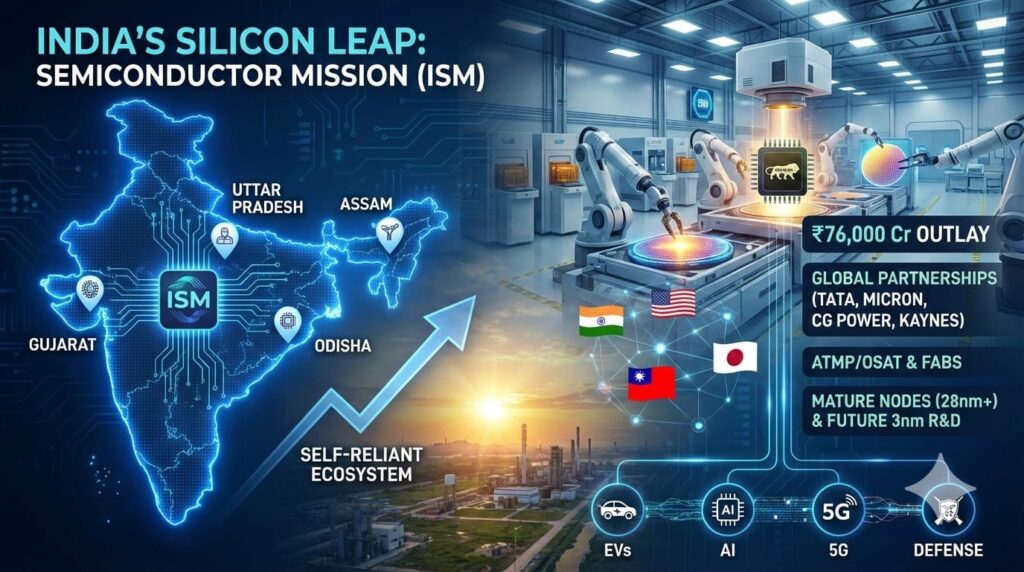
India is undergoing a transformative shift in its semiconductor landscape, propelled by the India Semiconductor Mission (ISM) under the Semicon India Programme. Launched in 2021 with an initial outlay of ₹76,000 crore (approximately $9–10 billion), the mission seeks to foster a self-reliant ecosystem, drastically reduce India’s near-total reliance on imported chips, generate high-skilled employment, and establish the country as a vital node in global supply chains for design, fabrication, assembly, testing, marking, and packaging (ATMP/OSAT).
The approach remains pragmatic and phased: prioritize mature process nodes (28nm and above) for faster deployment in high-demand sectors such as automotive, power electronics, IoT, and electric vehicles (EVs); secure technology transfers through strategic partnerships; provide substantial incentives (up to 50% central fiscal support, supplemented by state subsidies); and develop specialized clusters in states including Gujarat, Assam, Uttar Pradesh, and Odisha. This strategy aligns with global geopolitical shifts toward supply chain diversification—reducing over-dependence on Taiwan and China—while leveraging India’s established strengths in chip design (which accounts for ~20% of the world’s talent pool) and surging domestic demand from EVs, AI, 5G, and defense applications.
Major Investments and Recent Milestones :
As of February 2026, the ISM has approved 10 major projects with cumulative investments surpassing ₹1.6 lakh crore (~$19–20 billion), spanning wafer fabrication (fabs), OSAT/ATMP units, and compound semiconductors. A key milestone was reached in late 2025 with the launch of pilot lines and initial sample shipments (e.g., Kaynes Semicon exporting Multi-Chip Modules in October 2025). Full commercial-scale production and broader market deployment are now ramping up in 2026.
Union Minister Ashwini Vaishnaw confirmed in early 2026 that four units—Micron Technology, CG Power, Kaynes Semicon, and Tata Electronics (Assam OSAT)—are transitioning from pilots/trials to commercial manufacturing this year, with leading auto and telecom firms set to source domestically.
Key players and projects include:
- Tata Electronics (in partnership with Taiwan’s Powerchip Semiconductor Manufacturing Corp – PSMC): Committing ~₹91,000 crore (~$11 billion) to India’s first commercial semiconductor fab in Dholera, Gujarat. This advanced 300mm facility will produce up to 50,000 wafers per month on nodes from 28nm to 110nm, targeting automotive, power management, display drivers, microcontrollers, AI, high-performance computing, communications, and data storage. Construction and site preparation are advancing, with high-volume trial runs in progress and first commercial output targeted for late 2026 to FY2029–30 (realistic adjustments account for supply chain and execution timelines).
Complementing this, Tata’s OSAT facility in Morigaon/Jagiroad, Assam (~₹27,000 crore) is on track, with pilot production starting mid-2026 (around April) and commercial scaling by year-end. It focuses on advanced packaging (including Flip Chip and 2.5D/3D for AI accelerators) and aims for up to 48 million chips per day at peak capacity.
Combined, these initiatives are projected to generate 20,000–100,000 skilled jobs. - Micron Technology (US): A $2.75 billion (~₹22,516 crore) ATMP facility in Sanand, Gujarat, specializing in DRAM and NAND memory. Cleanrooms validated and pilot production underway; high-volume commercial exports of memory modules began in early 2026, significantly boosting India’s backend capabilities.
- CG Power (Murugappa Group, with Japan’s Renesas Electronics and Thailand’s Stars Microelectronics): An OSAT unit in Sanand, Gujarat (~₹7,600 crore). Pilot line (G1) inaugurated in August 2025 with trial runs complete; commercial production scaling in 2026, starting at ~0.5 million units/day and expanding via G2 to millions daily.
- Kaynes Semicon (Kaynes Technology subsidiary): An OSAT facility in Sanand, Gujarat (~₹3,300 crore). Breakthrough in late 2025 with sample Multi-Chip Module shipments; mass production ramping in 2026, targeting 6.3 million chips per day.
Other notable developments include SiCSem, CDIL, and RIR Power Electronics (SiC focus in Odisha for EVs), SCL Mohali modernization, and emerging projects like the HCL-Foxconn OSAT facility in Jewar, Uttar Pradesh (~₹3,700 crore), where Prime Minister Narendra Modi laid the foundation stone on February 21, 2026—marking Uttar Pradesh’s entry into the semiconductor space with operations targeted by 2028. Global collaborators such as AMD ($400M+ in design investments), Lam Research, and Qualcomm are deepening ties through training, tools, and ecosystem support.
These successes stem from generous subsidies, competitive state incentives (Gujarat as flagship hub), anchor effects drawing suppliers, and “China+1” strategies.
India Semiconductor Mission 2.0: Ecosystem Deepening :
Announced in the Union Budget 2026 (February 1, 2026), ISM 2.0 shifts focus from individual fabs/OSAT units to a full-stack ecosystem, with an initial ₹1,000 crore allocation for 2026–27. It prioritizes indigenous production of semiconductor equipment, speciality chemicals, industrial gases, wafers, and design IP—currently imported—while accelerating talent development and industry-led R&D. The Electronics Components Manufacturing Scheme outlay was expanded to ₹40,000 crore. Minister Vaishnaw emphasized that “design companies will be the top priority,” aiming to foster the next generation of Indian innovators and secure strategic sectors.
Path to Emulating Taiwan or China
Taiwan leads in cutting-edge fabrication (e.g., TSMC at 2nm/3nm), while China excels in scale and packaging via state support. India pursues a differentiated path:
- Start with backend (ATMP/OSAT) for expertise and jobs, then scale to front-end fabs.
- Emphasize mature nodes (~95% of automotive chips) for lower risk and quicker returns.
- Develop integrated clusters (e.g., Dholera-Sanand in Gujarat, akin to Taiwan’s Hsinchu).
- Strengthen upstream supply chains (materials/equipment via MSMEs) and design (centers in Bengaluru/Noida targeting advanced architectures).
- Target a $100–110 billion domestic market by 2030 (~10% global share) and up to 1 million jobs.
Challenges persist: R&D spending (~0.7% of GDP), talent gaps in fabrication processes, infrastructure demands (ultra-pure water, gigawatt-scale power), execution delays, and reliance on global partners for restricted tools like EUV lithography. Partnerships enable tech transfer, and ISM 2.0 supports full-stack growth, including sovereign AI and specialized nodes. Vaishnaw affirmed India’s goal to rank among the top-four global semiconductor hubs by 2032 and the best by 2035.
Progress on Nanometer Technology
India builds from foundational stages, prioritizing mature/legacy nodes:
- Current facilities target 28nm–110nm (e.g., Tata-PSMC fab) — ideal for automotive, power, and IoT.
- No commercial sub-10nm fabs yet; advanced nodes (7nm/5nm/3nm/2nm) remain in design/R&D.
- Design breakthroughs: Facilities in Bengaluru/Noida for 3nm development; ARM collaborations; lab achievements at 7nm/5nm. Qualcomm announced tape-out of a 2nm chip design in early 2026 (with major contributions from Bengaluru, Chennai, and Hyderabad centers), signaling India’s growing role in leading-edge design.
- Commercial output: Indigenous mature-node chips from Kaynes, CG Power, and Micron rolling out in 2026; Tata fab trials producing logic chips.
- Globally, TSMC/Samsung lead at 2nm mass production; India trails on sub-10nm manufacturing due to complexity, costs (~$20B+ per fab), and ecosystem needs. Experts project first 7nm/5nm commercial fabs by 2028–2030 via joint ventures.
Long-term, India aims to leapfrog through partnerships, specialized tech (e.g., SiC for EVs), and advanced packaging (2.5D/3D). Sustained momentum could yield sub-10nm capabilities by 2030–2035.
Developing Smaller Nanometer Chips: Key Steps for India
To achieve sub-10nm manufacturing (7nm, 5nm, 3nm), pursue a sustained strategy:
- Massive, Sustained R&D Investment — Elevate national R&D to 2–3% of GDP; fund centers via ISM 2.0, partnering with IBM, IMEC for roadmaps to 2036 (GAA transistors, High-NA EUV).
- Strategic Global Partnerships and Tech Transfer — Attract top foundries (TSMC, Intel, Samsung) for 7nm/5nm joint ventures by 2028–2030. Secure EUV access from ASML through alliances, including frameworks like US-led “Pax Silica.”
- Critical Supply Chain Ecosystem — Cultivate domestic suppliers for ultra-pure chemicals, gases, photoresists, precision equipment; subsidize MSMEs and establish upstream clusters.
- Talent Pipeline Acceleration — Train over 85,000 engineers via universities, global programs, and fab exchanges.
- Government Incentives and Policy Support — Enhance ISM 2.0 with elevated subsidies for sub-10nm projects, sovereign funds for high-risk R&D, and strong IP protections.
Achieving Success Like the Netherlands’ ASML
ASML’s EUV lithography monopoly (essential for <7nm chips) stems from decades of excellence. Lessons for India:
- Long-Term Vision and Risk-Taking — ASML invested 30+ years despite setbacks; India needs patience and sustained funding.
- Deep Ecosystem and Partnerships — ASML collaborates with 5,000+ suppliers and major investors. Foster similar interdependencies, including direct ASML ties.
- Neutral, Stable Environment with Policy Backing — Leverage democratic alliances (US, Europe, Japan) for tech access while ensuring stable incentives.
- Monopoly via Unmatched Expertise — Prioritize IP in design, tools, and niches (e.g., specialized nodes/packaging).
In summary, 2026 marks India’s semiconductor awakening—from zero commercial fabs to multiple operational units and exports. With ISM 2.0’s ecosystem focus, talent cultivation, and global alliances, India is poised to become a resilient, diversified hub—complementing Taiwan and China—while generating millions of jobs by 2030. This “Silicon Leap” embodies Atmanirbhar Bharat, powering AI, EVs, and national security. As Vaishnaw stated, India is on course to rank among the top-four semiconductor manufacturing nations by 2032 and lead by 2035.