
The UN’s outdated rules stall action on terrorism, nuclear threats, and global fairness. Can it reform before it loses relevance?
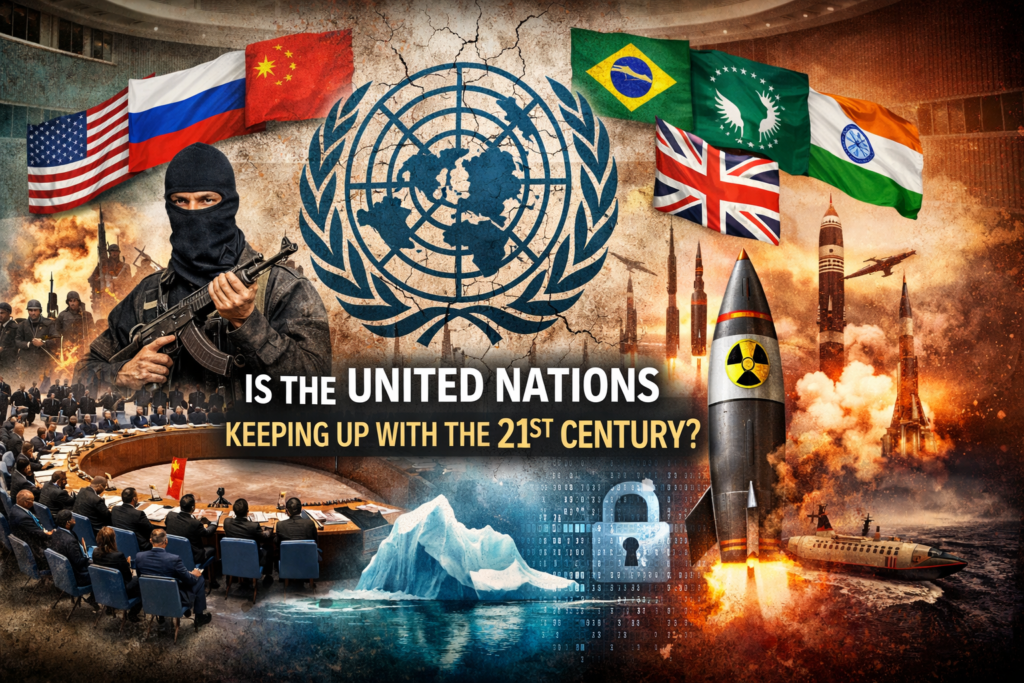
The United Nations was born out of hope. After the devastation of World War II, in 1945, nations came together to create a body that would promote peace, security, and cooperation across the globe. Fast forward to today, and the UN counts 193 member states. But the core of its decision-making—especially the Security Council—still reflects a world shaped by postwar politics. The five permanent members, the United States, Russia, China, France, and the United Kingdom, hold veto power, often stalling decisive action on issues that matter most.
In a world racing forward with climate crises, cyber threats, and non-state actors shaking the status quo, the UN sometimes feels stuck in time. From tackling terrorism to preventing nuclear proliferation, it struggles to act decisively.
The Representation Gap
One of the UN’s biggest blind spots is the Security Council’s outdated structure. Africa, home to over 1.4 billion people and 54 member states, has no permanent seat, despite contributing heavily to peacekeeping missions. South America, with emerging powers like Brazil, faces a similar sidelining. India, now the world’s most populous democracy and a responsible nuclear power, is still waiting for a permanent seat despite decades of advocacy. The African Union demands two permanent seats with veto rights, while the G4 nations—India, Brazil, Germany, and Japan—push for expansion. UN Secretary-General António Guterres has repeatedly warned that excluding Africa undermines the UN’s credibility. Yet, the existing powers resist reform, clinging to a postwar order that no longer reflects today’s global realities.
Terrorism: A Test the UN is Failing
When it comes to terrorism, the UN’s limitations are clear. Even with resolutions and specialized bodies like the Counter-Terrorism Committee, enforcement is weak. Political rivalries and veto powers prevent unified action. A universal definition of terrorism remains elusive, leaving loopholes that some states exploit. Violent groups—like ISIS affiliates—continue to grow in Africa and the Sahel, while cross-border threats go largely unchecked. Countries like India have repeatedly criticized the global framework for failing to address state-sponsored terrorism, highlighting how geopolitical divides block meaningful action.
The Nuclear Dilemma
Nuclear weapons present another challenge. The Nuclear Non-Proliferation Treaty (NPT), overseen by the UN, was meant to prevent the spread of nuclear arms while promoting disarmament. But the system has gaps. North Korea withdrew from the NPT in 2003, tested its first nuclear weapon in 2006, and continues to expand its arsenal despite UN sanctions. Pakistan, never a signatory, quietly built its nuclear program in the 1990s. Iran, an NPT member, continues uranium enrichment, facing inconsistent enforcement due to divisions among powerful nations. Clearly, sanctions and regulations alone aren’t enough to stop determined states.
The Mantra’s Take
The UN’s 1945 blueprint no longer fits a rapidly evolving world. Its veto-driven Security Council sidelines rising powers, slows responses to terrorism, and cannot reliably prevent nuclear proliferation. The organization needs urgent reform—expanding permanent membership to include Africa, South America, and India is not just a political argument, it’s a necessity for legitimacy. If the UN fails to adapt, it risks becoming a relic—a symbol of past victories rather than a guardian of todays and tomorrow’s global challenges. In short, to remain relevant, the United Nations must embrace change boldly, reflecting the world as it is, not as it was.