
From Armenia to Iran, Russia and China failed to act when allies needed help. See how this reshapes the global order. Learn more.
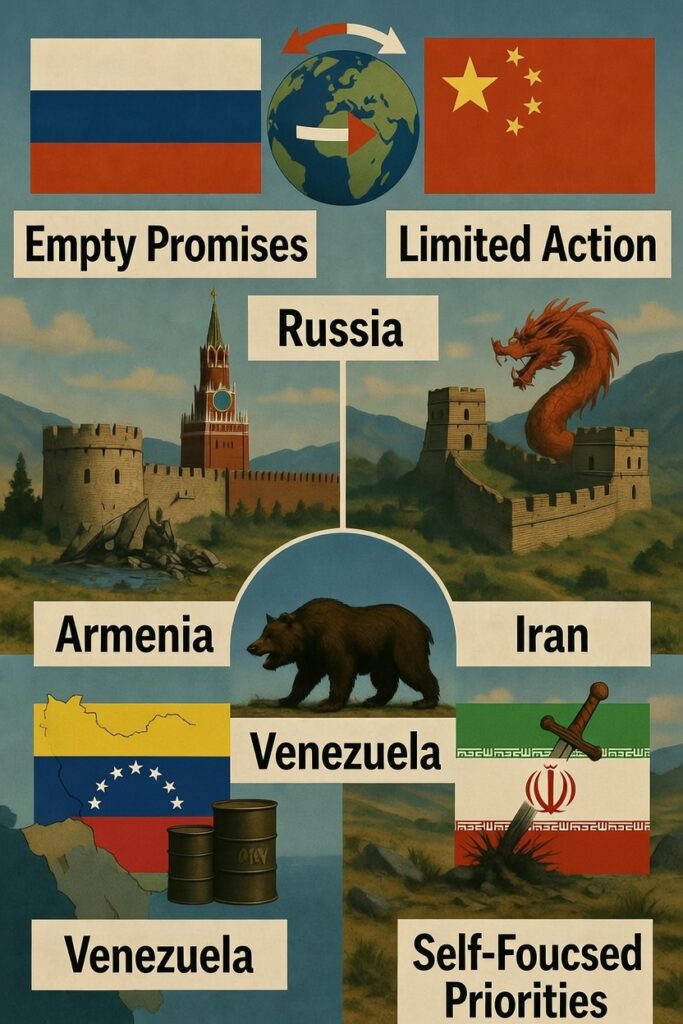
In global politics, friendships are tested not by speeches, but by crises.
When missiles fly, borders collapse, and leaders fall, the real strength of alliances is revealed. In recent years, Russia and China—often portrayed as challengers to Western dominance—have repeatedly failed this test. Their partners expected protection. What they received instead were statements, silence, and hesitation.
From the mountains of Armenia to the deserts of Iran and the oil fields of Venezuela, a troubling pattern has emerged: strong words, but weak action. This erosion of trust is reshaping how smaller nations view Moscow and Beijing—and offers important lessons for countries like India navigating an increasingly uncertain world.
Armenia: When a Security Pact Meant Little
Armenia believed it had insurance. As a member of the Russia-led Collective Security Treaty Organization (CSTO), it expected protection when its sovereignty was threatened.
That belief shattered in 2020 and again in 2023, when Azerbaijan retook control of Nagorno-Karabakh. Despite Russian peacekeepers being present on the ground, they stood aside as territory changed hands and thousands of Armenians fled their homes.
When Armenia formally requested CSTO assistance, Russia responded with little more than a fact-finding mission. No troops. No deterrence. No defense.
The message was impossible to ignore.
By 2025, Armenia froze its CSTO participation and openly declared Russia an unreliable partner. It turned instead to India, France, and Western nations for defense cooperation. Moscow, deeply consumed by the war in Ukraine, simply did not have the capacity—or perhaps the will—to act.
Iran: Alone in Its Darkest Hour
In June 2025, Iran faced one of its gravest moments in decades. Israeli strikes targeted key nuclear facilities, followed by direct U.S. bombings at sites such as Natanz and Fordow. The conflict raged for nearly two weeks before ending in a tense ceasefire.
Iran had long-standing strategic relationships with both Russia and China—arms deals, energy partnerships, diplomatic backing. In its hour of need, Tehran expected more than condemnation.
What it got were press statements.
No weapons shipments.
No intelligence support.
No military deterrence.
Russia, overstretched in Ukraine, was in no position to escalate. China, wary of a direct confrontation with the United States, chose caution over commitment. For Iran, the realization was bitter: strategic partnerships do not always translate into real protection.
Venezuela: Condemnation Without Consequences
The most dramatic example came in January 2026, when U.S. forces struck Venezuelan military targets and detained President Nicolás Maduro, taking him to the United States for trial.
Once again, Russia and China condemned the action as illegal and imperialistic. Yet condemnation was where their involvement ended.
No emergency aid.
No military response.
No economic lifeline.
Years of oil deals and political alignment offered Venezuela little defense when power truly mattered. Russia’s economy was strained by sanctions and war. China, prioritizing global trade stability, chose not to jeopardize its economic ties with Washington.
Venezuela stood isolated—proof that rhetorical support does not equal strategic rescue.
Why Russia and China Step Back When It Matters Most
The reasons are not mysterious:
- Russia is locked in a prolonged and resource-draining war in Ukraine, facing sanctions and military overstretch.
- China is slowing economically and carefully avoiding direct military confrontation with the United States.
- Both fear escalation into wider conflicts that could threaten their own stability.
In short, self-preservation comes first.
This reality weakens their credibility. Allies begin to question whether these partnerships are genuine or merely convenient when costs are low.
What This Means for India
India’s relationship with Russia is deep and historic—spanning defense, energy, and diplomacy. But the global landscape is changing, and blind dependence is no longer an option.
These recent events offer India valuable lessons.
The Mantras to Take
In today’s fractured world order, power is no longer defined by who speaks the loudest—but by who shows up when it counts.
Russia and China’s faltering support to their partners is a warning sign for all mid-sized powers.
For India, the path forward is clear: strategic independence, diversified alliances, and unwavering focus on self-strength.
Trust, once broken, is hard to rebuild. Nations that understand this early will shape the future—rather than be shaped by it.
Nice