
India is the world’s IT capital, but we are losing the race for AI and Innovation. From the $45B Infosys-OpenAI miss to the R&D crisis—here is why we must change. Read more.
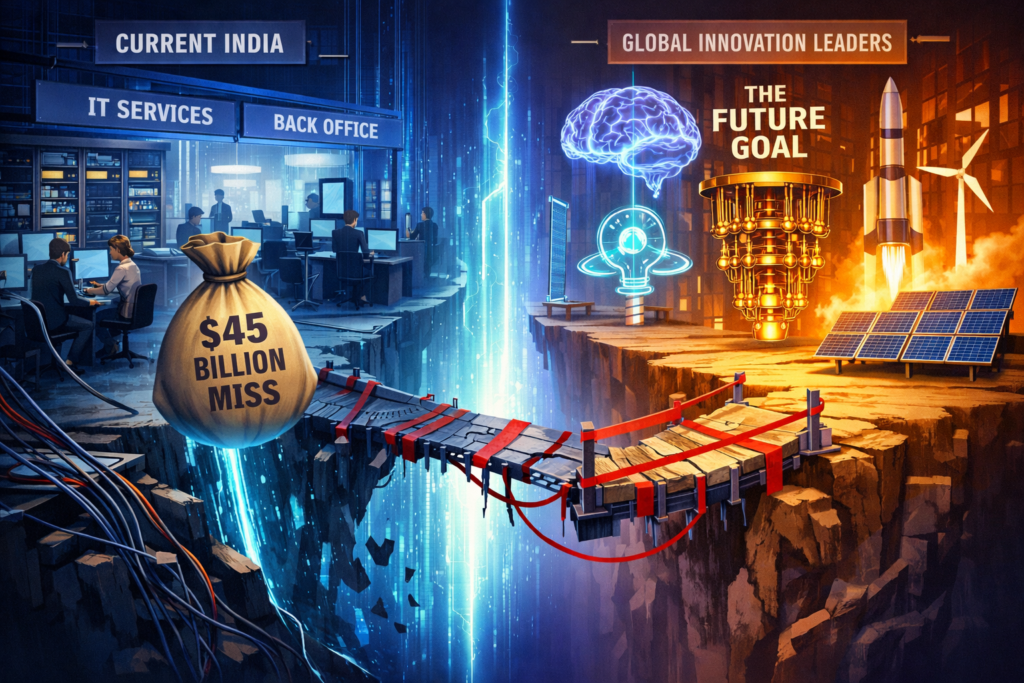
In today’s hyper-connected world, technology is no longer just a support system—it’s the engine driving global power and economic growth. From artificial intelligence reshaping entire industries to quantum computing unlocking unimaginable processing power, the race for technological leadership is well underway.
Countries like the United States, China, and South Korea are sprinting ahead, investing billions in research and development (R&D) to secure their future. India, despite being the world’s fifth-largest economy and home to one of the largest talent pools on the planet, is still struggling to keep pace.
So the big question is – why is India lagging in future technologies?
And more importantly, what can be done to change that?
The R&D Reality Check
One of the biggest reasons for India’s slow progress is its low investment in research and development.
India currently spends just 0.64% of its GDP on R&D, far below the global average of about 2.2%. To put this into perspective:
- China spends 2.4%
- The United States invests 3.5%
- South Korea leads with a massive 5.2%
This gap has real consequences. India spends roughly $20 billion a year on R&D, but to reach even a modest 2% of GDP, it would need to invest over $80 billion annually. Because of this shortfall, India struggles to make breakthroughs in critical areas like AI, biotechnology, renewable energy, and advanced manufacturing, often ending up dependent on imported technologies.
Why Innovation Struggles in India
Several long-standing issues have widened this gap.
For decades, India’s tech success has been driven mainly by IT services and outsourcing, not by deep innovation or product creation. While this model delivered quick profits and global recognition, it also encouraged a short-term mindset, where companies preferred buying or importing technology rather than building it from scratch.
Many large Indian tech firms hesitate to invest heavily in R&D, citing high risk and uncertain returns. A famous example is Infosys, which once planned a $1 billion investment in OpenAI in 2015. Internal leadership disagreements led to the deal being dropped—an investment that today could have been worth around $45 billion.
Then there’s the issue of brain drain. Some of India’s brightest minds move to Silicon Valley or Europe in search of better research opportunities, funding, and freedom to experiment. At home, research in universities often stays locked inside academic papers, with little commercial impact due to weak industry partnerships and funding gaps.
On top of this, limited investment in school-level education, bureaucratic red tape, and a cultural preference for job security over experimentation further slow down innovation.
How India Can Leap Forward
The situation may look challenging—but it’s far from hopeless.
India has everything it needs to succeed: a young population, digital expertise, massive data resources, and a growing economy. What’s missing is focus, funding, and execution.
To truly compete, India must aim to raise R&D spending to at least 2% of GDP, with stronger participation from the private sector. In most innovation-driven nations, businesses—not governments—lead R&D investments.
Here are the key areas where India must act decisively:
1. Artificial Intelligence and Machine Learning
With its strong IT base and vast datasets, India is perfectly positioned to lead in AI. Increased funding for initiatives like the National AI Strategy could transform healthcare, agriculture, and public services.
2. Semiconductors and Electronics
India’s heavy dependence on imported chips is a major strategic weakness. Investing in chip fabrication, design, and electronics manufacturing—through hubs like GIFT City—can boost self-reliance and exports.
3. Quantum Computing and Automation
These frontier technologies will define future defense, manufacturing, and robotics. Strategic investments and global partnerships can place India among the leaders instead of followers.
4. Clean Energy and Sustainability
As climate change accelerates, R&D in solar, wind, battery storage, and green hydrogen is critical. The proposed ₹1 lakh crore clean energy innovation fund is a positive step—but sustained investment is essential for real breakthroughs.
5. Biotechnology and Healthcare
Building on India’s pharmaceutical strength, biotech research can drive drug discovery, personalized medicine, and affordable healthcare—while generating high-value jobs.