
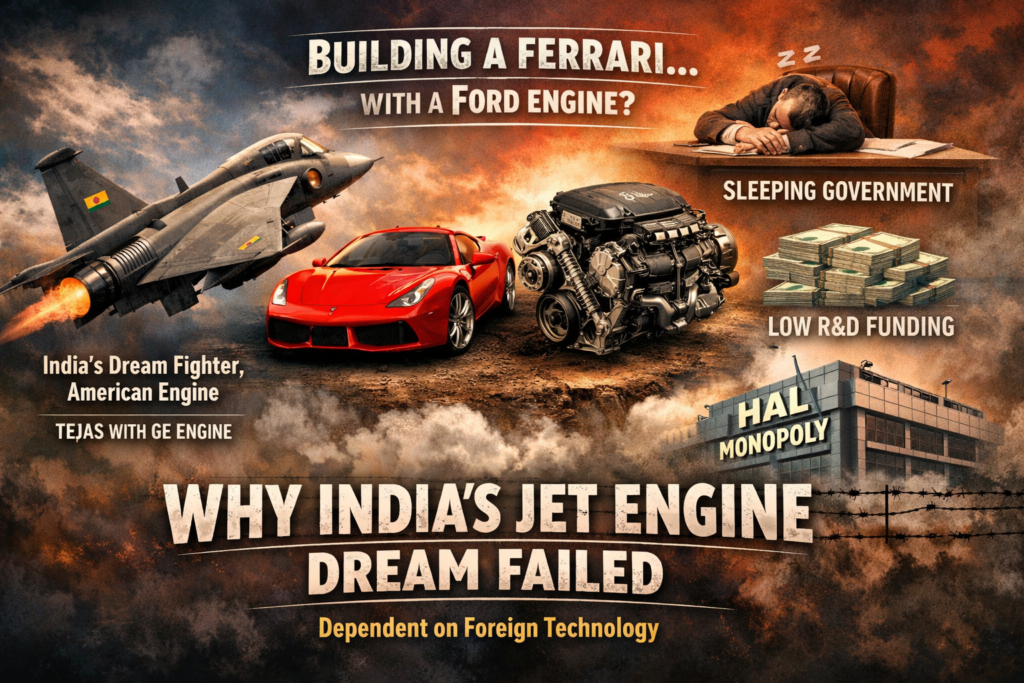
Imagine building a world-class Ferrari but having to buy the engine from Ford because you couldn’t figure out how to make one yourself. That, in a nutshell, is the story of India’s fighter jet program.
For decades, India has dreamed of building its own cutting-edge fighter aircraft to protect its skies. We’ve launched rockets to Mars and the Moon, yet the technology to build a powerful, reliable jet engine remains out of reach.
Why? The answer is a frustrating mix of missed opportunities, a government stuck in “sleeping mode,” and a massive state-owned company that has become part of the problem.
Here is the breakdown of why India’s air power is still dependent on others.
1. The Heartless Fighter: The Tejas Story
In the 1980s, India started the ambitious Light Combat Aircraft (LCA) program, which we know today as Tejas. It was supposed to be a 100% homegrown, fourth-generation fighter.
Fast forward 40 years. Tejas is flying, which is a proud achievement. But there’s a catch. The most critical part—the engine—is not Indian. It’s made by the American company, GE.
- Indigenous Content Reality: While India claims high indigenous content by the number of parts (around 75.5%), the most critical technologies—like the engine, ejection seat, and radar—are imported.
What happened to our own engine? We tried. The Kaveri engine project started in 1986. It was supposed to power the Tejas. But after 22 years and billions spent, it failed. It couldn’t produce enough power (thrust) and had reliability issues. In 2008, it was officially separated from the Tejas program.
2. The Government’s “Sleeping Mode”
Why is a country with so much talent falling behind? Critics say the government has been in a perpetual “sleeping mode” when it comes to long-term defense innovation.
- Show Me the Money: Innovation costs billions. India allocates about $2.8 billion to its defense research wing (DRDO). Compare that to China, which spends an estimated $44.4 billion—that’s 15 times more! No wonder China is building advanced stealth engines while we are still struggling.
- The Import Addiction: It’s easier to buy than to build. When the Air Force needs jets urgently, the government often takes the quicker route of importing expensive fighters like the Rafale from France, instead of enduring the long, painful process of developing our own.
3. The Monopoly Problem: HAL
At the center of this drama is Hindustan Aeronautics Limited (HAL), India’s massive state-owned aerospace company. HAL has a near-monopoly on defense production.
Without competition, critics argue HAL has become complacent and inefficient.
- Delays on Delays: Parliamentary committees have officially criticized HAL for its “casual approach” and lack of planning, leading to constant delays in delivering Tejas jets to the Air Force.
- Trust Issues: Past failures, like issues with the Dhruv helicopter fleet, have eroded the trust between HAL and the Indian Air Force.
HAL’s dominance has also suffocated the private sector, preventing other Indian companies from stepping up and innovating.
The Mantra Take
The stakes couldn’t be higher. Relying on foreign engines means our national security is vulnerable to sanctions, supply chain disruptions, and global politics.
We don’t need to look far for inspiration. Our space agency, ISRO, has shown that with focused leadership and funding, India can achieve impossible feats. It’s time to apply that same mindset to our defense sector.
India’s skies need not remain stalled. But to soar, the government must wake up, fund R&D aggressively, and break the monopolies that hold us back. The clock is ticking.
What do you think? Should India continue to import fighter jets for immediate security, or should we endure the pain and invest everything into building our own? Let us know in the comments!
Leave a Comment