
The year 2026 arrives not with a whisper, but with the high-pitched hum of innovation.
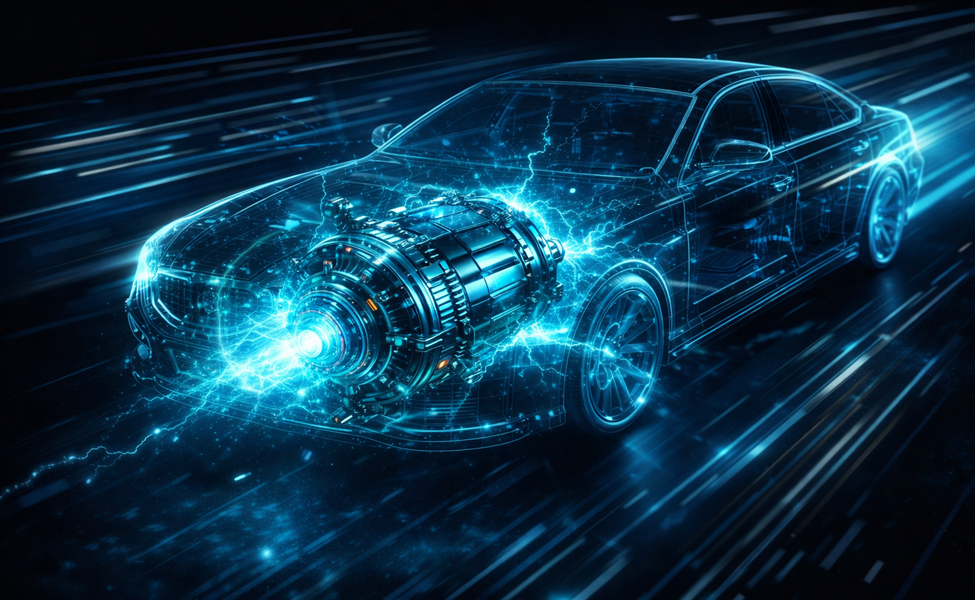
While the world watches the screens inside the cars, Chinese giant BYD has been busy reinventing what lies beneath the hood. They aren’t just building batteries anymore; they are rewriting the physics of how electric cars move.
Here is how BYD is turning the EV market on its head – again.
1. Power to the People: The 240 kW Upgrade
Usually, high-performance motors are reserved for luxury supercars. BYD disagrees.
They have quietly rolled out the TZ200XYAT motor, a beast delivering 322 horsepower (240 kW). The game-changer? This isn’t just for flagship models. It is being slipped into affordable, mid-range daily drivers like the Seal 06 GT and the Qin Max.
The Tech: Built on 800V architecture (meaning lightning-fast charging).
The Secret: Uses ultra-thin silicon steel and Silicon Carbide (SiC) to slash weight—making some cars over 400 lbs lighter.
The Result: Supercar acceleration is now available in family sedans.
2. The “Smart” Muscle: Variable-Flux Technology
Raw power is useless without control. In December, BYD filed patents for a new Variable-Flux Motor. Think of this as an engine that “breathes” differently depending on how you run.
City Mode: High magnetic flux for instant torque at traffic lights.
Highway Mode: Low flux to glide efficiently and save battery.
It is a brilliant evolution. Instead of just making bigger batteries for more range, BYD is making the motor smarter so it wastes less energy.
3. The Speed Demon: 30,000 RPM
Earlier this year, BYD stunned engineers with a motor that spins at a record-breaking 30,511 RPM. To put that in perspective, most EV motors top out way lower. This tech, featured in their “Super e-Platform,” allows for 0-100 km/h sprints in under 3 seconds and supports charging speeds that can add hundreds of kilometers in just 5 minutes.
The Mantra Takeaway
Why does this matter? Because BYD is doing what competitors are struggling to match: Vertical Integration. By making their own chips, batteries, and now these advanced motors, they are driving costs down while pushing performance up.
The gap between “budget EV” and “high-performance EV” is disappearing.
What’s your take?
Is 30,000 RPM overkill for the street, or is it exactly the kind of engineering push we need? Let us know in the comments below!
Thank you for your insightful comment. In fact, that disconnect between education and employment is exactly what we tried to…
The notion that “millions of young graduates entering the job market each year without matching opportunities” really stood out to…
Good read
The best thing about this episode is that whoever reads it it feels that’s it his story…


Đọc xong thấy rất bổ ích. Letco chuyên du học Hàn Quốc, tư vấn 1-1 theo năng lực và ngân…